You can become a skilled fitness coach from scratch without youth sports titles. The foundation rests on specialized education with hands-on practice and an exam, applied biomechanics, pre-exercise health screening with safe programming, and calm, long-term work with people. Being in great shape yourself helps set an example, yet it doesn't automatically create the skill to train other people with different proportions and limitations.
I'm Demid Lobanov, a fitness coach, training methodology specialist, and instructor. I entered the profession with a university engineering background, earned a Personal Trainer diploma (136 academic hours), and completed advanced Personal Trainer continuing education at Southern Federal University (72 hours). I've coached people for over six years—working across major commercial gym chains in Rostov-on-Don and teaching at one chain's internal academy—and now coach clients online. For more than four years I've taught aspiring colleagues at the PRO-FG school, graduating over 170 specialists, and for more than three years I've examined graduates in practical assessments. Below, I break down what entering the profession really takes and where newcomers stumble most often.
Why your own gym experience isn't the same as coaching
Prospective clients really do judge by appearances at first: in a 2021 study by Boerner and colleagues, 191 participants rated photos of men and women presented as personal trainers. Respondents assumed muscular candidates had deeper knowledge and competence, and rated lean body types as more competent than heavier ones. Trouble starts when good genetics or personal gym experience aren't backed by a structured foundation.
Back in 2002, Malek and colleagues tested 115 practicing fitness professionals across five core domains: nutrition, pre-exercise health screening, testing protocols, exercise prescription, and special populations. Strong predictors of actual knowledge were a relevant university degree and accredited certification (ACSM or NSCA). Years of coaching experience showed no relationship with knowledge at all: you can spend years in a gym repeating the exact same myths.
Today, the gap between surface-level instruction and genuine expertise is wider than ever. Focus groups with 11 trainers by Melton and colleagues in 2008 and interviews with 42 industry participants by Xie and colleagues in 2026 after mandatory state certification was repealed showed the same pattern. Without selection by education level, commercial gyms easily drift away from health and science toward entertainment and chasing sales. And in a 2026 comparison by D'hoe and colleagues, answers from 9 active certified European Qualification Framework Level 4 personal trainers to 9 common training questions were graded by 18 peers and 9 domain experts. The standard version of the ChatGPT chatbot outperformed those 9 trainers on 6 of 9 questions overall (5 on scientific accuracy and actionability, 6 on clarity), and trainers' answers did not win on a single question.
For anyone entering the field today, the takeaway is blunt: repeating generic internet tips creates zero value. A live coach stays in demand by reading an individual's real movement mechanics under load, protecting their joints, and guiding them to measurable progress.
What education you need and how to choose a program
Without a university sports-science degree, you can enter the profession through an extended professional retraining program granting a coach or fitness-methodology instructor qualification, or a foundational specialist school course with mandatory hands-on practice and an exam—followed by university continuing-education modules and focused seminars.
Grading exams, I regularly see the exact same gaps in graduates of short, formal online courses without hands-on practice. To pick a strong school the first time, check three items in the syllabus before paying:
- Practical technique coaching across different bodies. Textbooks teach bone and muscle names, whereas spotting pelvic shift, foot arch collapse, and scapular motion takes eyes and hands on the gym floor.
- Programming in numbers instead of cookie-cutter templates. A solid course teaches you to calculate weekly working sets, reps in reserve, and progression steps for a specific person.
- A strict practical exam. If a school hands out diplomas for passing an automated multiple-choice quiz without solving a live client case and demonstrating exercises, you'll end up relearning on your very first club internship.
What to master first: biomechanics, screening, and scope of practice
What a new coach will face on a real gym floor was clearly illustrated in a 2016 survey of 605 personal trainers by Waryasz and colleagues (64.2% held a relevant bachelor's degree and 89.0% held a trainer certificate). Out of 4,975 client injuries they recorded during sessions, the largest shares were lumbar muscle strain (10.7% of all injuries), rotator cuff tendon injury or inflammation (8.9%), anterior shin pain (8.1%), ankle sprain (7.5%), and neck muscle strain (7.4%).
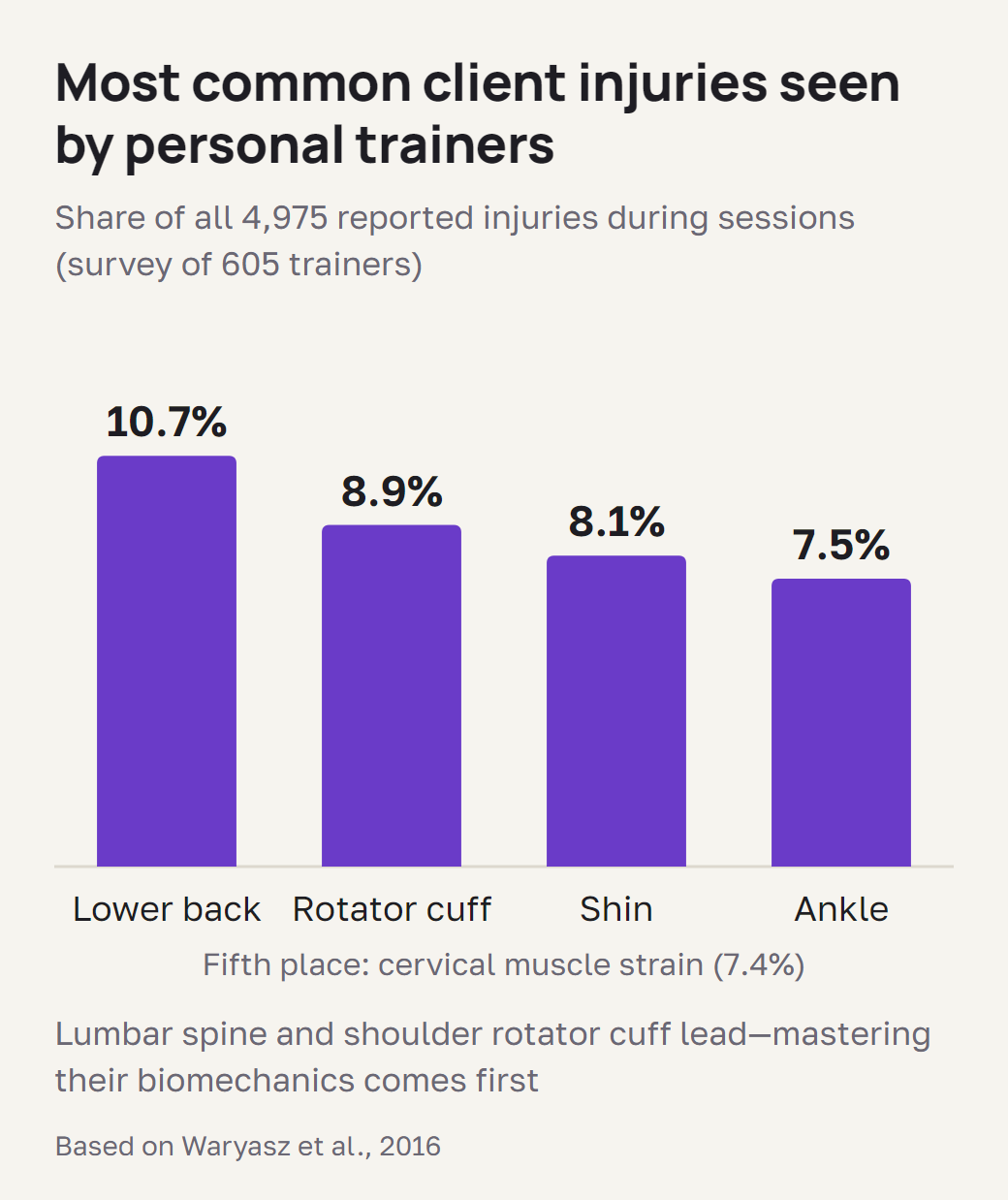
That is why core professional preparation rests on four pillars:
- Health screening and red flags. Under the American College of Sports Medicine consensus (Riebe and colleagues, 2015), before prescribing load you assess current physical activity, symptoms or diagnosed cardiovascular, metabolic, or renal disease, and planned exercise intensity. With chest pain, resting blood pressure of 160/100 mmHg or higher (or 140/90+ in uncontrolled hypertension), night pain, recurring numbness with shooting pain, or recent surgery, a coach postpones building a strength program and refers the client to a physician—the client's perspective is covered in How to Choose a Fitness Coach.
- Applied biomechanics. Rather than labeling exercises "good" or "bad," a specialist looks at the joint's axis of rotation, the line of force, and the moment arm. Because of differences in body proportions, joint mobility, and technique, the exact same barbell squat distributes load differently across the glutes, quads, and back.
- Evidence-based programming. According to the 2026 American College of Sports Medicine position stand (Currier and colleagues, 137 systematic reviews, over 30,000 participants), muscle growth rests on 10 or more weekly working sets per muscle group. Voluntary strength gains are further enhanced by loads of 80% of one-rep max or heavier through a full range of motion at least 2 times a week. In daily work, these principles come together into a clear weekly structure and weight log—detailed in Gym Workout Program, Full-Body vs. Split, and Progressive Overload.
- Honest nutrition boundaries. In a 2017 international review of standards across 10 countries and 16 organizations by Barnes and colleagues, trainers stepping outside their scope of practice in dietetics was flagged directly as an industry risk. A coach's job is to help calculate calories and protein, structure everyday eating, and build daily activity. A coach does not prescribe clinical diets for diseases, lab panels, or prescription medications. Protecting your own relationship with food matters too. A 2025 systematic review by Carroll and colleagues (9 studies across 14 articles, with small samples and varied questionnaires) found elevated rates of disordered eating among trainers themselves amid the profession's constant focus on body shape.
Getting your first gym and online clients without burning out in year one
Starting out, working on a live gym floor is invaluable. Floor shifts and intro sessions quickly develop professional observation: in person, you assess dozens of posture types, proportions, joint mobility patterns, and daily habits. After building that foundation, it's convenient to transition part of your clients into online coaching with mandatory video reviews of their working sets.
The biggest threat when starting at a commercial club is emotional burnout from sales-target pressure and self-doubt in your decisions. In a 2026 survey of 565 active commercial-club trainers by Li and colleagues, intention to leave the club went hand in hand with emotional exhaustion. The main protective resource was professional self-efficacy—confidence in applying knowledge in practice, communicating with clients and colleagues, and flexibly adapting programs to clients' needs.
In mentorship for aspiring and practicing fitness coaches, we build a foundation across three roles at once:
- Athlete: disciplined personal training and clean technique where you test programming principles on yourself.
- Specialist: running an intake session, building a program around limitations, analyzing movement on video, and calmly justifying every exercise choice on real client examples.
- Entrepreneur: showing your real work on social media, building a steady client pipeline, and stating your rates calmly without pushy scripts.
Step-by-step roadmap into the profession from scratch
- Put your own training in order: master clean technique on fundamental lifts and keep a log of working weights and reps in reserve.
- Complete foundational education covering anatomy, biomechanics, pre-exercise health screening, in-person practice, and a final exam.
- Practice the skill on 5–10 friends or volunteer models of varied ages and builds: learn to film sets from the side, refine joint angles, and guide each person through at least 4–8 weeks of planned training.
- Build a clear first-session intake checklist: goal, schedule, prior injuries, blood pressure, and symptoms requiring medical evaluation.
- Gain floor hours in a gym to develop keen observation while posting clear breakdowns of common mistakes for prospective clients.
- Test your readiness for independent work: looking at a client's intake form and set video, you should be able to explain without jargon which muscle leads the movement, why you picked that exercise, how many weekly sets are programmed, and where medical clearance begins.
If you're considering entering the profession or have already started coaching your first clients and want to calmly discuss your goals and growth points, book a free consultation.
I post breakdowns of exercises and coaching methodology on my YouTube channel @lobanov_fitness.
Sources
- Boerner PR et al. Is What You See What You Get? Perceptions of Personal Trainers' Competence, Knowledge, and Preferred Sex of Personal Trainer Relative to Physique. J Strength Cond Res, 2021. Article
- Malek MH et al. Importance of health science education for personal fitness trainers. J Strength Cond Res, 2002. PubMed
- Melton DI et al. The current state of personal training: an industry perspective of personal trainers in a small Southeast community. J Strength Cond Res, 2008. Article · Full text
- Xie Z et al. Market-driven fitness instruction: transforming the role of personal trainers in health promotion practices. BMC Public Health, 2026. Article · Full text
- D'hoe B et al. ChatGPT Outperforms Personal Trainers in Answering Common Exercise Training Questions. J Sports Sci Med, 2026. Article · Full text
- Waryasz GR et al. Personal Trainer Demographics, Current Practice Trends and Common Trainee Injuries. Orthop Rev (Pavia), 2016. Article · Full text
- Riebe D et al. Updating ACSM's Recommendations for Exercise Preparticipation Health Screening. Med Sci Sports Exerc, 2015. Article
- Currier BS et al. American College of Sports Medicine Position Stand. Resistance Training Prescription for Muscle Function, Hypertrophy, and Physical Performance in Healthy Adults: An Overview of Reviews. Med Sci Sports Exerc, 2026. Article · Full text
- Barnes K et al. An International Comparison of Nutrition Education Standards, Occupational Standards and Scopes of Practice for Personal Trainers. Int J Sport Nutr Exerc Metab, 2017. Article
- Carroll M et al. A systematic review of the prevalence of disordered eating in fitness professionals. Eat Behav, 2025. Article
- Li J et al. Self-efficacy and turnover intention among personal trainers in commercial fitness clubs: The mediating role of job burnout. PLoS One, 2026. Article · Full text