
Few gym exercises spark as much debate as the deadlift. Some coaches call it a mandatory staple for everyone, while others warn of inevitable lower-back injuries and steer lifters away from the bar.
Biomechanically, it is a straightforward compound movement—lifting a load from the floor by extending the hips and knees. It loads nearly the entire posterior chain and legs, and in practice, careful bar positioning and gradual load progression keep overload risk manageable.
I am Demid Lobanov, a coach and strength training educator. In this article, I break down which muscles work during the conventional deadlift, how to build a solid setup from lever mechanics, how it compares with Romanian, sumo, and hex-bar pulls, and what current research says about lower-back safety.
Which muscles work in the conventional deadlift
Lifting a bar from the floor requires dynamic work across two major joints—the hips and knees—while the trunk and upper-back muscles hold the spine and shoulder girdle steady.
- Primary movers: gluteus maximus and hamstrings extend the hip, while the quadriceps help break the bar off the floor through knee extension.
- Trunk and back stabilizers: erector spinae and latissimus dorsi stabilize the torso and help keep the bar close to the legs.
- Grip: forearm and hand muscles hold the bar securely.
A systematic review of electromyography (EMG) in deadlift variations (Martín-Fuentes et al., 2020) found that the biceps femoris was the most frequently studied muscle, followed by gluteus maximus, vastus lateralis, and erector spinae. Across deadlifts and their variants, erector spinae and quadriceps showed higher EMG activity than gluteus maximus and biceps femoris. Within the hamstrings, semitendinosus slightly exceeded biceps femoris, though the authors noted a lack of unified EMG recording and normalization standards. Keep one methodological caveat in mind (Vigotsky et al., 2022): acute surface EMG measures muscle excitation in the moment, not a validated predictor of long-term muscle hypertrophy.
Biomechanics and step-by-step conventional deadlift technique
The central mechanical rule of deadlifting comes straight from basic lever biomechanics (Hall, 2022; Dubrovsky & Fedorova, 2003). The external torque created by the bar at a joint equals gravitational force multiplied by the horizontal moment arm—the horizontal distance from the bar's line of action to the joint axis. The farther the bar's line of action drifts forward away from midfoot and the hip joint and lumbar segment axes, the greater the horizontal moment arm and flexion torque on the lumbar spine proportionally become for the exact same bar weight.
That principle gives a clean five-step setup I use in coaching practice:
- Foot stance. Place your feet roughly hip-width apart with toes turned slightly outward. Position the bar directly over midfoot—about 2–3 cm in front of your shins while your knees are straight.
- Grip without rolling the bar. Hinge down without pulling the bar toward you and take a symmetrical double-overhand grip just outside your shins.
- Shin and hip position. Bend your knees just enough for your shins to touch the bar—there is no need to squat deep. Your shoulders will sit slightly ahead of the bar with your shoulder blades directly over it.
- Pull the slack and brace. Lift your chest forward, depress your shoulders and engage your lats ("tuck your armpits"), and gently pull up on the bar until the slack clicks out of the sleeves. Take a deep belly breath and brace your trunk 360 degrees.
- Break off the floor, lockout, and lower. Start smoothly by pushing the floor away with your feet while dragging the bar close along your shins and thighs. Once the bar passes your knees, drive your hips forward into the bar until standing tall without leaning back or hyperextending the lumbar spine. Reverse the path on the way down: hinge your hips back first, and only bend your knees once the bar clears them.
When learning or refining technique in general fitness, set the bar down to a brief dead stop between reps instead of bouncing the plates off the floor. Pausing lets you verify your starting position and reset trunk tension before each liftoff.
Conventional vs. Romanian, sumo, and hex-bar deadlifts
Lifters often lump these four pulls together, even though they shift joint demands and serve different goals.
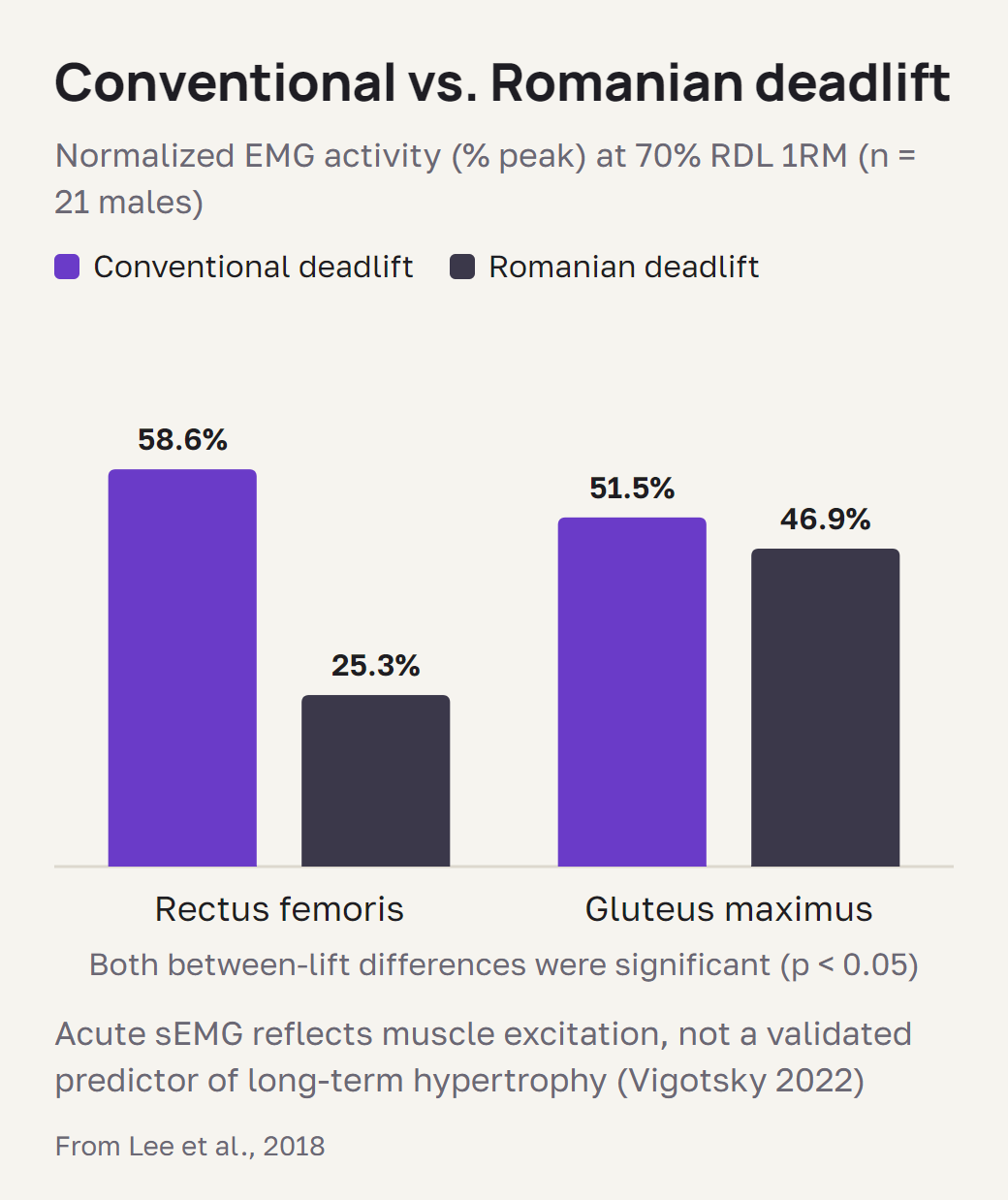
A biomechanical study of 21 men (Lee et al., 2018) compared conventional and Romanian deadlifts using the same absolute load—70% of Romanian deadlift 1RM (meaning relative intensity differed for the conventional lift). Conventional deadlifts produced higher normalized EMG in the rectus femoris (58.6% vs. 25.3% peak) and gluteus maximus (51.5% vs. 46.9%), along with larger knee and ankle net joint torques (p < 0.05; no advantage was noted for biceps femoris). Meanwhile, in Martín-Fuentes et al. (2020), the Romanian deadlift showed lower erector spinae activity relative to biceps femoris and semitendinosus. In practice, lifters often pick the Romanian deadlift to focus on the posterior chain with less axial fatigue and smaller knee joint moments.
Comparing conventional and sumo deadlifts in 30 experienced male lifters at 85% 1RM (Hanen et al., 2025) revealed clear shifts in joint demands. Conventional deadlifts produced greater hip flexion, higher hip extension moments, and greater peak EMG in biceps femoris across both phases and thoracic erector spinae in phase 2. Sumo deadlifts showed higher peak vastus lateralis activation in phase 1 and substantially greater hip and knee moments in the frontal and transverse planes.
Additional data came from a small study of 11 resistance-trained women on the final rep of a 3RM (Gundersen et al., 2025). Conventional (mean 103.2 kg) and sumo (101.5 kg) generated larger hip net joint moments near lockout, while the hex bar (mean 99.7 kg) produced greater barbell velocity, larger knee moments, and greater hip and knee flexion angles.
| Deadlift variant | Where demand is higher | Who it often suits | Key feature |
|---|---|---|---|
| Conventional deadlift | Hip and spinal extensors, quads off the floor | Lifters building full posterior-chain strength from the floor | Bar in front of shins, pull from the floor |
| Romanian deadlift | Hamstrings and glutes (less knee work, no floor break) | Targeted posterior-chain training with controlled loads | Starts from the top without resting on the floor |
| Sumo deadlift | Vastus lateralis at the start, larger frontal/transverse hip and knee moments and ranges | Lifters who feel comfortable in a wide stance | Wide stance with higher frontal and transverse plane demands |
| Hex-bar (trap-bar) deadlift | Knee joints, higher bar velocity (Gundersen 2025) | Beginners and lifters uncomfortable hinging with a straight bar | Side handles with greater hip and knee flexion angles |
Body proportions were tested in 47 deadlift-naive participants (Cholewa et al., 2019). Average 1RM did not differ between conventional and sumo, and the only statistically significant anthropometric link was a modest correlation with the sitting-height-to-total-height ratio (r = 0.297; p = 0.043; the abstract itself describes the direction inconsistently). Because the relationship is weak, always test stances in practice for joint comfort and clean mechanics.
Is the deadlift dangerous for your lower back?
The most common concern around deadlifting involves lumbar discs and spinal rounding. Current research paints a more measured, context-dependent picture.
A biomechanical study of 13 participants lifting 60–90% 1RM (Shoji et al., 2025) found greater flexion in the lower thoracic and upper lumbar spine alongside accelerated posterior pelvic tilt as loads increased. Based on those kinematics, the authors suggested increased lumbar flexion under heavy loads may elevate lumbar disc stress (disc loads were not directly measured). At the same time, a recent narrative review on low-back injury prevention in deadlifting (Cherni et al., 2026) notes that trained lifters naturally exhibit moderate lumbar flexion without clear prospective evidence of increased injury risk. Abrupt spikes in training load and volume appear to be more consistent—though probabilistic and context-dependent—predictors of injury than minor deviations from a rigid "neutral" posture.
Powerlifting epidemiology adds useful context. A cross-sectional online survey of 104 Swedish subelite classic powerlifters (Strömbäck et al., 2018) noted that earlier studies defining injury as training interruption reported relatively low rates (1.0–4.4 injuries per 1,000 training hours). When injury was defined broadly as pain or functional impairment affecting training, 70% reported a current complaint (most commonly lumbopelvic region, shoulder, and hip), yet only 16% of injured lifters had to stop training completely. The authors emphasize that injury causes remain unclear, and prevention likely depends on both load management and technique refinement.
When selected carefully, deadlifting can even help some individuals with recurrent mechanical low back pain. In a randomized trial of 70 patients (Aasa et al., 2015) over eight weeks (12 supervised sessions plus pain education), both low-load motor control training and high-load deadlifting significantly reduced pain with no statistically significant between-group difference (p = 0.505). Motor control produced larger improvements in daily activity (4.2 vs. 2.5 points; p < 0.001) and movement control (p < 0.001). A secondary analysis of the 35 participants in the deadlift arm (Berglund et al., 2015) showed that those who benefited most started with lower pain intensity, less disability, and higher hip and back extensor endurance on the Biering–Sørensen test.
With acute low back pain, shooting leg pain, numbness, or a disc herniation flare-up, do not pull from the floor—see a physician first and start back with calmer, axially unloaded variations.
Five common mistakes and how to program the deadlift
Here are five common technical mistakes in the conventional deadlift that I regularly fix in coaching practice:
- The bar drifts forward off the legs. Whenever the bar separates from your shins and shifts forward past midfoot at the start or mid-pull, the horizontal moment arm increases. On side-view video, the bar path should travel nearly straight up.
- Hips shoot up ahead of the shoulders. Your knees straighten too early, your torso tips horizontal, and the demand on your spinal erectors to stabilize the torso rises sharply while your hip extensors finish the pull. Fix it by pushing the floor smoothly and keeping your back angle steady until the bar clears your knees.
- Jerking off the floor with a loose back. Yanking the bar without pulling out the slack first often breaks trunk rigidity right at liftoff.
- Bouncing plates off the floor at speed. Touch-and-go rebounding makes it harder to keep your starting alignment and trunk tension.
- Hyperextending the lower back at lockout. Standing tall by locking the knees and bringing the hips through with glutes squeezed is enough—leaning far back is unnecessary.
For most recreational lifters focused on strength and physique outside competitive powerlifting, a reliable starting dose in my practice is once per week for 3–4 working sets of 5–8 reps with 2–3 reps in reserve (RIR 2–3). For session preparation details, see pre-workout warm-up. If hip mobility limits reaching the floor without heavy lumbar rounding, start from low blocks or a hex bar, or build the posterior chain with back extensions and Romanian deadlifts. It also helps to place heavy deadlifts on a separate day from heavy barbell squats so your lower back recovers cleanly.
I share short video breakdowns of pelvic position, bar path, and common deadlift errors on Demid Lobanov's YouTube channel. If you want your own deadlift technique audited on video with weights matched to your proportions, see training protocol and technique review. If you want a complete gym plan where deadlifts, squats, and accessories balance cleanly across the week, check out the gym workout program.
Frequently asked questions
Is the deadlift mandatory for building muscle?
No—the conventional deadlift is not mandatory for hypertrophy. If your goal is physique and muscle growth and floor pulling feels uncomfortable, Romanian deadlifts, back extensions, leg curls, and chest-supported rows cover those muscles effectively.
Do I need a lifting belt and straps?
With light and moderate loads, learn to brace your trunk and hold the bar without gear first. A belt can help on near-maximal sets but does not protect against poor technique, and straps make sense when your grip gives out well before your legs and back during working sets.
Double-overhand grip or mixed grip?
For general fitness and most working sets, a symmetrical double-overhand grip (or hook grip and straps on heavy sets) is preferable. A mixed grip introduces mild rotational asymmetry across the shoulders and trunk and places extra stress on the supinated biceps tendon, so outside competition it is used less often.
Can women do conventional deadlifts?
Yes—women perform conventional deadlifts effectively. In Cholewa et al. (2019), women completed more repetitions to fatigue at 60% 1RM than men in both deadlift styles (p = 0.041), and in Gundersen et al. (2025), trained women lifted around 100 kg on average for 3RM across conventional, sumo, and hex-bar deadlifts.
Sources
- Hall SJ. Basic Biomechanics. 9th ed. New York: McGraw Hill; 2022.
- Dubrovsky VI, Fedorova VN. Biomechanics. Moscow: VLADOS-PRESS; 2003.
- Martín-Fuentes I, Oliva-Lozano JM, Muyor JM. Electromyographic activity in deadlift exercise and its variants. A systematic review. PLoS One. 2020. DOI
- Vigotsky AD, Halperin I, Trajano GS, Vieira TM. Longing for a Longitudinal Proxy: Acutely Measured Surface EMG Amplitude is not a Validated Predictor of Muscle Hypertrophy. Sports Medicine. 2022. DOI
- Lee S, Schultz J, Timgren J, Staelgraeve K, Miller M, Liu Y. An electromyographic and kinetic comparison of conventional and Romanian deadlifts. Journal of Exercise Science & Fitness. 2018. DOI
- Hanen NC, et al. Biomechanical analysis of conventional and sumo deadlift. Frontiers in Bioengineering and Biotechnology. 2025. DOI
- Gundersen AH, van den Tillaar R, Falch HN, Fredriksen AB, Larsen S. A Biomechanical Comparison Between Conventional, Sumo, and Hex-Bar Deadlifts Among Resistance Trained Women. Journal of Strength and Conditioning Research. 2025. DOI
- Cholewa JM, Atalag O, Zinchenko A, Johnson K, Henselmans M. Anthropometrical Determinants of Deadlift Variant Performance. Journal of Sports Science & Medicine. 2019. PMC
- Shoji K, et al. Load-dependent increase in lumbar kyphosis is associated with posterior pelvic tilt during deadlift. Frontiers in Sports and Active Living. 2025. DOI
- Cherni B, et al. Beyond the Neutral Spine: A Narrative Review and Modern Framework for Low Back Injury Prevention in Deadlifting. Sports. 2026. DOI
- Strömbäck E, Aasa U, Gilenstam K, Berglund L. Prevalence and Consequences of Injuries in Powerlifting: A Cross-sectional Study. Orthopaedic Journal of Sports Medicine. 2018. DOI
- Aasa B, Berglund L, Michaelson P, Aasa U. Individualized low-load motor control exercises and education versus a high-load lifting exercise and education to improve activity, pain intensity, and physical performance in patients with low back pain: a randomized controlled trial. Journal of Orthopaedic & Sports Physical Therapy. 2015. DOI
- Berglund L, Aasa B, Hellqvist J, Michaelson P, Aasa U. Which Patients With Low Back Pain Benefit From Deadlift Training? Journal of Strength and Conditioning Research. 2015. DOI