
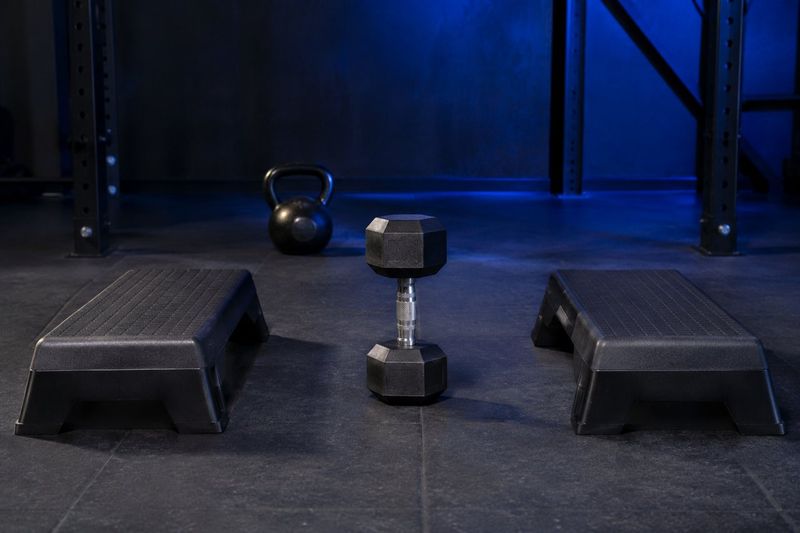
The sumo squat is a squat with a wide stance and the feet turned out. The main working muscle is the adductor magnus on the inner thigh; the lower part of the gluteus maximus and the quads, the muscles on the front of the thigh, work along with it. The version with a dumbbell held between the legs is called the plié squat. The key technique rule: the feet are turned out exactly as far as the thigh is turned out, and the knees track in line with the feet.
I'm Demid Lobanov, a fitness coach. In my exercise library, wide-stance squats, dumbbell plié squats off platforms, and Smith machine sumo squats sit in the adductor section. Below I explain why they're not in the glute section.
Which muscles work in sumo squats
| Muscle | What it does in the sumo squat |
|---|---|
| Adductor magnus, posterior fibers | prime mover: extends the hip from deep flexion and adducts the thigh from an abducted position |
| Lower fibers of the gluteus maximus | help extend the hip |
| Quads: the vastus muscles | extend the knee |
| Adductor longus and brevis, pectineus, gracilis | help extend the hip in the bottom third of the range; throughout the range, they help control the thigh together with the abductors |
| Gluteus medius and the deep external rotators, the muscles that rotate the thigh outward | keep the thigh turned out and stop the knee from caving in |
| Spinal erectors and abdominal muscles | hold the pelvis and spine in a neutral position |
In a wide stance, both actions of the adductor magnus, hip extension and adduction, match what the movement demands. Structurally, it is primarily a hip extensor. In a 2025 study by Takahashi and colleagues in 15 young people, more than 80% of its volume had a longer moment arm for extension than for adduction, and its potential extension moment was more than twice its adduction moment.
The hamstrings barely change length in a squat and don't grow from regular-stance squats; there's no data on their growth in a wide stance. The rectus femoris barely grows either.
How the sumo squat differs from a regular squat
A wide stance takes some of the load off the knee. In a 2025 study by Larsen and colleagues, 12 trained men did barbell squats for 3 reps in a wide and a narrow stance: 1.7 and 0.7 times shoulder width. In the wide stance, the knee flexed less, the knee extension moment and the force of the vastus muscles were lower, and hip abduction was greater.
| Sumo | Regular squat | |
|---|---|---|
| Stance | wide, feet turned out | hip-width or shoulder-width |
| Main target | adductor magnus | quads and gluteus maximus |
| Knee load | lower | higher |
| What limits depth | hip mobility in abduction and external rotation, butt wink | ankle mobility, butt wink |
There is also data on the muscles' electrical activity. In a 2021 study by Coratella and colleagues, 10 competitive bodybuilders squatted 80% of their max in five variations. On the way up, the sumo squat with turned-out feet produced more adductor longus activity than the regular and front squats. The vastus lateralis was more active in the sumo squat only compared with the front squat. Glute activity on the way up didn't differ across the variations, and on the way down it was higher in the front squat.
In the 2026 model by Collings and colleagues (15 people), the squat was among the exercises with the highest force in the posterior part of the adductor magnus, along with the deadlift, sumo deadlift, step-up, and Copenhagen adduction. The abstract doesn't say how wide the squat stance was.
A muscle's activity shows that it's working, but it doesn't predict growth (a 2022 review by Vigotsky and colleagues). I found no direct training comparisons of muscle growth with different stance widths.
Does the plié squat build the glutes?
The plié squat does build the glutes, but whether it beats a narrow stance hasn't been compared directly. A wide stance requires abduction and external rotation of the thigh. That is the upper gluteus maximus fibers' own job, so by anatomical calculation they're already shortened before the movement starts. There's no direct measurement by stance width, and no data on glute growth at different widths either.
What we know for sure: squats grow the glutes. In a 2023 study by Plotkin and colleagues, 9 weeks of squats and hip thrusts produced the same glute growth in untrained people, while the adductors and quads grew more from squats; the squat stance in that study was 1–1.5 times shoulder width. For the glutes, going by my library, I use a narrow or neutral stance; more on that in the article “How to Build Your Glutes”.
Plié squats don't remove fat from the inner thighs. A 2021 review by Ramirez-Campillo and colleagues pooled 13 studies with 1,158 participants: one arm or leg was trained and the other wasn't, and fat on the trained side didn't decrease more. Fat comes off in a calorie deficit; more on that in the article “How to Lose Weight”.
How to do a dumbbell sumo squat (plié): step by step
- Set your feet wider than shoulder width and turn them out as far as your thighs turn out.
- Grab the dumbbell by its top end and hold it vertically between your legs with your arms straight.
- Lower yourself so that your pelvis travels down between your feet.
- Track your knees in line with your second and third toes.
- Keep going down as long as your pelvis stays neutral: butt wink at the bottom marks the end of your range.
- Stand up by pushing your feet into the floor without letting your knees cave in.
Stance width works like a sliding scale: moderately wide is closer to the glutes, sumo and plié are closer to the adductors. Wider isn't better: you find the optimal width rather than pushing it to the limit. Torso lean determines which works more, the hip or the knee: a more upright torso means more knee work, leaning forward means more hip work.
Variations: dumbbell, off platforms, Smith machine
| Variation | How it differs | Best for |
|---|---|---|
| Dumbbell from the floor | depth is limited by the dumbbell touching the floor | learning the movement |
| Dumbbell off platforms (deficit plié squat) | feet on two platforms, you can sit below parallel, the adductor works at a longer length | when the floor version doesn't give you enough depth |
| Smith machine | the bar moves on a fixed path, no need to balance | working closer to failure |
| Barbell on the back | free weight, the load presses down on your back | people who have already mastered the barbell squat |
In the dumbbell plié squat, grip often limits the working weight: it gives out before your legs, and the last reps no longer load the legs properly. In the Smith machine, foot position relative to the bar sets the torso angle, so set it before your first rep.
Where the sumo squat is hardest and how deep to squat
It's hardest at the bottom and at the start of the ascent. That's also where the adductor magnus is most stretched, since hip abduction and flexion add up. In my library, the loading profile is medium: the load is closer to the stretched position, but the range isn't extreme.
Deeper is better for the adductors. In a 2019 study by Kubo and colleagues, 17 men did deep or shallow squats for 10 weeks: adductor volume increased by 6.2% versus 2.7%, and gluteus maximus volume by 6.7% versus 2.2%. Depth is limited by hip mobility, by the shape of your hip joint, which is individual and can't be trained, and by butt wink. In a wide stance, butt wink kicks in earlier if your feet are turned out more than your thighs.
Common sumo squat mistakes
| Mistake | What happens | How to fix it |
|---|---|---|
| Feet turned out more than the thighs | the knee doesn't track with the foot, and depth is limited by the joint before the muscles | turn your feet out exactly as far as your thighs turn out |
| Knees cave in on the way up | the working adductors themselves pull the thigh inward | track your knees in line with your feet, use less weight |
| Butt wink at the bottom | the back rounds, and the range comes from the lower back | go down only to where your pelvis is still neutral |
| Hips shift back | the torso leans forward more, and the squat turns into a hinge | pelvis down between the feet |
| Grip gives out before the legs | the last reps don't load the legs | end the set or switch to the Smith machine version |
Sumo squats and pain
With acute groin pain or a flare-up of adductor tendon pain, skip sumo squats for that period: the exercise loads the adductors in a stretched position. With acute low back pain, take the load off your back and see a doctor first. If your hip joint reacts to deep flexion with the thigh turned out and your doctor knows the cause, adjust depth and width based on pain; if the cause is unclear, see a doctor first. If pain appears without a clear cause, is severe, or is getting worse, see a doctor first.
How many sets to do
The benchmark in my database is 10–20 working sets per muscle group per week. I program sumo squats for people whose program is built around a narrow stance and whose adductors get too little work. Sumo sets count toward your leg volume along with your other squats, and you can add machine hip adduction on top. More in the article “How Many Sets per Week”.
How to add sumo squats to your workout: step by step
- Decide which muscle you're targeting: for the adductors, sumo and plié squats; for the glutes, a narrow or neutral stance and hip thrusts.
- Start with the dumbbell plié squat from the floor; if you lack depth, go off platforms; if you need more weight, use the Smith machine or a barbell.
- Turn your feet out as far as your thighs turn out and track your knees in line with your feet.
- Lower yourself as long as your pelvis stays neutral.
- Count sumo sets toward your weekly leg volume: 10–20 per muscle group.
- With acute groin pain, stop; with acute low back pain or pain without a clear cause that is severe or getting worse, see a doctor first.
If you need a plan for your goal and your gym, there's the personalized program.
I post exercise breakdowns on my YouTube channel @lobanov_fitness.
Sources
- Takahashi K et al. Redefining muscular action: human "adductor" magnus is designed to act primarily for hip "extension" rather than adduction in living young individuals. Journal of Applied Physiology, 2025. Article
- Larsen S et al. The Impact of Stance Width on Kinematics and Kinetics During Maximum Back Squats. J Strength Cond Res, 2025. Article
- Coratella G et al. The Activation of Gluteal, Thigh, and Lower Back Muscles in Different Squat Variations Performed by Competitive Bodybuilders: Implications for Resistance Training. Int J Environ Res Public Health, 2021. Article · Full text
- Collings TJ et al. Hip Adductor Muscle Forces during Strength Training and Rehabilitation Exercises. Med Sci Sports Exerc, 2026. Article
- Vigotsky AD et al. Longing for a Longitudinal Proxy: Acutely Measured Surface EMG Amplitude is not a Validated Predictor of Muscle Hypertrophy. Sports Med, 2022. Article
- Plotkin DL et al. Hip thrust and back squat training elicit similar gluteus muscle hypertrophy and transfer similarly to the deadlift. Front Physiol, 2023. Article · Full text
- Ramirez-Campillo R et al. A proposed model to test the hypothesis of exercise-induced localized fat reduction (spot reduction), including a systematic review with meta-analysis. Hum Mov., 2021. Article
- Kubo K et al. Effects of squat training with different depths on lower limb muscle volumes. Eur J Appl Physiol, 2019. Article