
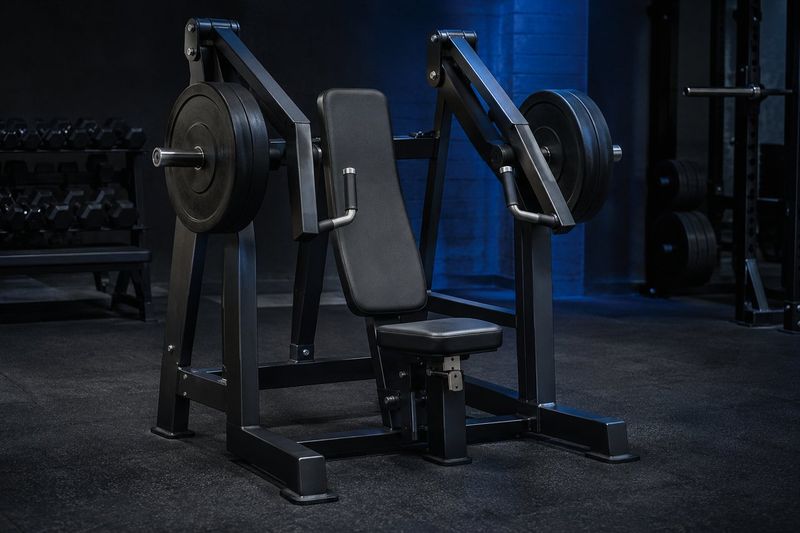
The machine chest press is a seated exercise in which the handles move along a path set by a lever or a cable. The main working muscle is the sternal head of the pectoralis major. It's assisted by the clavicular head, the front delts, and the triceps.
The most important part of the setup is seat height: it determines the line of the press. Muscles grow just as well with machines as with free weights, although the chest muscles weren't measured separately in these studies.
I'm Demid Lobanov, a fitness coach. My exercise library has two presses like this: the seated press on a lever machine, which people call the Hammer Strength press, and the horizontal press on a cable machine. Of the chest exercises, I give beginners the Hammer Strength press.
Which muscles work in the machine chest press?
The roles of the muscles are based on my exercise library and Hall's textbook.
| Muscle | What it does |
|---|---|
| Pectoralis major, sternal head | primary mover: horizontally adducts the shoulder, bringing the arm forward and toward the midline |
| Clavicular head of the pectoralis major | assists; its share grows when the press goes upward and forward |
| Front delt | helps flex the shoulder and bring the arm forward toward the midline |
| Triceps | extends the elbow; on a machine it often fails before the chest does |
| Serratus anterior | moves the shoulder blade forward; on the Hammer Strength machine, the back pad partly takes over its work |
| Rotator cuff muscles | hold the head of the humerus in the joint |
| Middle and lower traps, rhomboids | press the shoulder blades against the back pad |
On a cable machine without a back pad, the abs work too: the cable pulls your torso backward.
Machine press or bench press?
No difference was found for muscle growth, but there is one for strength. In the 2020 study by Coratella and colleagues, 10 competitive bodybuilders did barbell presses on a flat, incline, and decline bench, as well as a machine press, with 80% of their max.
The sternal head of the pecs worked the same on the machine as in the bench press. The clavicular head was less active on the machine than in all the barbell variations. The triceps was less active than in the flat and decline bench press, and the side delt was less active than in all three. The authors explain this by the barbell being less stable.
The study used sensors on the skin to measure the muscles' electrical activity over 4 reps, not taken to failure. Muscle growth wasn't measured: activity shows which muscles are engaged, but it doesn't predict their growth.
The 2023 meta-analysis by Haugen and colleagues (13 studies, 1,016 people) found no difference in muscle growth between machines and free weights. But there is little data on growth, only 5 studies, and growth was measured in different ways.
Strength depends on the exercise: in free-weight tests, it increases more with free weights. In the 2020 study by Schwanbeck and colleagues, 46 people (36 finished) trained on machines or with free weights for 8 weeks. Biceps and quad thickness increased equally; the chest muscles weren't measured.
The machine press went up more in the machine group, by 13.9% versus 8.6%, while the barbell bench press went up equally in both groups.
So for chest growth, the Hammer Strength press works as your main press: there's no direct measurement of the pecs, but muscles grow no less with machines. If you need strength specifically in the bench press, the bench press should be in your program.
Hammer Strength or cable machine?
| Lever machine (Hammer Strength) | Cable machine | |
|---|---|---|
| Resistance profile | mid-range | stretched |
| Where it's heaviest | on a typical model, in the first third of the stroke from the bottom stop; the lever and cam of a specific model change how the load is distributed | at the starting point, where the pecs are stretched |
| Stretched position | limited by the back pad and the handle stops | the pecs are loaded in the stretched position |
| Stability | high: your back is supported, the path is fixed | lower: you have to hold the shoulder blade in place yourself |
| Level | beginner | intermediate |
| What it's for | a beginner's main press, training close to failure without a spotter, an accessory exercise after a press | loading the chest in the stretched position |
Failure is the point at which you can no longer do the next rep with proper technique.
The main trade-off of the Hammer Strength press: high stability and the ability to train to failure, but less load in the stretched position. If your goal is to load the pecs in the stretched position, the cable version or the dumbbell press wins. That's why for experienced lifters I use the Hammer Strength press to build training volume or to finish off chest work, alongside another press.
How to set up the machine
Seat height determines which part of the chest works more. With the seat lower, the press goes upward and forward, and the clavicular head works more. With the seat higher, the press goes downward and forward, and the lower fibers work more. This is a conclusion based on fiber direction; there is no direct measurement on the machine. For the middle of the chest, set the handles at chest level.
The handles' bottom stop and the back pad set the range of motion, the distance the handles travel. It differs from model to model, so you don't carry the setup of one machine over to another. Independent handles let you press with one arm, for example if one side is lagging.
How to do the machine chest press: step by step
- Set the seat: for the middle of the chest, the handles should be at chest level.
- Sit down and press your shoulder blades and shoulders against the back pad.
- Grab the handles at the bottom of the stroke: your hands should be roughly in the plane of your torso.
- Press the handles forward until your arms are almost straight, without locking out your elbows.
- Slowly return the handles to the bottom stop without lifting your shoulders off the back pad.
- Work through the machine's full range of motion, including the bottom half.
On a cable machine without a back pad, watch your shoulder blade: it shouldn't move forward and up at the starting point. Don't bring your hands together until they touch in front of your chest: there's almost no load on the pecs there anymore.
Common machine chest press mistakes
| Mistake | What happens | How to fix it |
|---|---|---|
| Reaching forward with your shoulder after the handle | the shoulder moves forward, and the load shifts to the front delt and the front of the joint | keep your shoulder blades and shoulders pressed against the back pad |
| Wrong seat height | the press doesn't follow the line of the chest | set the handles at chest level |
| Only the top half of the stroke | there's almost no load there anymore | work from the bottom stop |
| "Depth" from the shoulder blade | the shoulder blade moves forward, and the pecs don't lengthen | let the stop limit the depth, with your shoulder blades pressed back |
| Hands touching on the cable machine | the torque there is zero, and the pecs are shortened | stop before your hands come together |
Machine chest press with shoulder pain
If a doctor has already diagnosed pain under the acromion (the bony process of the shoulder blade above the shoulder joint) and it's in the acute phase, the bottom of the stroke is limited to the pain-free point. On the Hammer Strength machine, that's the handles' bottom stop; on the cable machine, it's the back part of the range.
After a recent injury or surgery on the shoulder joint or the pectoralis major, do this exercise only once a doctor has cleared you. If the pain came on for no clear reason, is severe, or is getting worse, see a doctor first.
The Hammer Strength press has fewer limitations than free weights: your back is supported, and there's no arch in the lower back. That's why, when there are shoulder or lower back limitations, I program it instead of the bench press.
How many sets to do
As a guideline: 10–20 working sets per week for the chest, and 10–12 when you're starting out. Train your chest 2 times a week.
Machine press sets count toward this volume along with other presses and flyes. For the triceps, a set of pressing counts as half a set. More on this in the article "How to Build Your Chest".
How to add the machine chest press to your workout: step by step
- For beginners, the Hammer Strength press as the main chest press; for experienced lifters, to build training volume or finish off the work after the bench press or dumbbell press.
- If you need load in the stretched position, add the cable machine or dumbbells.
- Set the seat for your goal: handles at chest level for the middle of the chest, the seat lower for the upper chest.
- Count the sets toward your weekly chest volume: 10–20.
- If you need strength in the bench press, keep the bench press in your program.
- If you've already been diagnosed and the pain is acute, limit the bottom of the stroke; if the pain has no clear cause, see a doctor first.
If you need a plan for your goal and your gym, there's the personalized program.
I post exercise breakdowns on my YouTube channel @lobanov_fitness.
Sources
- Hall SJ. Basic Biomechanics. 9th edition. McGraw Hill, 2022. Chapter 7: upper extremity.
- Coratella G et al. Specific prime movers' excitation during free-weight bench press variations and chest press machine in competitive bodybuilders. Eur J Sport Sci, 2020. Article
- Haugen ME et al. Effect of free-weight vs. machine-based strength training on maximal strength, hypertrophy and jump performance - a systematic review and meta-analysis. BMC Sports Sci Med Rehabil, 2023. Article · Full text
- Schwanbeck SR et al. Effects of Training With Free Weights Versus Machines on Muscle Mass, Strength, Free Testosterone, and Free Cortisol Levels. J Strength Cond Res, 2020. Article




