

Plyometric exercises are explosive speed-strength movements—jumps, hops, and clap push-ups—where a rapid muscle stretch transitions immediately into a forceful push-off. Their purpose is building reactive power, running speed, and tendon elasticity rather than "burning calories" in exhausting circuits.
Gym-goers often confuse plyometrics with HIIT workouts and jump nonstop for a minute under heavy fatigue. Below we explain jump mechanics, summarize modern meta-analyses, and lay out a safe way to add plyometrics to strength training.
How the stretch-shortening cycle works
The biomechanical foundation of plyometrics is the stretch-shortening cycle (SSC; Hall, 2022, Ch. 6). When you dip rapidly or land before jumping again, the muscle–tendon unit stretches quickly and stores elastic energy in series elastic components. If the push-off follows without pause, it generates more power than jumping from a dead stop.
That is why true plyometrics differs from jump cardio: every rep must be performed fresh, fast, and with crisp landing control, followed by full rest between sets. Once your legs feel heavy and ground contact drags out, you stop training explosive power and simply hammer fatigued joints.
What plyometrics actually improves according to meta-analyses
Recent meta-analyses clearly define where plyometrics excels:
- Reactive strength. In a meta-analysis of 61 studies involving 2,576 healthy participants aged 8–73 (Ramirez-Campillo et al., 2023), plyometric jump training significantly raised the reactive strength index versus active controls including standard strength work (ES = 0.54; p < 0.001; moderate GRADE certainty). Adults ≥18 responded more than youth (p = 0.023), and programs >7 weeks and >14 sessions trended stronger (p = 0.027–0.060; meta-regression R² = 0.0). Exceeding 1,080 total jumps offered no extra benefit over ≤1,080 jumps.
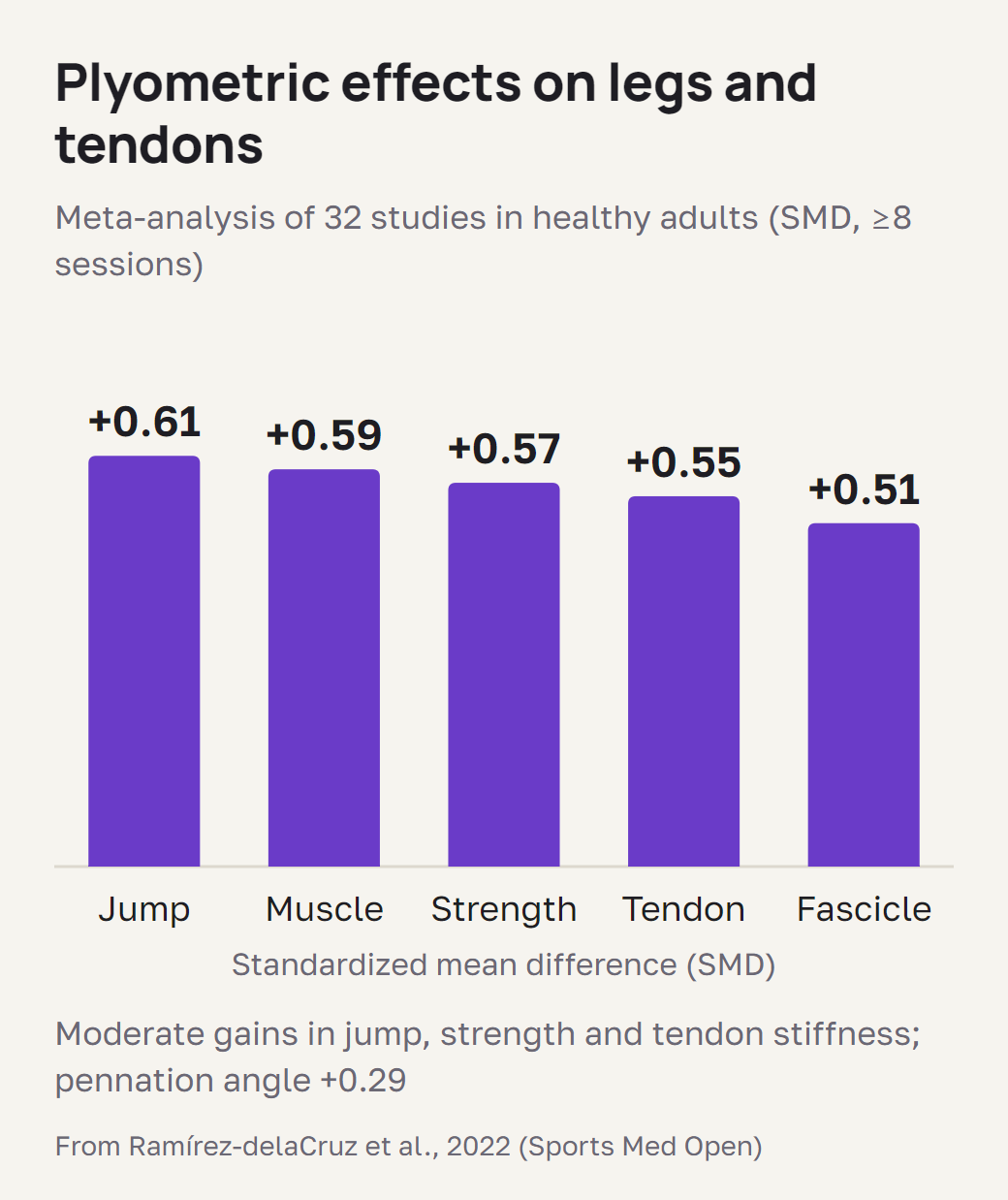
- Tendons, jump height, and muscle architecture. A meta-analysis of 32 adult studies (Ramírez-delaCruz et al., 2022) found moderate gains in jump height (SMD = 0.61), lower-limb strength (SMD = 0.57), tendon stiffness (SMD = 0.55), muscle thickness (SMD = 0.59), and fascicle length (SMD = 0.51), plus a small pennation angle shift (SMD = 0.29). Still, heavy resistance training with sustained loading remains the primary foundation for structural tendon strengthening, with jumps layered on top.
- Running economy. In a meta-analysis by Llanos-Lagos et al. (2024), plyometrics specifically yielded a small running economy benefit (ES = −0.307; p = 0.028) at speeds ≤12 km/h, whereas heavy strength training (≥80% 1RM) was more effective at faster speeds.
Does plyometrics build muscle or burn fat?
Plyometrics can modestly grow leg muscles—especially in untrained individuals—but does not replace full-body resistance training and does not burn body fat on its own.
In a multilevel meta-analysis of 15 studies (Arntz et al., 2022), jump training produced a small-to-moderate hypertrophy effect (SMD = 0.47; p < 0.001), larger in non-athletes (SMD = 0.55) than athletes (SMD = 0.33), clear in the quadriceps (SMD = 0.72; p < 0.001) and inconsistent in the calves (SMD = 0.65; p = 0.143).
Another meta-analysis of 21 RCTs in 594 men (Ramirez-Campillo et al., 2022) showed increased leg (ES = 0.55; p = 0.009) and thigh (ES = 0.38; p = 0.043) muscle volume, yet no statistically significant drop in body fat percentage or skinfolds versus controls. Fat loss depends on a calorie deficit, not impact jumps.
Plyometrics, strength training, and external load
Strength training remains the base for maximal force and hypertrophy, while pairing both yields the best athletic balance. In a meta-analysis of 34 studies on 1,396 high-level male youth soccer players (Oliver et al., 2024), strength, plyometric, and combined programs similarly improved jumping, acceleration, change of direction (g = 0.73–1.08), and sprinting (g = 0.40–0.59). Lower-body maximal strength separated them: plyometrics alone had a small effect (g = 0.27), well behind strength (g = 1.07) and combined training (g = 0.75).
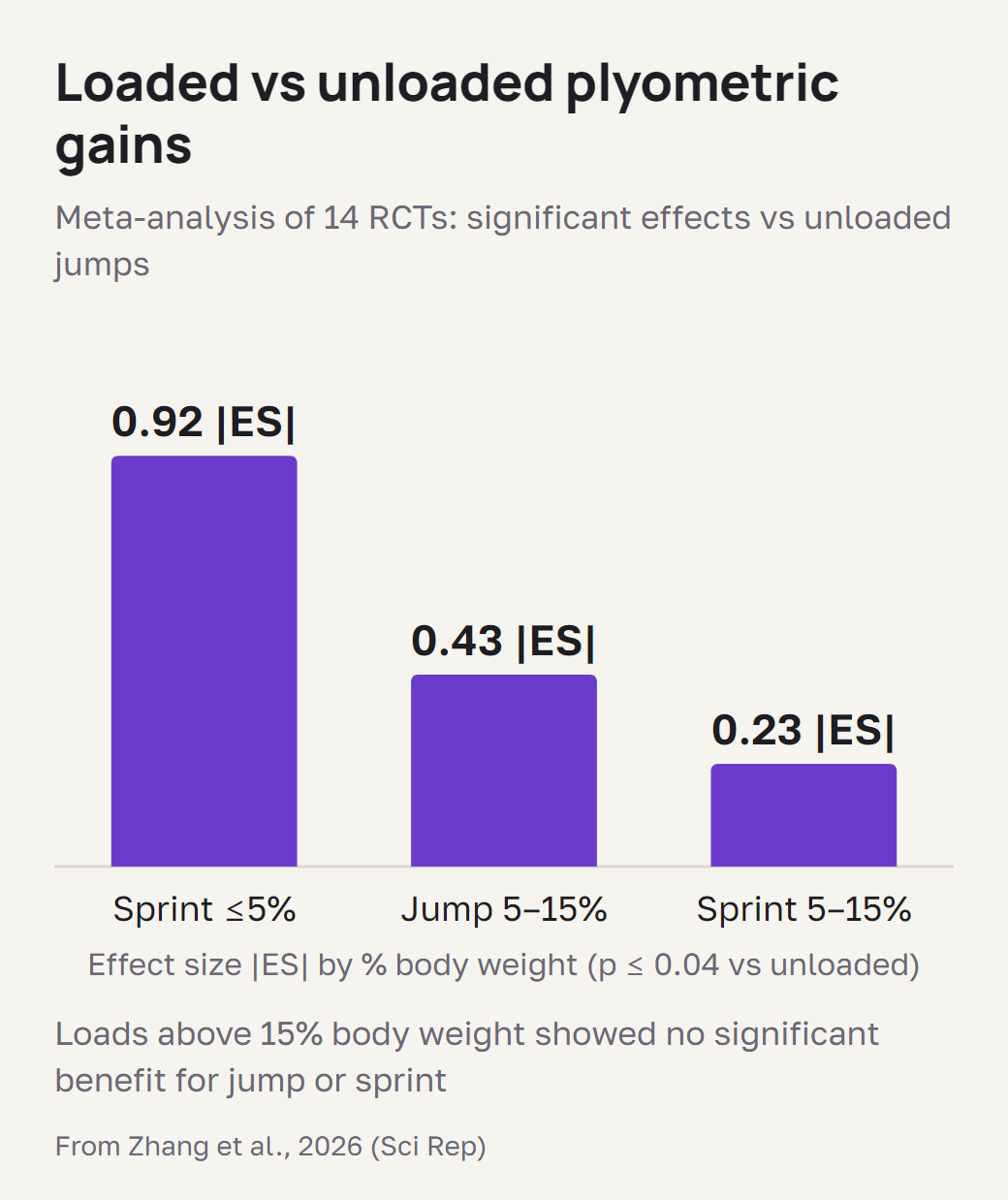
What about jumping with weights? A meta-analysis of 14 RCTs (Zhang et al., 2026) compared unloaded versus loaded jumps. Vertical jump improved further only with moderate loads of 5–15% body weight (ES = 0.43; p < 0.0001). Sprint times improved with light loads ≤5% (ES = −0.92; p = 0.0005) and moderate loads 5–15% (ES = −0.23; p = 0.04). Loads above 15% body weight offered no jump or sprint advantage and simply slowed movement.
| Goal | Plyometrics | Strength training | Best combination |
|---|---|---|---|
| Explosive power and jump | Primary tool (ES 0.54–0.61) | Builds force foundation | Strength base + 2 jump blocks/week |
| Maximal leg strength | Small effect (g = 0.27) | Primary tool (g = 1.07) | Squats and hinges as foundation |
| Full-body hypertrophy | Limited to legs (SMD 0.47) | Balanced full-body growth | Lifting with progressive overload |
| Fat loss | Does not reduce fat alone | Preserves lean mass | Calorie deficit + lifting + daily steps |
How to start plyometrics safely: 5 steps
I am Demid Lobanov, a fitness coach and training methodologist. In custom training programs and coach mentorship, I verify two prerequisites before adding jumps: basic lower-body strength and quiet, controlled landings without knees caving inward.
- Master landing mechanics. Start with low step-offs and soft squat landings: land quietly with knees tracking over the second and third toes and a stable foot position.
- Start with low-impact box landings. Box jumps (including seated box jumps) remove harsh downward landing impact—always step down rather than jumping off.
- Place plyometrics first. Right after your warm-up and before heavy squats while the nervous system is fresh.
- Track ground contacts. Beginners need 40–60 contacts per session (e.g., 4 sets × 5–6 jumps across 2 exercises) 1–2 times per week with 60–120 s full rest. Youth meta-analytic data (Ramirez-Campillo et al., 2023) show measurable gains from ~4 weeks (8 sessions) and ~92 jumps/week (low to very low GRADE certainty).
- Progress gradually. Begin with bilateral box and broad jumps, add light rhythmic hops after 4–6 weeks, and save single-leg hops for well-controlled lifters. External loads above 5–15% body weight are unnecessary.
I also post leg and runner strength breakdowns on YouTube at @lobanov_fitness.
Who should avoid plyometrics and see a doctor first
Most controlled studies reported no injuries, but that relies on careful screening and volume control. Skip impact jumps and consult a doctor if you have:
- acute or aching knee, ankle, Achilles, or lower-back pain (see training with knee pain);
- recent ligament tears, surgery, or joint instability;
- significant excess body weight accompanied by joint pain;
- early postpartum recovery or pelvic floor symptoms such as leakage on impact (see postpartum training).
Frequently asked questions
Are plyometric exercises good for weight loss?
Not as a standalone fat-loss tool: a 21-RCT meta-analysis (Ramirez-Campillo, 2022) found no fat-mass reduction without dietary changes. Jumps build athleticism; a calorie deficit drives fat loss.
How does plyometrics differ from functional training and burpees?
Functional training and timed burpees are typically done under high heart rate and fatigue for conditioning. True plyometrics uses brief explosive sets with 1–2 minutes of full rest.
Do I need plyometrics if my goal is simply bigger legs and glutes?
No. Classic strength training is enough for hypertrophy; plyometrics is mainly valuable for runners, court/field athletes, or anyone targeting jump power and elastic stiffness.
How many times per week should you do plyometrics?
Recreational lifters do well with 1–2 sessions per week of 40–60 contacts before lifting. Athletic studies go up to 3 sessions/week (Ramirez-Campillo, 2023), which demands at least 48 hours of tendon recovery between sessions.
Sources
- Hall SJ. Basic Biomechanics, 9th ed. McGraw Hill, 2022. Chapter 6 – The Biomechanics of Human Skeletal Muscle.
- Ramirez-Campillo R et al. Effects of Plyometric Jump Training on the Reactive Strength Index in Healthy Individuals Across the Lifespan: A Systematic Review with Meta-analysis. Sports Med, 2023. Article · Full text
- Ramírez-delaCruz M et al. Effects of Plyometric Training on Lower Body Muscle Architecture, Tendon Structure, Stiffness and Physical Performance: A Systematic Review and Meta-analysis. Sports Med Open, 2022. Article · Full text
- Arntz F et al. Effect of Plyometric Jump Training on Skeletal Muscle Hypertrophy in Healthy Individuals: A Systematic Review With Multilevel Meta-Analysis. Front Physiol, 2022. Article · Full text
- Ramirez-Campillo R et al. Body composition adaptations to lower-body plyometric training: a systematic review and meta-analysis. Biol Sport, 2022. Article · Full text
- Oliver JL et al. The Effects of Strength, Plyometric and Combined Training on Strength, Power and Speed Characteristics in High-Level, Highly Trained Male Youth Soccer Players: A Systematic Review and Meta-Analysis. Sports Med, 2024. Article · Full text
- Zhang Z et al. Differential effects of plyometric training loads on jump and sprint performance reveal optimal strategies. Sci Rep, 2026. Article · Full text
- Ramirez-Campillo R et al. Plyometric-Jump Training Effects on Physical Fitness and Sport-Specific Performance According to Maturity: A Systematic Review with Meta-analysis. Sports Med Open, 2023. Article · Full text
- Llanos-Lagos C et al. Effect of Strength Training Programs in Middle- and Long-Distance Runners' Economy at Different Running Speeds: A Systematic Review with Meta-analysis. Sports Med, 2024. Article · Full text