

High-intensity interval training—HIIT—has been marketed for years as a way to burn twice the fat in 15 minutes, usually leaning on the "afterburn effect." Once researchers pooled dozens of controlled and randomized trials into major meta-analyses, a very different picture emerged: for fat loss, HIIT is no more magical than steady moderate cardio, yet it holds a clear, proven edge elsewhere.
I am Demid Lobanov, a fitness coach and strength-training educator. When designing plans in online coaching and training programs, I treat intervals as a practical tool for cardiorespiratory fitness and time efficiency that needs careful pairing with strength work. Below is where HIIT wins and where it falls short according to research.
Does HIIT burn more fat than steady moderate cardio?
Four independent meta-analyses converge on the same conclusion: in head-to-head comparisons of HIIT and moderate-intensity continuous training (MICT) for fat loss, there is no winner.
- In a meta-analysis of 13 studies averaging 10 weeks at 3 sessions per week in adults aged 18–45 with overweight or obesity (Wewege et al., 2017), both formats produced modest, significant reductions in whole-body fat mass and waist circumference (p < 0.05) with no difference between them and no accompanying drop in total body weight. HIIT's edge was time efficiency—requiring roughly 40% less training time. Running protocols produced large fat-mass effects in both formats (SMD −0.82 and −0.85), whereas cycling produced no significant fat loss.
- In a meta-analysis of 31 studies lasting at least 4 weeks (Keating et al., 2017), body fat percentage fell by 1.26% after interval training and 1.48% after steady cardio, while fat mass dropped by 1.38 kg and 0.91 kg respectively. Between-group differences were absent, and when HIIT involved lower time commitment or energy expenditure, results tended to favor steady cardio (p = 0.09). Neither short-term format alone produced clinically large fat loss.
- In a multilevel meta-analysis rated high certainty under GRADE (Steele et al., 2021), the standardized difference between interval and steady cardio was −0.016 for fat mass (95% CI −0.07 to 0.04) and −0.0004 for fat-free mass (95% CI −0.05 to 0.05)—statistically indistinguishable from zero.
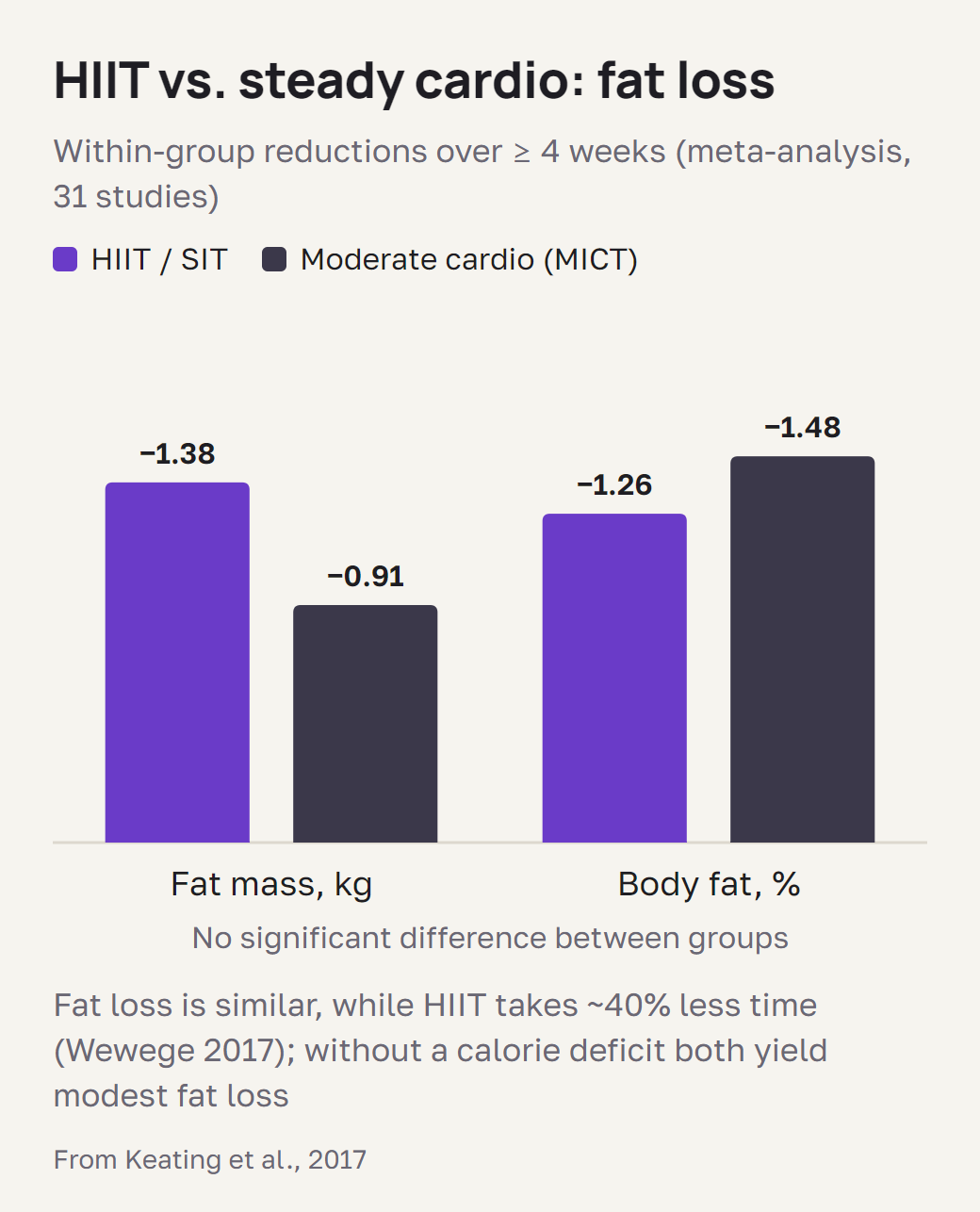
Based on Keating 2017, Wewege 2017, and Steele 2021: HIIT and steady cardio show no difference in fat loss; short cardio protocols without diet control yield small changes, and low-volume HIIT (Sultana 2019) did not differ from non-exercising controls.
A 47-study meta-analysis closed the "10 minutes of HIIT instead of dieting" myth even more firmly (Sultana et al., 2019). Low-volume HIIT (≤ 500 MET-minutes per week) showed no body-composition differences compared with steady cardio (fat mass p = 0.872; body fat % p = 0.974; lean mass p = 0.768) or even non-exercising controls (p = 0.455; p = 0.700; p = 0.744). According to the ISSN position stand on diets and body composition (Aragon et al., 2017), sustained calorie deficit drives fat loss, while cardio complements energy balance. For balancing nutrition, lifting, and cardio, see Cardio or Strength Training for Weight Loss.
Where HIIT genuinely outperforms steady cardio
HIIT's true strength is cardiorespiratory fitness (VO2max) and selected cardiometabolic markers. In that same Sultana 2019 meta-analysis, low-volume HIIT failed to move body fat yet improved cardiorespiratory fitness significantly more than both non-exercising controls (p < 0.001) and steady cardio (p = 0.017).
A meta-analysis of 28 controlled trials covering 723 healthy adults aged 18–45 (Milanović et al., 2015) showed that compared with no exercise, steady endurance training raised VO2max by 4.9 mL/kg/min and HIIT raised it by 5.5 mL/kg/min—giving HIIT a direct edge of 1.2 mL/kg/min (±0.9).
A larger meta-analysis of 53 randomized trials clarified which protocols actually beat steady cardio (Wen et al., 2019). Against passive controls, even short sprints (≤ 30 seconds) and tiny volumes (≤ 5 minutes) improved VO2max (SMD 0.79–1.65; p < 0.05). To outperform MICT directly, however, programs needed long intervals (≥ 2 minutes), higher work volume (≥ 15 minutes per session), and 4–12 weeks of training (SMD 0.65–1.07; p < 0.05).
Pre-to-post cardiometabolic effects of HIIT (without direct MICT comparison) were evaluated across 65 intervention studies (Batacan et al., 2017). In adults with overweight or obesity, programs under 12 weeks improved VO2max (SMD 0.74), diastolic blood pressure (SMD −0.52), and fasting glucose (SMD −0.35). At 12 weeks or longer, waist circumference (SMD −0.20), body fat percentage (SMD −0.40), resting heart rate (SMD −0.33), and systolic blood pressure (SMD −0.35) improved as well, while insulin, lipid profile, and inflammatory markers (CRP, IL-6) showed no significant change. In normal-weight adults, only VO2max improved significantly.
Real-world adherence and recovery fatigue
In strength and conditioning practice, true HIIT means hard intervals near 85–95% of maximum heart rate where speaking in full sentences becomes impossible by the end of a bout. For beginners and people carrying extra weight, I recommend starting on low-impact machines rather than jumping circuits.
A large meta-analysis of 188 studies covering 8,928 insufficiently active adults or patients with medical conditions (Santos et al., 2023) found high supervised attendance in both formats: 89.4% for HIIT and 92.5% for MICT (65 studies, p = 0.78—no difference). Once participants trained unsupervised, adherence fell to 63% for HIIT and 68.2% for MICT (10 studies, p = 0.096—no statistically proven gap, though evidence certainty was very low).
In my practice, stacking three hard HIIT workouts on top of three weekly strength sessions in a calorie deficit often impairs leg recovery and stalls compound lifts. In that setup, easy treadmill walking or moderate running for weight loss fits much better—see Cardio After Strength Training for scheduling details.
How to choose a protocol and start HIIT safely
Low-impact cyclic machines—stationary bike, elliptical, rower, or steep incline treadmill walking—are the safest starting point.
| Level and goal | Interval protocol | Frequency and total session time |
|---|---|---|
| Beginner or overweight | Bike or incline walk: 30 s hard (7–8/10) + 90 s easy, 6–8 rounds | 1–2×/week, 22–28 min with warm-up and cool-down |
| Intermediate, time-efficient | Bike, rower, or run: 1 min hard (8–9/10) + 1–2 min easy, 8 rounds | 1–2×/week, 26–35 min with warm-up and cool-down |
| VO2max focus (≥15 min threshold, Wen 2019) | 4 rounds × 4 min at 85–90% HRmax + 3 min active recovery (Norwegian 4×4) | 1–2×/week, 35–38 min with warm-up and cool-down |
Five rules so HIIT builds fitness without burning you out:
- Include a 5–7 minute warm-up and 5-minute cool-down so hard intervals remain manageable.
- Limit HIIT to 1–2 sessions per week alongside lifting, keeping at least 24 hours between heavy leg days and hard intervals.
- Do not rely on HIIT alone for fat loss—as Keating 2017, Sultana 2019, and the 2017 ISSN position stand show, sustained calorie deficit drives meaningful fat loss.
- Track progress after 4–6 weeks by higher pace or wattage at the same heart rate and faster breathing recovery between bouts (only a few words possible during work intervals, steady recovery during rest).
- Get medical clearance first if you have hypertension, chest pain, dizziness, or cardiovascular disease before starting high-intensity intervals.
If you want lifting, cardio, and nutrition coordinated around your recovery capacity, we can build that in online coaching or pick a structured base from training programs.
I also publish practical cardio, strength, and fat-loss breakdowns on my YouTube channel @lobanov_fitness.
Sources
- Wewege M et al. The effects of high-intensity interval training vs. moderate-intensity continuous training on body composition in overweight and obese adults: a systematic review and meta-analysis. Obes Rev, 2017. Article · PubMed
- Keating SE et al. A systematic review and meta-analysis of interval training versus moderate-intensity continuous training on body adiposity. Obes Rev, 2017. Article · PubMed
- Steele J et al. Slow and Steady, or Hard and Fast? A Systematic Review and Meta-Analysis of Studies Comparing Body Composition Changes between Interval Training and Moderate Intensity Continuous Training. Sports (Basel), 2021. Article · Full text
- Sultana RN et al. The Effect of Low-Volume High-Intensity Interval Training on Body Composition and Cardiorespiratory Fitness: A Systematic Review and Meta-Analysis. Sports Med, 2019. Article · PubMed
- Milanović Z et al. Effectiveness of High-Intensity Interval Training (HIT) and Continuous Endurance Training for VO2max Improvements: A Systematic Review and Meta-Analysis of Controlled Trials. Sports Med, 2015. Article · PubMed
- Wen D et al. Effects of different protocols of high intensity interval training for VO2max improvements in adults: A meta-analysis of randomised controlled trials. J Sci Med Sport, 2019. Article · PubMed
- Batacan RB et al. Effects of high-intensity interval training on cardiometabolic health: a systematic review and meta-analysis of intervention studies. Br J Sports Med, 2017. Article · PubMed
- Santos A et al. Rates of compliance and adherence to high-intensity interval training: a systematic review and Meta-analyses. Int J Behav Nutr Phys Act, 2023. Article · Full text
- Aragon AA et al. International society of sports nutrition position stand: diets and body composition. J Int Soc Sports Nutr, 2017. Article · Full text