
In gyms, functional training is often marketed as a more "real-life" replacement for regular lifting, yet in practice one label mixes three different methods: exercises on unstable surfaces, high-intensity functional training circuits (HIFT), and applied balance and coordination movements. According to recent meta-analyses, stable strength training remains the foundation for muscle growth, strength, and safety, while functional elements work best as targeted additions for a specific goal.
I am Demid Lobanov, a fitness coach and training methodology specialist with over six years of experience (over 300 clients) and more than four years teaching strength practice at PRO-FG school (170+ graduates). Below, I break down what science actually knows about unstable surfaces, high-intensity functional training, and classic strength work so you can choose a format for your goal without marketing myths.
Three different formats called functional training
There is no single strict definition of "functional training" in the fitness industry. Research reviews and gyms use the phrase for three distinct tasks:
- Unstable-surface exercises – squats on half-balls, presses on stability balls, suspension-strap work where the main difficulty comes from keeping balance.
- High-intensity functional training (HIFT) – circuit and interval workouts combining multi-joint strength and aerobic moves performed at high pace with short rests.
- Applied everyday movement and balance – sit-to-stands, stepping, carries, balance, and coordination work, most often for athletes and older adults.
Results depend completely on which of these formats you mean. Judging "functional training" as one uniform method is inaccurate.
Unstable surfaces: effects on core muscles, strength, and shoulder blades
The main selling point for half-balls and stability balls is that "deep stabilizers switch on and muscles work harder." Meta-analyses show a more nuanced picture with a clear trade-off.
In a meta-analysis of 86 EMG studies (Batista et al., 2024; 1,783 participants), adding an unstable surface did increase activity in core muscles and some upper-body muscles compared with a stable surface. Activity rose in the rectus abdominis (effect size 0.51), external oblique (0.44), internal oblique (1.04), erector spinae (0.37), lumbar multifidus (0.35), pectoralis major (0.28), and triceps (0.45). For lower-limb muscles, however, no significant EMG increase was found on unstable surfaces.
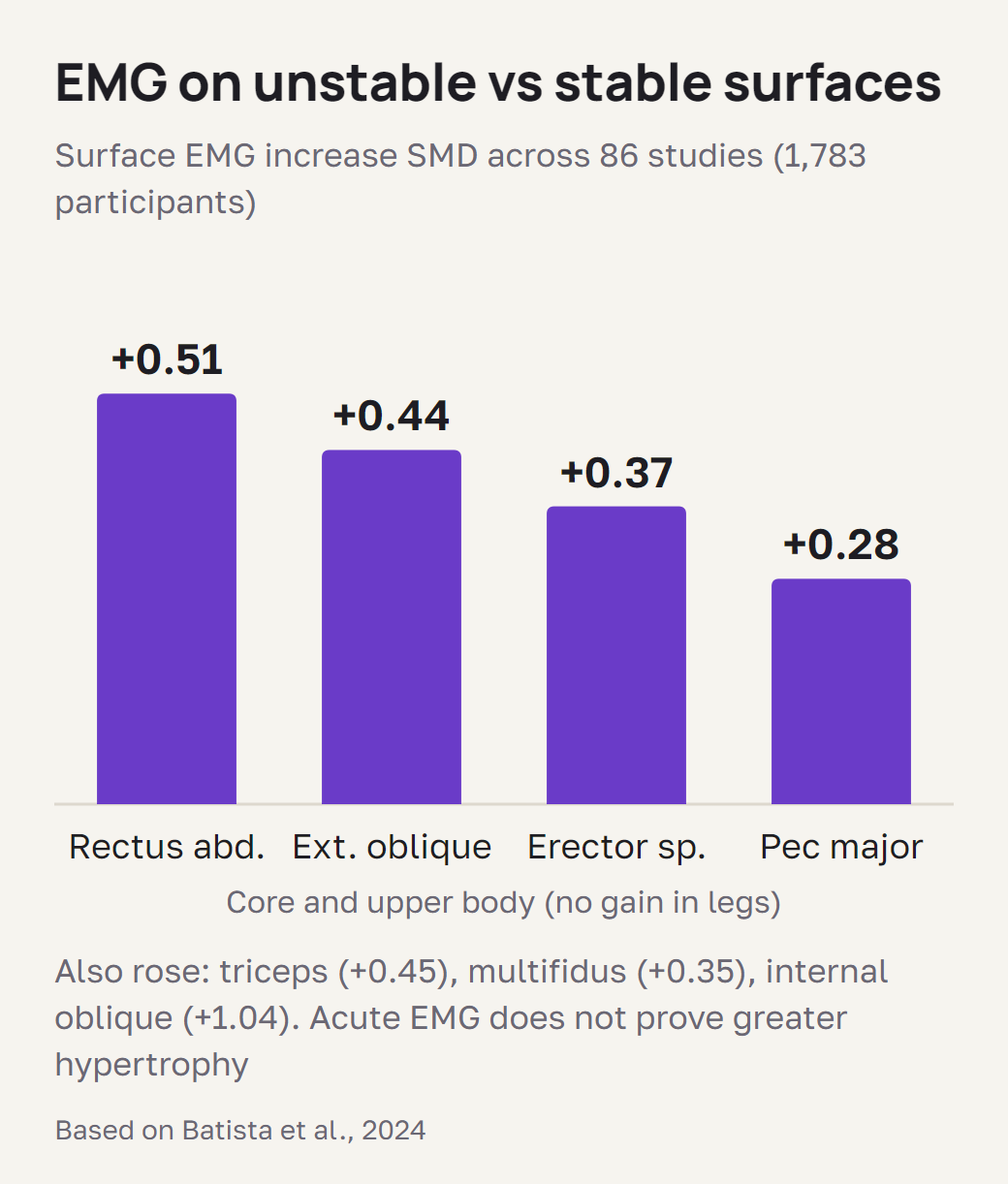
Still, this effect comes with three major limits:
- Strength, power, and speed drop. In a systematic review of 9 controlled studies in healthy adults (Marquina et al., 2021; stability balls, balance hemispheres, and suspension trainers), instability decreased strength, power, and movement speed compared with stable surfaces in most conditions. The authors noted high protocol heterogeneity (mean STROBE score 14.3); strength suffered most, although differences narrowed near one-rep maximum loads.
- Scapular stabilizers gain very little. In a meta-analysis of 33 studies (Cappato et al., 2021; 678 healthy participants), adding instability to upper-body exercises gave only a small increase in upper-trapezius activity (0.14; p = 0.04). It had no effect on middle (p = 0.10) or lower trapezius (p = 0.25), and slightly decreased serratus anterior activity (−0.21; p = 0.01).
- Surface EMG reflects muscle activity during a set, not muscle growth. Higher core EMG does not automatically translate into superior long-term hypertrophy on unstable surfaces.
High-intensity functional training (HIFT): endurance, strength, and body composition
High-intensity circuit formats (HIFT) are popular because they combine resistance and aerobic movements with short rest intervals inside one session. Here is what reviews show for HIFT and general functional training:
- HIFT in healthy people versus no training. In a multilevel meta-analysis of 17 studies (Wilke et al., 2020), HIFT produced small-to-moderate gains in endurance (effect 0.42; p = 0.03) and strength (0.60; p = 0.04), but did not improve balance (−0.10; p = 0.42). For endurance, HIFT matched moderate cardio (p = 0.75) and high-intensity interval training (HIIT; p = 0.66), and the authors found no direct comparisons of HIFT against classic strength training.
- HIFT in athletes. In a meta-analysis of 13 randomized trials (Wang et al., 2023; 478 athletes aged 10 to 24.5), HIFT improved upper- and lower-body strength, power, flexibility, and sport-specific performance (effect 0.414 to 3.351; all p < 0.05), with no significant impact on endurance or agility.
- General functional training and body composition. In a systematic review of 9 studies on broad functional training in athletes (Xiao et al., 2021; modest quality rating PEDro 3–4), training improved speed, strength, power, balance, and agility, yet across the 3 studies assessing body composition no significant improvement was found.
In short, HIFT is a practical tool for general conditioning and applied fitness when time is tight, but there is no evidence to treat it as "the best way to build muscle or burn fat."
How classic strength training differs from functional training
A common myth claims that "machines and a regular barbell are non-functional because you do not move like that in life." In reality, regular strength training is the core way to train human function—lifting, carrying, standing up, and holding posture.
According to the American College of Sports Medicine Position Stand (ACSM; Currier et al., 2026; 137 systematic reviews, over 30,000 healthy adults), regular progressive strength training compared with no exercise significantly improves strength, muscle size, power, endurance, gait speed, balance, and physical function. For physical function specifically, power training with a fast concentric phase stands out further, while equipment type and exercise complexity alone did not consistently provide an advantage.
Free weights and machines do not split into "functional" and "useless" either. In a meta-analysis of 13 studies (Haugen et al., 2023; 1,016 adults aged 18–60, blocks of 6+ weeks), direct comparisons showed no differences between free weights and machines for dynamic strength (p = 0.387), isometric strength (p = 0.660), jump height (p = 0.290), or muscle hypertrophy (−0.055; p = 0.751). Strength gains proved specific to the equipment used in training and testing.
| Criterion | Classic strength training (stable ground) | Unstable surfaces and HIFT | What studies say |
|---|---|---|---|
| Strength, power, and hypertrophy | Well-studied base (easy to control load and progression) | Lower acute strength and power on unstable surfaces; no direct HIFT vs. lifting comparisons found | Lower strength and power on unstable surfaces (Marquina, 2021); no direct HIFT vs. lifting trials (Wilke, 2020); equal effect of free weights and machines (Haugen, 2023) |
| Endurance | Improves compared with no training | Small-to-moderate gain in HIFT, comparable with cardio and HIIT | Resistance training improves endurance (ACSM; Currier, 2026); HIFT matches cardio and HIIT (Wilke, 2020) |
| Injury profile | Lowest among resistance modalities | Higher injury risk in HIFT/CrossFit than in traditional lifting | Traditional strength training was safest across 28 studies (Serafim, 2023) |
| Balance and daily function at 60+ | Improves strength and gait | Lowers fear of falling in 10–12 wk and improves TUG at 24 wk | Functional programs improve balance and TUG at 60+ (Niyazi, 2024; Doan, 2026) |
Safety is another strong argument for a stable lifting base. In a systematic review of 28 epidemiological studies (Serafim et al., 2023: 17 on HIFT/CrossFit, 3 each on powerlifting, traditional strength training, and weightlifting, 1 on strongman, and 1 mixed), injury incidence ranged from 0.21 to 18.9 per 1,000 hours, and prevalence from 10% to 82%. Traditional strength training proved the safest modality and strongman the least safe (though the authors note few highest-quality studies and uneven research depth across modalities).
Who actually needs functional training
Functional formats deliver clear benefits in three straightforward scenarios:
- Adults aged 60+ and fall prevention. In a meta-analysis of 16 randomized trials in adults 60+ (Niyazi et al., 2024), functional programs significantly improved everyday functional markers. Improvements occurred in the Barthel index (p = 0.01), gait speed (p = 0.002), cadence (p = 0.0002), step length (p < 0.0001), Berg Balance Scale (p = 0.0003), Timed Up and Go (TUG; p = 0.02), and five-times sit-to-stand (p < 0.0001), though grip strength did not change. In a review and meta-analysis of 7 randomized trials by Doan et al. (2026; 6 pooled quantitatively) in older adults, unstable lifting did not beat stable lifting for leg strength or mobility at 10–12 weeks. Yet it reduced fear of falling more at 10–12 weeks and improved TUG more at 24 weeks. More on training later in life is in Strength Training After 50.
- Court, field, and speed athletes. In athletic cohorts, HIFT and functional programs improved strength, power, speed, flexibility, and sport-specific test scores (Wang, 2023; Xiao, 2021).
- Recreational lifters who want conditioning in tight time windows. A short circuit after main lifts or on a separate day adds aerobic load and variety.
A clear boundary applies: after recent injuries or surgeries, therapeutic exercise, balance work, and return to loading are managed by a physician or rehabilitation specialist—general HIFT and unstable-surface plans are not used during early rehab.
How to combine strength and functional work sensibly: step by step
In my programs, progressive strength lifts on stable surfaces—squats, rows, presses, and unilateral lunges—always remain the base for muscle growth, strength, and everyday resilience. Functional blocks are added on top when there is a clear goal and technique does not suffer.
- Keep 70–80% of training time on stable strength lifts. Choose clear free-weight or machine exercises and log working loads (weekly structure is in Gym Workout Program, split choice in Full Body vs. Split).
- Use stable unilateral lifts instead of balancing on half-balls. Lunges, Bulgarian split squats, and single-arm rows let you train one side at a time without losing stability or working load.
- Manage progression in your main lifts with a clear rule. Raise weight only with clean form in your target rep range (see Progressive Overload).
- Place circuits (HIFT) or balance work at the end of a session or on a separate day so you perform technically demanding strength lifts without prior fatigue.
- Pick your format by a measurable goal. For strength and physique, track working loads and reps in stable lifting; for endurance and balance, add 1–2 circuit or balance blocks per week and track completion time, rounds completed, or stance hold duration.
I post exercise breakdowns on my YouTube channel @lobanov_fitness. If you want a balanced plan for your goal and gym, it can be built as a custom workout program, and if you want regular video form checks and weekly load adjustments for your schedule—through online coaching.
Sources
- Batista GA et al. Comparison of the Electromyography Activity during Exercises with Stable and Unstable Surfaces: A Systematic Review and Meta-Analysis. Sports (Basel), 2024. Article · Full text
- Marquina M et al. Effects on Strength, Power and Speed Execution Using Exercise Balls, Semi-Sphere Balance Balls and Suspension Training Devices: A Systematic Review. Int J Environ Res Public Health, 2021. Article · Full text
- Cappato de Araújo R et al. Use of unstable exercises in periscapular muscle activity: A systematic review and meta-analysis of electromyographic studies. J Bodyw Mov Ther, 2021. Article
- Doan HN et al. Comparative Effectiveness of Unstable Versus Stable Resistance Training on Lower Limb Strength, Mobility, and Fear of Falling in Older Adults: A Systematic Review and Meta-analysis of Randomized Controlled Trials. Am J Phys Med Rehabil, 2026. Article
- Niyazi A et al. The effect of functional exercise program on physical functioning in older adults aged 60 years or more: A systematic review and meta-analysis of randomized controlled trials. Geriatr Nurs, 2024. Article
- Wilke J et al. Chronic effects of high-intensity functional training on motor function: a systematic review with multilevel meta-analysis. Sci Rep, 2020. Article · Full text
- Wang X et al. Effects of high-intensity functional training on physical fitness and sport-specific performance among the athletes: A systematic review with meta-analysis. PLoS One, 2023. Article · Full text
- Xiao W et al. Effect of Functional Training on Physical Fitness Among Athletes: A Systematic Review. Front Physiol, 2021. Article · Full text
- Serafim TT et al. Which resistance training is safest to practice? A systematic review. J Orthop Surg Res, 2023. Article · Full text
- Currier BS et al. American College of Sports Medicine Position Stand. Resistance Training Prescription for Muscle Function, Hypertrophy, and Physical Performance in Healthy Adults: An Overview of Reviews. Med Sci Sports Exerc, 2026. Article · Full text
- Haugen ME et al. Effect of free-weight vs. machine-based strength training on maximal strength, hypertrophy and jump performance - a systematic review and meta-analysis. BMC Sports Sci Med Rehabil, 2023. Article · Full text