

Isometric exercises are static contractions where a muscle generates tension while the joint angle remains fixed—such as a plank, wall sit, or pause at the bottom of a squat. Research shows they build angle-specific strength, can induce hypertrophy when performed at long muscle lengths, and lower resting blood pressure.
At the same time, isometrics rarely replace full dynamic strength training, and anyone with elevated blood pressure must account for acute pressure spikes during the set itself. Below we examine the physiology and clinical evidence for muscles, tendons, and blood pressure.
What happens inside a muscle during an isometric contraction
People often say the muscle "does not change length" during isometrics. The physiology is slightly more nuanced: overall muscle–tendon unit length and joint angle stay virtually constant, yet the contractile units (sarcomeres) shorten to generate force while elastic tissues and the tendon stretch (Hall, 2022, Ch. 6; Kawakami et al., 1998).
Coaching practice distinguishes two isometric modes:
- Pushing (overcoming) isometrics (PIMA): pushing maximally into an immovable object, such as pressing a barbell into safety pins.
- Holding (yielding) isometrics (HIMA): holding an external load or body weight steady at a fixed angle (plank, wall sit, dumbbell pause).
In a 6-week within-subject RCT of 10 adults (Lum et al., 2026; 20 limbs, 70% MVC × 20 s × 4–6 reps), both variants improved isometric strength and quadriceps thickness. Pushing isometrics also improved concentric (g = 0.31) and eccentric strength (g = 0.50), whereas holding isometrics produced larger gains in quadriceps thickness (g = 0.46), rectus femoris (g = 1.44), and patellar tendon thickness (g = 0.12). Given the small sample (10 participants), these results remain preliminary but clarify each mode's role.
Do isometrics build muscle, strength, and tendon health?
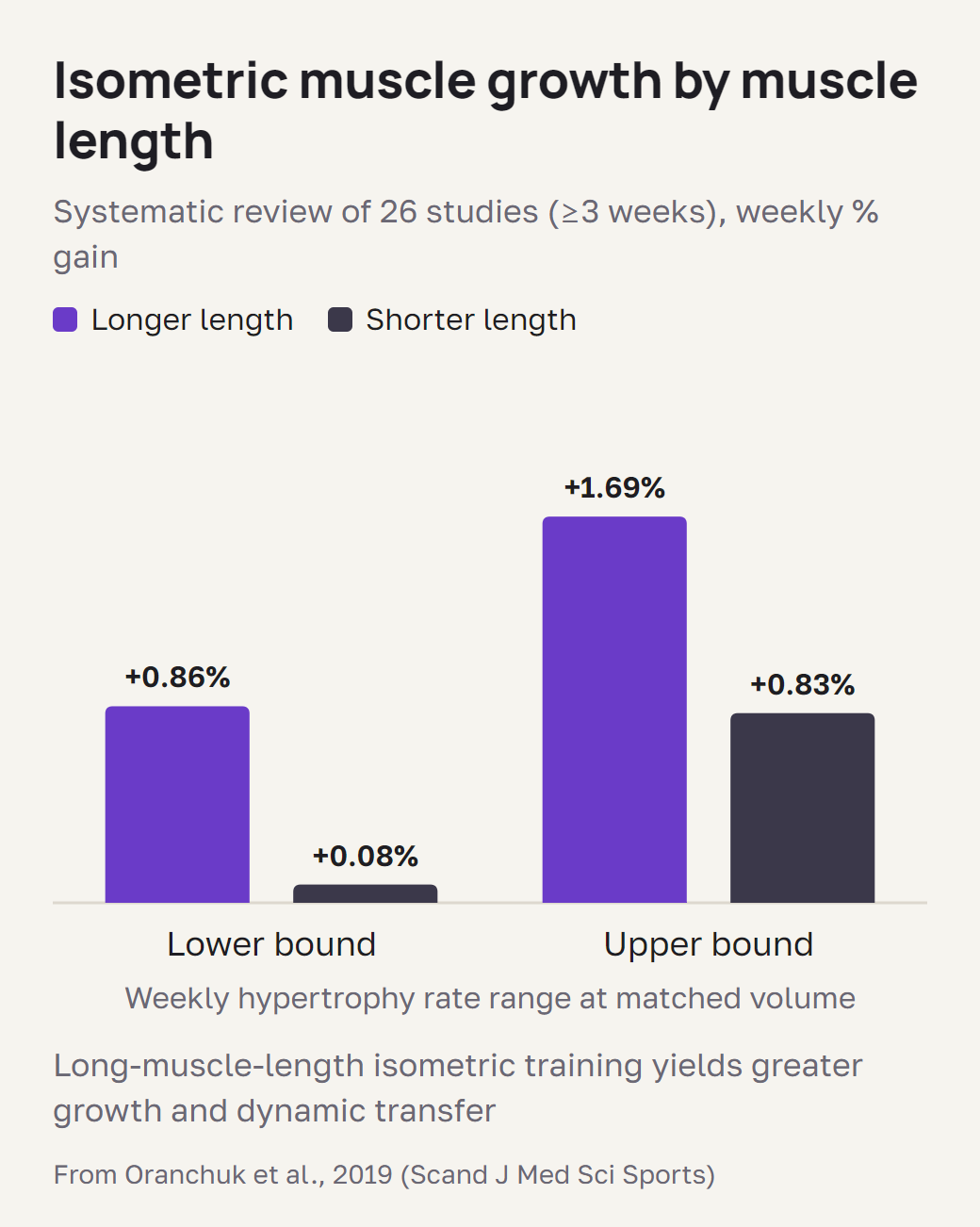
Muscle length at the chosen joint angle is the decisive variable. In a systematic review of 26 studies ≥3 weeks (Oranchuk et al., 2019), training at longer muscle lengths produced greater weekly hypertrophy—0.86–1.69%/week (ES = 0.03–0.09/wk) versus 0.08–0.83%/week at shorter lengths (ES = −0.003 to 0.07/wk)—along with superior transfer to dynamic performance. High intensity (≥70% MVC) was needed to improve tendon structure and function, while ballistic intent accelerated rate of force development gains (1.2–13.4%/wk vs. 1.01–8.13%/wk with gradual ramp-up).
Compared with dynamic strength training, a meta-analysis of 32 studies in 621 adults aged 18–45 (Ghayomzadeh et al., 2025) confirmed clear specificity. Isometric training increased combined isometric and isokinetic strength over controls (SMD = 0.65; p < 0.0001) and outperformed dynamic training specifically on isometric strength tests (SMD = 0.43; p < 0.0001), with no difference in dynamic isokinetic strength (SMD = −0.20; p = 0.24).
A practical review (Lum et al., 2019) notes that isometrics create less overall fatigue than high-volume dynamic sets and outlines evidence-based targets:
- For hypertrophy: 70–75% MVC, 3–30 s per rep, >80–150 s total tension per session over >36 sessions.
- For maximal strength: 80–100% MVC, 1–5 s per rep, 30–90 s total per session across multiple angles or at the sticking point.
Dynamic training through a full range of motion remains the foundation for all-around growth, while isometrics serve as a targeted supplement.
Isometric exercises and blood pressure: benefits and precautions
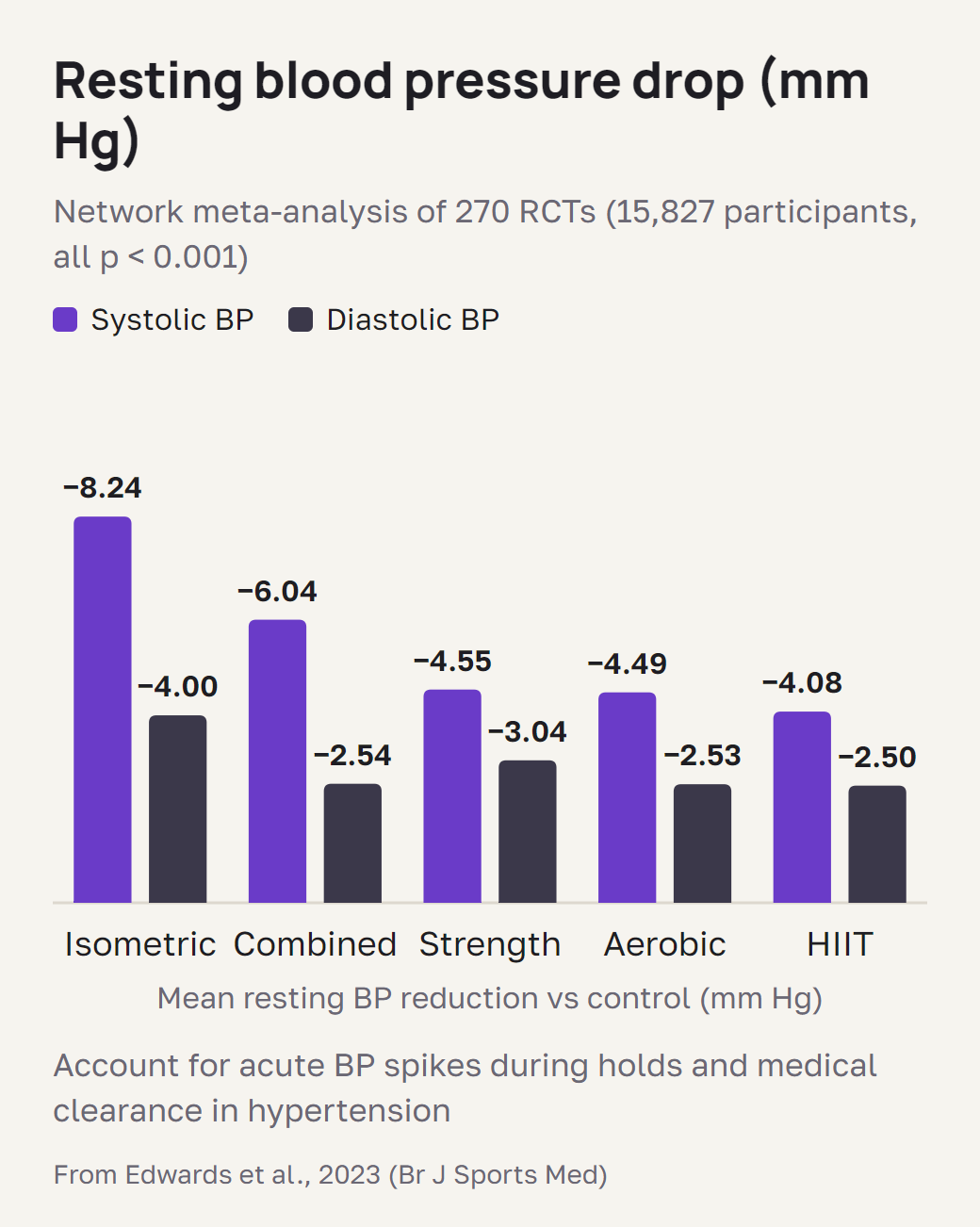
Cardiology research has highlighted isometric training for resting blood pressure. In a network meta-analysis of 270 RCTs totaling 15,827 participants (Edwards et al., 2023), programs ≥2 weeks lowered resting blood pressure across all modes, with isometric training showing the largest average reduction: −8.24/−4.00 mm Hg (p < 0.001; SUCRA 98.3% for systolic BP), ahead of combined (−6.04/−2.54), dynamic resistance (−4.55/−3.04), aerobic (−4.49/−2.53), and HIIT (−4.08/−2.50). Among specific protocols, isometric wall squats ranked highest for systolic BP (90.4%).
A meta-analysis of 12 studies in 415 adults with hypertension (Baffour-Awuah et al., 2023) confirmed reductions in office BP (−7.47/−3.17 mm Hg, p < 0.01) and nighttime BP, though 24-hour ambulatory averages did not change significantly. Which modality ranks first remains debated: a newer Bayesian network meta-analysis of 105 RCTs in adults with prehypertension and hypertension (Xin et al., 2026) ranked combined training (−12.05/−6.20 mm Hg) and HIIT (−10.97/−6.42) highest, with smaller effects for standalone isometrics and aerobic training.
The flip side is the acute blood pressure spike during the hold itself. In a systematic review of 102 studies with a 7-study meta-analysis (Coneglian et al., 2023), large-muscle isometrics spiked BP markedly more than handgrip holds: bilateral leg extension added +9.8/+7.9 mm Hg over handgrip (p = 0.017 and p = 0.022), while isometric deadlift added +26.8/+12.4 mm Hg over handgrip (p ≤ 0.001). Spikes were greater in men, older adults, hypertension, and higher intensities. Anyone with resting BP ≥160/100 mm Hg or uncontrolled hypertension ≥140/90 mm Hg needs medical clearance before starting static holds—and should always breathe steadily without breath-holding.
Do isometrics relieve tendon pain?
Despite popular claims that static holds instantly "turn off" tendon pain, modern reviews are more restrained.
In a network meta-analysis of 37 RCTs on patellar tendinopathy (Challoumas et al., 2021), pairwise comparison of 3 trials showed no advantage of isometrics over isotonic loading for immediate pain relief (MD = −1.03, p = 0.19). Progressive eccentric loading remained the first-line recommendation, while evidence for isometrics and slow resistance exercise was deemed inadequate. A systematic review of 13 RCTs in 336 patients across tendinopathies (Soliman et al., 2026) found statistically significant improvements in pain and function in only 3 of 13 trials (10 were low quality). Isometrics are well tolerated early on and may provide short-term relief, but do not outperform progressive dynamic loading long term.
How to use isometrics in the gym and at home
I am Demid Lobanov, a fitness coach and training methodologist. In custom training programs and online coaching, I keep dynamic strength training as the base and use isometrics for four specific jobs:
| Purpose | Practical example | Dosage |
|---|---|---|
| Neutral trunk control | Forearm and high plank, side plank | 3 sets × 20–45 s with steady breathing |
| Overcoming a sticking point | 2–3 s pause at the bottom of a squat, press, or RDL | Inside regular 3–4 sets × 6–10 reps |
| Limited joint range in remission | Comfortable angle hold on a machine or wall | 3–4 sets × 15–30 s pain-free |
| Endurance or BP support | Moderate wall sit or handgrip (with physician clearance if hypertensive) | 3–4 sets × 30–60 s, 1–2 min rest, steady breathing |
I also post core and joint-friendly technique breakdowns on YouTube at @lobanov_fitness.
Step-by-step guide to adding isometrics
- Define the goal. Keep dynamic exercises with progressive overload as your muscle-building base; use isometrics for sticking points, trunk control, or rehab.
- Choose longer working muscle lengths. Slightly stretched positions yield superior strength and hypertrophy transfer compared with fully shortened angles (Oranchuk, 2019).
- Control your breathing. Never hold your breath at peak tension—steady inhales and smooth exhales limit unnecessary blood pressure spikes.
- Skip multi-minute plank records. Stop a set the moment the lower back sags; three clean 30–40 s holds beat one sloppy 3-minute hold.
- Respect medical limits. With uncontrolled hypertension, cardiovascular disease, or acute joint/tendon pain, consult a physician first.
Frequently asked questions
Can you lose weight with isometric exercises alone?
Static holds burn relatively few calories on their own. Fat loss is driven by an overall calorie deficit and daily activity (see how to lose weight).
How long should you hold an isometric exercise?
Trunk stability and endurance holds typically run 20–45 seconds; strength pauses inside compound lifts take 2–3 seconds; maximal overcoming pushes run 1–5 seconds (Lum, 2019).
Are isometric exercises dangerous with high blood pressure?
Long-term moderate isometrics help reduce resting blood pressure (Edwards, 2023), yet heavy large-muscle holds spike blood pressure acutely during the set (Coneglian, 2023). Hypertensive individuals should get medical clearance, start lightly, and breathe continuously.
Wall sit vs. squats: which is better?
For leg and glute strength and hypertrophy, full-range squats are superior. Wall sits work well for quadriceps endurance or a joint-friendly no-equipment option at home.
Sources
- Hall SJ. Basic Biomechanics, 9th ed. McGraw Hill, 2022. Chapter 6 – The Biomechanics of Human Skeletal Muscle.
- Kawakami Y et al. Architectural and functional features of human triceps surae muscles during contraction. J Appl Physiol (1985), 1998. Article
- Oranchuk DJ et al. Isometric training and long-term adaptations: Effects of muscle length, intensity, and intent: A systematic review. Scand J Med Sci Sports, 2019. Article
- Ghayomzadeh M et al. Effects of isometric vs. dynamic resistance training on isometric and isokinetic muscular strength: A systematic review with meta-analysis. J Sci Med Sport, 2025. Article
- Lum D et al. Brief Review: Effects of Isometric Strength Training on Strength and Dynamic Performance. Int J Sports Med, 2019. Article
- Lum D et al. Comparing the Effects of Push and Hold Isometric Training on Strength and Musculotendinous Adaptations: A Within-Subject Randomized Controlled Trial. J Strength Cond Res, 2026. Article
- Edwards JJ et al. Exercise training and resting blood pressure: a large-scale pairwise and network meta-analysis of randomised controlled trials. Br J Sports Med, 2023. Article
- Baffour-Awuah B et al. Isometric Resistance Training to Manage Hypertension: Systematic Review and Meta-analysis. Curr Hypertens Rep, 2023. Article · Full text
- Coneglian JC et al. Acute Blood Pressure Response to Different Types of Isometric Exercise: A Systematic Review with Meta-Analysis. Rev Cardiovasc Med, 2023. Article · Full text
- Xin X et al. Optimal Exercise Modalities and Dosages for Blood Pressure Reduction in Adults With Prehypertension and Established Hypertension: A Network Meta-Analysis and Dose-Response Relationship Study. J Am Heart Assoc, 2026. Article · Full text
- Challoumas D et al. Management of patellar tendinopathy: a systematic review and network meta-analysis of randomised studies. BMJ Open Sport Exerc Med, 2021. Article · Full text
- Soliman EFF et al. Isometric Exercises for Tendinopathies: A Systematic Literature Review. Clin Ther, 2026. Article