

When knees ache during squats, lunges, or going down stairs, stopping training completely falls short of progressive strength work. For patellofemoral pain (pain around the kneecap) and knee osteoarthritis, structured resistance exercise is considered first-line therapy. The key is separating red flags that need a physician's evaluation from overload whose symptoms can be calmed through smart angle and volume adjustments.
I am Demid Lobanov, a fitness coach and strength-training educator. When working with clients, I screen for red flags first and only then adjust range of motion and exercise selection in an individual consultation or online coaching. Below is what major clinical reviews show about training with knee pain.
When to see a doctor first and pause lower-body lifting
A coach does not diagnose injuries or treat acute joint trauma. Pause lower-body strength training and consult an orthopedic specialist or sports physician if you notice:
- sharp pain after a fall, knee twist, pop, or direct impact;
- visible joint swelling, redness, or local warmth;
- mechanical locking where the knee cannot fully flex or extend;
- instability or a sensation that the knee gives way under load;
- pain at rest or at night unrelated to exercise.
When red flags are absent, a physician can confirm non-traumatic patellofemoral overload or age-related cartilage changes. Medical assessment is still useful here, while regular progressive exercise remains the core of recovery.
Why strength exercises help painful knees more than rest
A clinical best-practice guide synthesizing 65 high-quality randomized trials covering 3,796 participants (Neal et al., 2024) established knee-targeted exercise therapy (with or without hip-targeted exercises) paired with patient education as first-line care for patellofemoral pain. A Cochrane review of 31 trials covering 1,690 participants (van der Heijden et al., 2015) pointed the same way: in short-term comparisons versus controls (up to 3 months), exercise lowered pain during activity by 1.46 points on a 0–10 scale (5 trials, 375 people) and improved estimated function by 12.2 points on the 100-point AKPS scale (7 trials, 483 people). Evidence certainty was rated very low due to design limitations, quasi-randomization, lack of blinding, and small samples.
Knee osteoarthritis follows a similar pattern. A dose-response network meta-analysis of 46 randomized trials covering 3,463 patients (Yang et al., 2025) showed that consistent moderate-intensity resistance training around 43–47% of one-repetition maximum (1RM) meaningfully reduces pain and improves daily function. Another network meta-analysis (Jiang et al., 2024) confirmed benefits across all three modes—isometric, isotonic, and isokinetic—compared with standard physiotherapy.
Risk-factor research also highlights muscle capacity. In a meta-analysis of 18 prospective studies covering 4,818 participants (483 developed patellofemoral pain; Neal et al., 2019), age, weight, BMI, Q-angle, and hip weakness did not predict first-onset pain, whereas quadriceps weakness in military recruits significantly raised risk (moderate certainty).
Why strengthening the hip alongside the knee works better
A common gym mistake is trying to fix a sore knee exclusively with isolated quadriceps work. Three meta-analyses show that pairing hip and knee strengthening delivers stronger pain relief.
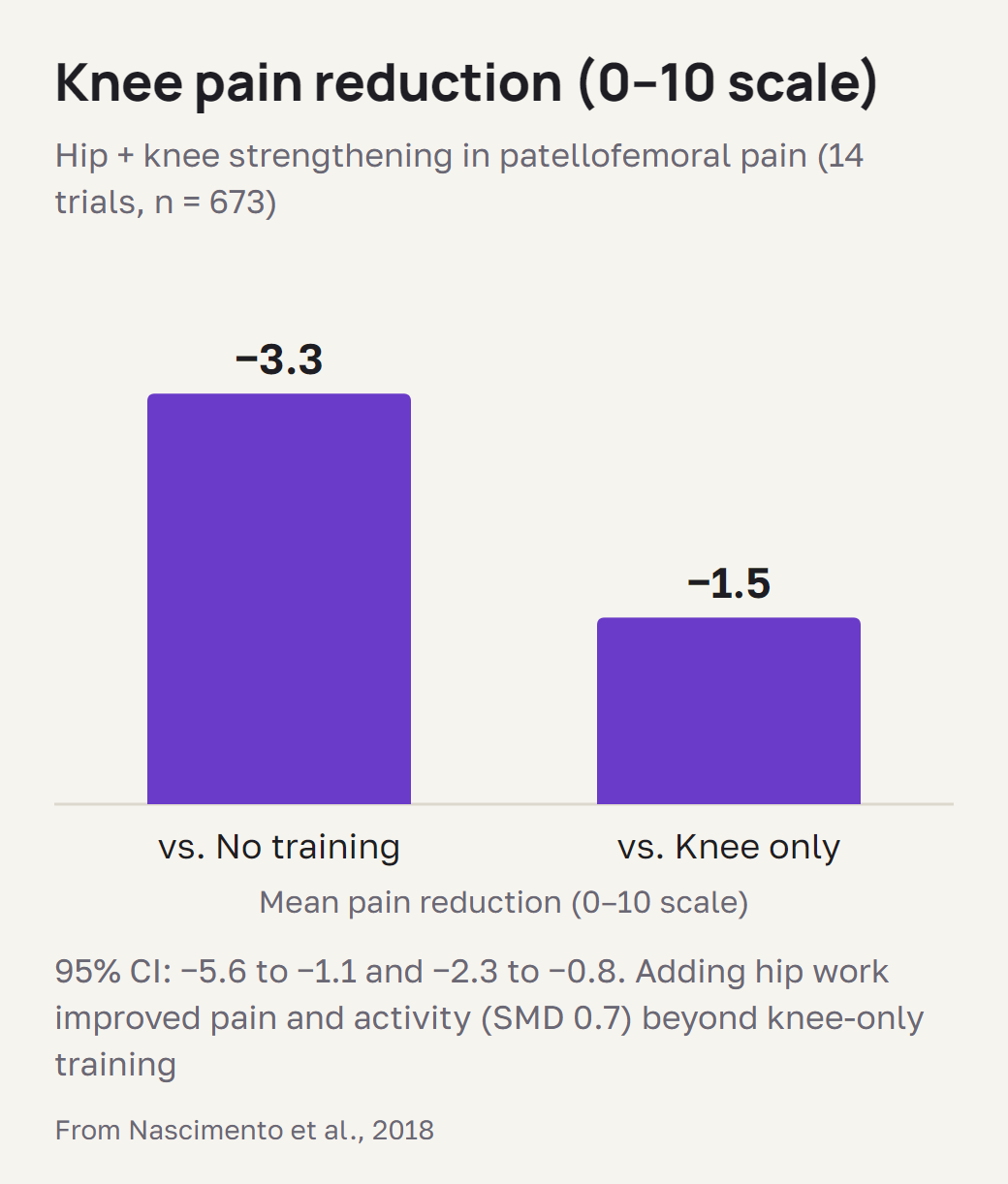
In a meta-analysis of 14 trials covering 673 participants (Nascimento et al., 2018), hip-plus-knee strengthening lowered pain by 3.3 points versus no exercise. Directly compared with knee-only exercises, adding hip and glute work reduced pain by an extra 1.5 points and increased activity more—with gains maintained beyond the program. A meta-analysis of 6 randomized trials covering 241 patients (96.3% women; Halabi et al., 2025) confirmed superior pain and function outcomes for combined strengthening despite high heterogeneity. Notably, in both reviews symptoms and activity improved even without statistically significant gains in measured maximal muscle strength. In the 2015 Cochrane review, hip-plus-knee training beat knee-only training by 2.20 points for short-term activity pain (3 trials, 104 people; very low certainty), though superiority was not confirmed for function or recovery.
In practice, this ties to movement control: strong glutes and hip abductors help steady the femur, limit inward knee collapse, and keep joint loading predictable.
Can you train through mild discomfort?
Fear of any sensation often keeps people away from useful loading. A systematic review of 7 randomized trials covering 385 people with chronic musculoskeletal pain (Smith et al., 2017) compared protocols allowing controlled pain during exercise against strictly pain-free protocols. Short term, allowing controlled discomfort produced a small statistical edge for pain relief (moderate certainty), with no difference medium or long term and no difference in function or disability at any time point.
In my exercise library and coaching practice, we use a simple traffic-light rule:
| Discomfort during a set (0–10) | Next-day response | How to adjust load |
|---|---|---|
| 0–3 (mild, tolerable) | No flare-up and no extra morning stiffness | Keep weight and volume, progress gradually |
| 4–5 (overload signal) | Symptoms settle within 24 hours | Reduce weight, trim depth, or adjust angle back to 0–3 |
| Above 5 or sharp twinge | Knee aches worse the next day | Remove the exercise |
Which exercises fit better and what to limit temporarily
During a patellofemoral flare-up or osteoarthritis irritation, the goal is keeping strong hip and glute work while trimming peak patellofemoral compression and high-impact stress.
| Target | Gentler options | What to limit temporarily |
|---|---|---|
| Glutes and hamstrings | Glute bridge, Romanian deadlift, 45° back extension, machine knee flexion (leg curl) | Box jumps, plyometrics, hard-surface running during flare-ups |
| Hip and pelvis stability | Machine or cable hip abduction, banded lateral walks | Fast deep forward lunges with a bottom bounce |
| Quadriceps | Comfortable-depth squats, reverse lunges, high-foot leg press, comfortable-angle isometrics | Deep bouncing squats, full-range machine knee extension through sharp pain |
If mid-range machine knee extension irritates the joint, trim the range to a comfortable arc or swap temporarily to a leg press with feet set slightly higher on the sled for gentler knee flexion. For squat mechanics and knee travel, see Can Knees Go Past Toes in a Squat?.
Do knee sleeves and taping replace strength training?
A meta-analysis of 45 randomized trials covering 2,023 participants (25 pooled; Souto et al., 2024) tested popular add-ons layered onto exercise for patellofemoral pain. Taping, knee bracing, vibration platforms, and EMG biofeedback added no extra pain relief or functional improvement over exercise alone (very low certainty). Short-term added reductions in subjective pain appeared for neuromuscular electrical stimulation and monopolar dielectric diathermy, though certainty remained very low as well.
You can still wear a sleeve for personal comfort, yet the review confirms it does not replace progressive quadriceps and glute strengthening.
How to rebuild leg training safely: step by step
- Screen out red flags (acute injury, swelling, redness, local warmth, locking, giving way, rest or night pain)—any of these require a doctor's exam first.
- During a flare-up, pause impact work and deep abrupt loaded knee bends, sticking to movements at 3/10 discomfort or lower.
- Build your base around glutes, hip abductors, and hamstrings—in my practice, these help trim peak patellofemoral compression while keeping discomfort under 3/10.
- Reintroduce quadriceps loading with controlled tempo, comfortable squat or leg-press depth, and 2–3 weekly strength sessions.
- Check your response both during the set and the next morning: when pain stays calm, expand range of motion first and add load second.
If you want your program, lifting technique videos, and joint constraints reviewed together, we can cover them in an individual consultation or inside online coaching.
I also publish exercise and technique breakdowns on my YouTube channel @lobanov_fitness.
Sources
- Neal BS et al. Best practice guide for patellofemoral pain based on synthesis of a systematic review, the patient voice and expert clinical reasoning. Br J Sports Med, 2024. Article · PubMed
- Nascimento LR et al. Hip and Knee Strengthening Is More Effective Than Knee Strengthening Alone for Reducing Pain and Improving Activity in Individuals With Patellofemoral Pain: A Systematic Review With Meta-analysis. J Orthop Sports Phys Ther, 2018. Article · PubMed
- Halabi MH et al. The Efficacy of Hip and Knee Muscles Strengthening Versus Knee Muscle Strengthening Alone in Managing Patellofemoral Pain Syndrome: A Systematic Review and Meta-Analysis. Musculoskeletal Care, 2025. Article · PubMed
- van der Heijden RA et al. Exercise for treating patellofemoral pain syndrome. Cochrane Database Syst Rev, 2015. Article · Full text
- Smith BE et al. Should exercises be painful in the management of chronic musculoskeletal pain? A systematic review and meta-analysis. Br J Sports Med, 2017. Article · Full text
- Yang Y et al. Optimal resistance training strategies for knee osteoarthritis symptom relief: a systematic review and network meta-analysis. BMC Musculoskelet Disord, 2025. Article · Full text
- Jiang Y et al. Effects of three types of resistance training on knee osteoarthritis: A systematic review and network meta-analysis. PLoS One, 2024. Article · Full text
- Neal BS et al. Risk factors for patellofemoral pain: a systematic review and meta-analysis. Br J Sports Med, 2019. Article · PubMed
- Souto LR et al. Are adjunct treatments effective in improving pain and function when added to exercise therapy in people with patellofemoral pain? A systematic review with meta-analysis and appraisal of the quality of interventions. Br J Sports Med, 2024. Article · PubMed