
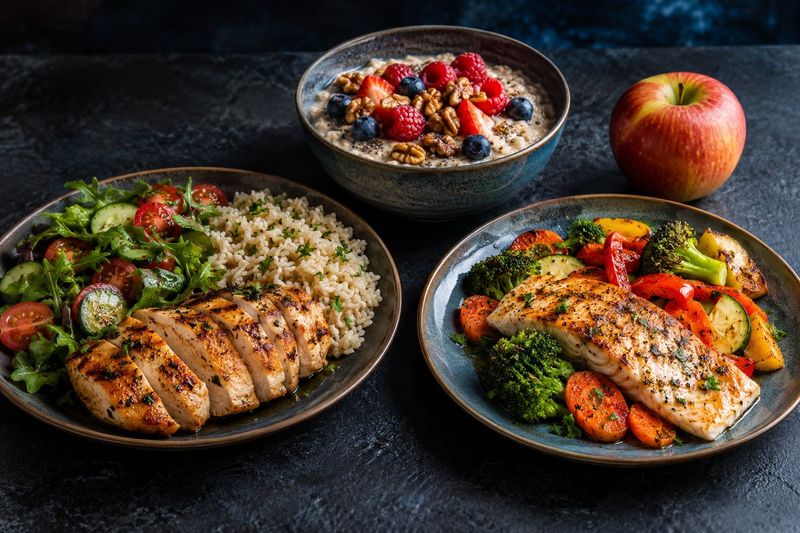
1,500 kcal a day is a weight-loss target for, say, a 30-year-old woman who is 165 cm tall, weighs 65 kg, and is lightly active: with a 20% deficit, it comes to 1,507 kcal. A deficit means you get less energy from food than you burn.
I'm Demid Lobanov, a fitness coach. The sample day below was put together by a program with a database of dishes, which I use to build meal plans for my clients. It has four meals, 1,531 kcal, 112 g protein, 62 g fat, 116 g carbs, and 27 g fiber. You can swap a dish without recalculating the day; I'll show you how below.
Who a 1,500-calorie meal plan is for
1,500 kcal isn't the right target for everyone. Your target is your basal metabolic rate × activity factor minus the deficit. Basal metabolic rate is the energy your body uses to function at rest. The activity factor accounts for how much you move.
For 30-year-old women who are 165 cm tall, lightly active (1.375), with a 20% deficit:
| Weight | Basal metabolic rate | Expenditure at 1.375 | Target with a 20% deficit |
|---|---|---|---|
| 55 kg | 1,270 kcal | 1,747 kcal | 1,397 kcal |
| 65 kg | 1,370 kcal | 1,884 kcal | 1,507 kcal |
| 75 kg | 1,470 kcal | 2,022 kcal | 1,617 kcal |
| 85 kg | 1,570 kcal | 2,159 kcal | 1,727 kcal |
1,500 kcal is close to the target for a woman weighing about 65 kg. At 55 kg, it's a 14% deficit; at 75 kg, already 26%; at 85 kg, about 30%.
For a man, 1,500 kcal is almost always too little. In the article How Many Calories You Need per Day, a 35-year-old man who is 180 cm tall and weighs 85 kg, with an activity factor of 1.55, has a target of 2,238 kcal including the deficit.
Why 1,200 calories is usually too little
For the woman in the example, 1,200 kcal is below her basal metabolic rate of 1,370 kcal. A 30-year-old woman who is 165 cm tall has a basal metabolic rate above 1,200 kcal at any weight from 48 kg up. In my algorithm, the calorie target never drops below basal metabolic rate: that rate of weight loss is unrealistic. At 1,200 kcal, the deficit is 36% of expenditure.
According to my algorithm, this woman's target is 117 g protein and 65 g fat. The sample day has slightly less, 112 and 62 g: a day can differ from the target by up to 5 g for protein and up to 10% for fat. If you keep the same protein and fat targets at 1,200 kcal, only 37 g is left for carbs, which is keto diet territory, meaning a very low-carb way of eating. To keep at least 95 g of carbs, protein would have to drop to 1.6 g per kg and fat to 45 g, which is below 1.0 g per kg, the lower limit of the fat target in my algorithm.
If your period is late while you're in a calorie deficit, that's a common sign of energy deficiency: raise your calories, and see a gynecologist about the late period. In a 2023 expert consensus statement, the International Olympic Committee describes the harm energy deficiency does to athletes' health and performance.
1,500-calorie meal plan: a sample day
Weights are given for raw foods, with grains weighed dry. Carbs are listed without fiber, and calories are calculated as follows: protein and carbs at 4 kcal per gram, fat at 9, fiber at 2. My algorithm calculates the target without fiber, so the calories from protein, fat, and carbs in the meal plan come in slightly below the target: fiber supplies about 55 kcal.
| What to eat | Kcal | Protein, fat, carbs |
|---|---|---|
| Breakfast. Oatmeal made with water, with apple and almonds: rolled oats 39 g, apple 78 g, almonds 10 g, 5% fat cottage cheese 78 g | 338 | 20 / 11 / 35 g |
| Lunch. Chicken breast with buckwheat and vegetable salad: chicken breast 135 g, buckwheat 52 g, cucumber 75 g, tomato 75 g, olive oil 13 g | 469 | 38 / 18 / 34 g |
| Snack. Dates with peanut butter: dates 39 g, peanut butter 13 g, peanuts 10 g | 256 | 6 / 12 / 30 g |
| Dinner. Cottage cheese with berries and flaxseed: 5% fat cottage cheese 250 g, currants 125 g, flaxseed 19 g | 468 | 48 / 21 / 17 g |
| Total | 1,531 | 112 / 62 / 116 g |
This meal plan has 27 g of fiber, which is above the World Health Organization (WHO) benchmark of 25 g.
You can have sweets on 1,500 kcal too, as long as you stay within your calories. WHO advises limiting free sugars. These are sugars added to food and drinks, plus the sugars found in honey, syrups, juices, and juice concentrates. They should make up less than 10% of calories, which at 1,507 kcal is about 38 g.
How to swap a dish in the meal plan
Any meal can be replaced with a dish from the same group: breakfast with a breakfast, lunch with a lunch. For the portions listed, these differences from the original dish are acceptable: calories ±5% but no more than 40 kcal, protein and fat ±5 g, carbs ±10 g.
For example, the lunch from the meal plan, 469 kcal and 38 g protein, can be replaced with a homemade shawarma wrapped in lavash. You'll need: lavash 64 g, chicken breast 128 g, white cabbage 64 g, tomato 64 g, cucumber 48 g, 67% fat mayonnaise 12 g, olive oil 5 g. That's 470 kcal and 36 g protein, within the acceptable range.
How to adjust the day's meal plan to your target
Keep the amount of protein the same and change the portions of sides and oil: 30 g dry buckwheat is 99 kcal, 30 g rolled oats is 109 kcal, 40 g whole-grain bread is 98 kcal, 10 g olive oil is 90 kcal. If your target is higher, increase the portions; if it's lower, decrease them.
Example: with a 1,800 kcal target, this meal plan is about 270 kcal short. Add 30 g buckwheat to lunch, 10 g oil to the salad, and 40 g whole-grain bread to dinner: that's 287 kcal. The day's total comes to 1,818 kcal.
Don't set your fat target below 1.0 g per kg or below 45 g for a woman, and don't set your calories below your basal metabolic rate. The limit applies to the target: on any given day, fat can be up to 10% below the target.
How to build a weekly meal plan from one day
- Repeat breakfast two days in a row, and cook lunch for two days at once.
- Change dinner every day.
- Bring the same dish back no sooner than 7 days after the last day it was in the meal plan: for breakfast and lunch, count from the second of the two consecutive days.
- Choose at least three different dishes for each meal: people fall off their diet more often from monotony than from calories.
A sample weekly meal plan is in the article Weekly Meal Plan for Weight Loss. The full calculation process is in the article Weight Loss Diet Plan.
How to tell if 1,500 calories is right for you
Weigh yourself every morning and calculate your average weight for each week. After 14 days, compare the average weights of the two consecutive weeks. Expected weekly weight loss is calculated with the rule “1 kg of fat is about 7,700 kcal”: daily deficit × 7 ÷ 7,700. For the woman in the example, (1,884 − 1,507) × 7 ÷ 7,700 ≈ 0.34 kg per week.
If your weight dropped by less than half the expected amount (for the woman in the example, by less than 0.17 kg) and you stuck to the plan, cut 5–10 g of fat from your target. Don't set your fat target below 1.0 g per kg and 45 g for a woman. If it's already at that limit, as it is for the woman in the example, cut about 90 kcal from carbs.
If you had your period during the second week and your weight barely changed, don't change your target; watch your weight for another week.
If your weight is dropping faster than 1.5% a week, raise your calories.
If you have diabetes or kidney or liver disease, are pregnant or breastfeeding, or have a stomach or bowel condition or an eating disorder, plan your diet together with a doctor. An eating disorder is a disturbance in your relationship with food and in your eating habits that harms your health.
I post exercise breakdowns on my YouTube channel @lobanov_fitness.
Sources
- Mifflin MD et al. A new predictive equation for resting energy expenditure in healthy individuals. Am J Clin Nutr, 1990. Article
- Bueno NB et al. Very-low-carbohydrate ketogenic diet v. low-fat diet for long-term weight loss: a meta-analysis of randomised controlled trials. Br J Nutr, 2013. Article
- Mountjoy M et al. 2023 International Olympic Committee's (IOC) consensus statement on Relative Energy Deficiency in Sport (REDs). Br J Sports Med, 2023. Article
- World Health Organization. Healthy diet: fact sheet, 2026. WHO fact sheet
- World Health Organization. Carbohydrate intake for adults and children: WHO guideline, 2023. WHO guideline · WHO news release




