
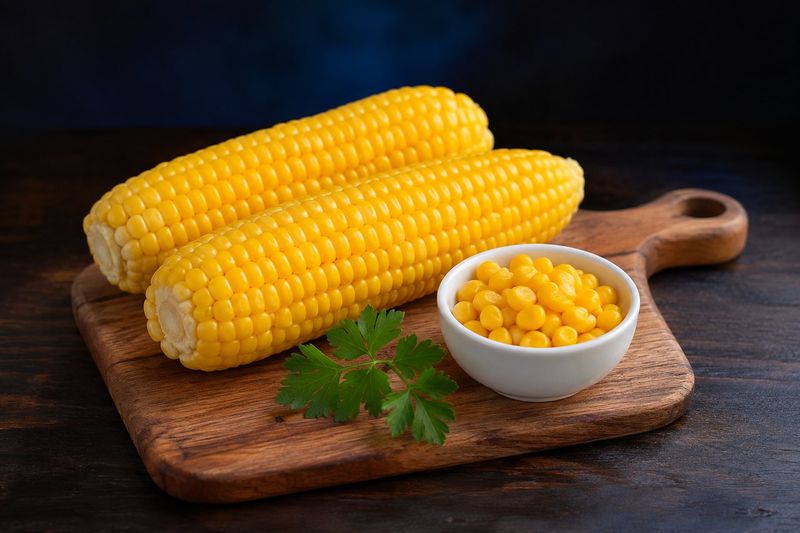
You can eat corn while losing weight, but calorie-wise it's more of a starchy side than a light vegetable. Boiled corn has about 106 kcal per 100 g, and drained canned corn about 73 kcal. That's 3 or more times as much as green cabbage. Corn works for weight loss if it replaces part of the rice, potatoes, or bread in the same meal.
I'm Demid Lobanov, a fitness coach. In the recipe database I use to build meal plans for clients, corn appears in 6 of 260 dishes. These are salads with chicken, chickpeas, and beans, rice with turkey, rice with tuna and corn, and polenta, a porridge made from cornmeal.
Calories in corn
Corn is a starchy vegetable, like potatoes and peas. In terms of calories, it's much closer to starchy sides than to cabbage and cucumbers.
| Food, 100 g | Kcal | Protein, g | Fat, g | Carbs, g |
|---|---|---|---|---|
| Boiled corn | 106 | 3.4 | 1.5 | 18.6 |
| Canned corn, drained | 73 | 2.3 | 1.2 | 12.3 |
| Green cabbage | 24 | 1.3 | 0.1 | 3.3 |
| Cornmeal, dry | 338 | 8.3 | 1.2 | 71 |
The data on canned corn, cabbage, and cornmeal come from my food database. The composition is taken from USDA and the tables of the Federal Research Center of Nutrition and Biotechnology (Russia), and calories are calculated using the Russian formula. The data on boiled corn come from USDA, with calories calculated using the same formula. USDA itself lists 96 kcal because it calculates calories differently. The carbs in the table are digestible carbs, excluding fiber.
Is corn a vegetable or a starchy side?
Calorie-wise, it's a starchy side. The 2015 observational study by Bertoia and colleagues included 133,468 people in the US, mostly women working in healthcare. Follow-up lasted up to 24 years. Each additional daily serving of corn was associated with 0.93 kg of weight gain over 4 years, with the estimate ranging from 0.4 to 1.4 kg. For potatoes the association was weaker, 0.34 kg per serving, and for peas it was 0.51 kg. For non-starchy vegetables, such as cauliflower, the association was inverse.
In 2023, Wan and colleagues analyzed data from the same cohorts. Eating more starchy vegetables (peas, corn, and potatoes) was associated with greater weight gain, and more so in people with excess weight. Replacing them with the same serving of non-starchy vegetables, fruits, and whole grains was associated with less weight gain.
These are observational studies: they show an association but don't prove that corn causes weight gain. The practical takeaway is simple. Corn goes in place of part of your grains, potatoes, or bread rather than being added to your plate "as a vegetable." It's better to fill out your plate with non-starchy vegetables.
Glycemic index of corn
According to the 2008 international tables by Atkinson and colleagues, the GI of sweet corn is 52, while boiled potatoes in the same tables have a GI of 78. The glycemic index shows how a food containing carbohydrates affects blood glucose. For 100 g of boiled corn, the glycemic load, meaning the effect of a specific serving on blood glucose, is about 10. That amount contains about 19 g of digestible carbs.
When you're losing weight, the calories in a serving matter more than its GI. More on what GI shows in the article Fast Carbs. If you have diabetes, work out the amount of corn and other starchy sides together with your doctor.
Boiled corn for weight loss
You can eat boiled corn as long as you count it in your daily calories. Calories are calculated based on the weight of the kernels. Butter on the cob counts too: according to my food database, 10 g of butter has about 75 kcal.
Canned corn for weight loss
You can eat canned corn: about 73 kcal per 100 g, drained. It's best to drain the liquid from the can, since the calories in the database are calculated for the kernels without it. In my dishes, a serving usually contains 60–100 g of canned corn, which is 44–73 kcal.
For example, the dinner "salad with chickpeas, corn, and egg" has 528 kcal and 30.1 g of protein, and the dinner "rice with tuna, corn, and cucumber" has 610 kcal and 39.9 g of protein.
How much corn can you eat while losing weight?
There's no set amount: it depends on your daily calories. A handy guideline is what I use in my dishes: 60–100 g of canned kernels per meal, in place of part of the starchy side.
Can you eat corn at night?
Yes, if it fits into your daily calories: when calories are the same, meal timing has almost no effect on weight. In the evening, corn is the same starchy side as it is during the day. More in the article Can You Eat at Night?
Corn for weight loss: step by step
- Count corn as a starchy side: it replaces part of your rice, potatoes, or bread.
- Weigh the kernels: boiled corn has about 106 kcal per 100 g, canned corn about 73 kcal.
- Drain the liquid from the can.
- Count the butter on boiled corn separately: 10 g of butter is about 75 kcal.
- If you have diabetes, work out the amount of corn together with your doctor.
- After two weeks, compare your average weight for the week with your average for the previous week. If your weight isn't going down, cut back on portions of high-calorie foods.
I post nutrition and training breakdowns on my YouTube channel @lobanov_fitness.
Sources
- Bertoia ML et al. Changes in Intake of Fruits and Vegetables and Weight Change in United States Men and Women Followed for Up to 24 Years: Analysis from Three Prospective Cohort Studies. PLoS Med, 2015. Article · Full text
- Atkinson FS et al. International tables of glycemic index and glycemic load values: 2008. Diabetes Care, 2008. Article · Full text
- Wan Y et al. Association between changes in carbohydrate intake and long term weight changes: prospective cohort study. BMJ, 2023. Article · Full text
- USDA FoodData Central: Corn, sweet, yellow, cooked, boiled, drained, without salt (169999); Corn, sweet, yellow, canned, whole kernel, drained solids (169214); Cabbage, raw (169975). Website