
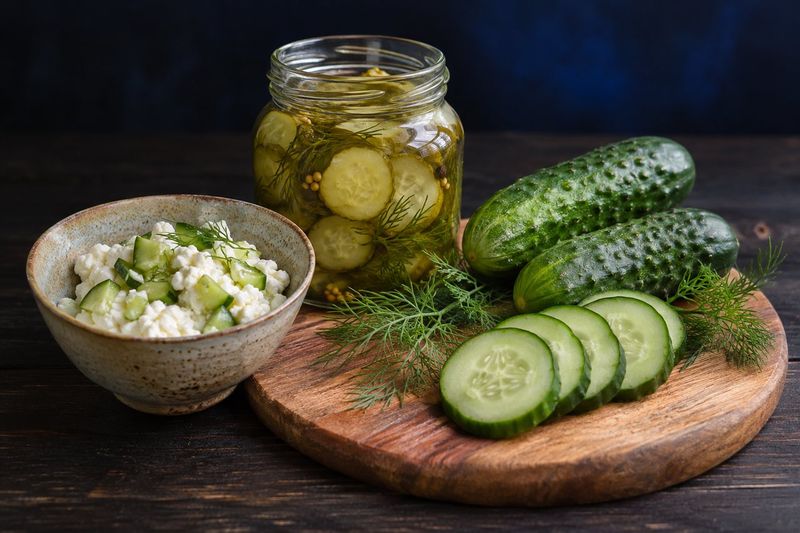
You can eat cucumbers while losing weight: 100 g of fresh cucumbers has about 17 kcal. A 150 g serving gives about 26 kcal. Pickles are also low in calories, but high in salt: 100 g has about 40% of the daily sodium limit.
I'm Demid Lobanov, a fitness coach. In the database I use to build meal plans for clients, fresh cucumbers appear in 37 dishes out of 260: salads to go with chicken and fish, snacks with cottage cheese and eggs, and sandwiches. Each serving has 50–120 g of cucumber.
Calories in cucumbers
According to USDA data, 100 g of fresh cucumbers with the peel contains 0.7 g of protein, 0.1 g of fat, and 3.6 g of carbs, of which 0.5 g is fiber. By my database's formula, that's about 17 kcal; by USDA data, 15. Pickles have about 12 kcal per 100 g, according to USDA data.
Cucumbers don't burn fat or speed up your metabolism. They help with weight loss in a different way: according to USDA data, 100 g of cucumbers contains 95.2 g of water, so cucumbers take up a lot of space on the plate for very few calories.
Do cucumbers help you lose weight
Cucumbers help if they replace higher-calorie food. I didn't find any studies on how cucumbers affect weight. Researchers have studied vegetables and fruit together, often in people with overweight, type 2 diabetes, or a risk of heart disease.
In a 2014 meta-analysis by Mytton and colleagues (8 studies, 1,026 people, 14.7 weeks on average), people who ate more vegetables and fruit lost on average 0.54 kg more than those who ate less. The difference is small and rests on a single study with 9 participants: without it, the difference becomes non-significant. In a 2014 meta-analysis by Kaiser and colleagues with strict selection criteria (7 studies), there was no difference in weight. Participants in these studies were not advised to eat less of other foods. That's why cucumbers help most when they replace part of your side dish, bread, or cheese.
Pickles for weight loss
You can eat pickles as long as you account for the salt. According to USDA data, 100 g of pickles contains 809 mg of sodium on average, ranging from 502 to 1,170 mg across samples. WHO advises adults to consume less than 2 g of sodium per day, that is, less than 5 g of salt. So 100 g of pickles provides about 40% of the daily sodium limit, and the saltiest samples provide more than half. In homemade pickles, the amount of salt depends on the recipe.
If your doctor has advised you to limit salt, for example because of high blood pressure, check with them how many pickles you can have.
Cucumbers at night for weight loss
You can eat cucumbers at night. For your weight, calories over the day matter more than meal timing. More in the article Is It OK to Eat at Night.
If you eat dinner late, cucumbers work well as part of a dinner with a protein dish. In my database, the dinner "tilapia with vegetable salad" is 331 kcal and 42.7 g of protein. It contains 200 g of tilapia, 100 g of cucumbers, 120 g of tomatoes, 60 g of lettuce, and 10 g of olive oil.
What to eat cucumbers with
Cucumbers are easy to pair with a protein food: after a high-protein meal, you feel less hungry over the next few hours. In my database, the snack "cottage cheese with cucumber and dill" is 200 kcal and 26.4 g of protein, and "boiled eggs with cucumber" is 156 kcal and 13.3 g of protein.
In a cucumber and tomato salad, most of the calories are in the dressing: 10 g of oil is 90 kcal. That's more than 300 g of the cucumbers and tomatoes themselves. More on dressings in the article Tomatoes for Weight Loss.
Cucumbers for weight loss: step by step
- Count the calories in cucumbers: about 17 kcal per 100 g.
- Use cucumbers in place of part of your side dish, bread, or cheese, without making the portion bigger.
- Eat cucumbers with a protein food: cottage cheese, eggs, chicken, or fish.
- Weigh the oil for your salad: 10 g is 90 kcal.
- Eat pickles with the salt in mind: 100 g is about 40% of the daily sodium limit.
- After two weeks, compare your average weight for the week with your average for the previous week. If your weight isn't going down, cut back on portions of higher-calorie foods.
I post nutrition and training breakdowns on my YouTube channel @lobanov_fitness.
Sources
- Mytton OT et al. Systematic review and meta-analysis of the effect of increased vegetable and fruit consumption on body weight and energy intake. BMC Public Health, 2014. Article · Full text · Correction, 2017
- Kaiser KA et al. Increased fruit and vegetable intake has no discernible effect on weight loss: a systematic review and meta-analysis. Am J Clin Nutr, 2014. Article · Full text
- WHO. Healthy diet. Fact sheet, January 26, 2026. Page
- USDA FoodData Central, SR Legacy: Cucumber, with peel, raw (FDC 168409); Pickles, cucumber, dill or kosher dill (FDC 168558). Database