
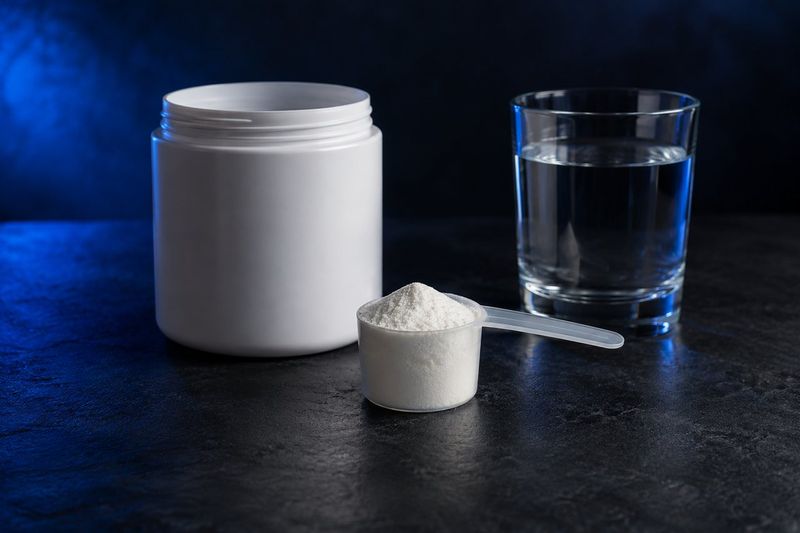
Collagen is the body's main structural protein: it makes up about a third of all protein and is responsible for the strength of skin and connective tissue. In meta-analyses, meaning studies that pool the results of several papers, collagen supplements improve skin hydration and elasticity. But in studies not funded by pharmaceutical companies, and in high-quality studies, there is no significant effect. In osteoarthritis, joint pain and function improve slightly. For muscle, collagen is an incomplete protein: it lacks the essential amino acid tryptophan.
I'm Demid Lobanov, a fitness coach. In my materials on supplements, one rule applies: evaluate them only by meta-analyses and randomized trials. Manufacturers' websites don't count. With collagen, this rule is especially important, because the result depends noticeably on who paid for the study.
What collagen is and why the body needs it
Collagen is the most abundant structural protein, accounting for a third of the protein in the human body. It supports the strength of connective tissue and the properties of skin. Collagen makes up 65–80% of the dry weight of tendons, according to a 2021 review by Khatri and colleagues. In bone, according to Hall's biomechanics textbook, minerals provide stiffness and compressive strength, while collagen provides flexibility and tensile strength.
Supplements usually contain hydrolyzed collagen: protein broken down into short chains called peptides. The de Miranda meta-analysis on skin studied hydrolysate, while the osteoarthritis studies also used other forms of collagen.
Does collagen help skin?
Meta-analyses from 2021 and 2023 said yes. The 2021 meta-analysis by de Miranda and colleagues pooled 19 randomized trials with 1,125 people aged 20 to 70, 95% of them women. In such trials, participants are assigned to groups at random. With collagen, skin was better hydrated and more elastic, with fewer wrinkles, than with placebo, a product with no active ingredient. The authors conclude that the effect comes from taking it for 90 days. In the 2023 meta-analysis by Pu and colleagues (26 studies, 1,721 people), hydration and elasticity also improved, but the authors identified a number of biases.
The 2025 meta-analysis by Myung and colleagues changed the picture: 23 randomized trials, 1,474 people. Taken together, all the studies showed improved hydration and elasticity and fewer wrinkles. But studies not funded by pharmaceutical companies showed no effect on any measure, while studies with such funding did. High-quality studies also found no significant effect; in low-quality ones, skin elasticity improved. The authors' conclusion: there is currently no clinical evidence that collagen prevents or treats skin aging.
Does collagen help joints?
Here the evidence is more convincing than for skin. The 2024 meta-analysis by Liang and colleagues included 35 randomized trials and 3,165 people with osteoarthritis. Collagen derivatives slightly reduced pain and improved joint function: the authors call the effect small to moderate, with moderate certainty for pain and high certainty for function. Treatment discontinuations and side effects were no more frequent than without collagen.
In the 2025 meta-analysis by Simental-Mendía and colleagues on knee osteoarthritis (11 studies, 870 people), compared with placebo, function improved by 6.46 points and pain decreased by 13.63 points. At the same time, results varied widely between individual studies.
Exercise also reduces pain in knee osteoarthritis. The 2024 Cochrane review by Lawford and colleagues included 139 studies with 12,468 people. Cochrane is an international network that compiles research results into systematic reviews. Compared with placebo or with a control in which people received the same amount of attention without exercise, pain decreased by 8.7 points out of 100 (28 studies, low certainty). Function improved by 11.3 points (24 studies, moderate certainty). The authors consider it unclear how noticeable this is in daily life. The reviews use different scales and comparison groups, so the numbers for collagen and for exercise aren't compared directly. Osteoarthritis treatment is chosen by a doctor.
In the 2021 review by Khatri and colleagues (15 studies of collagen combined with training, mostly in recreational athletes), the greatest benefit was specifically for joint pain and function.
Does collagen count as protein for muscle?
No: it can't be counted as a complete protein. Collagen lacks the essential amino acid tryptophan, so its PDCAAS protein quality score is zero. Blood leucine after whey protein was 5.5 times higher than after collagen. The authors link this amino acid to a stronger increase in muscle protein synthesis. These data come from the 2021 review by Khatri and colleagues.
In a 2020 randomized trial by Oikawa and colleagues, 22 women around 69 years old received 30 g of whey protein or collagen twice a day for 6 days. Whey protein raised muscle protein synthesis more, both at rest and after exercise. With collagen, muscle protein synthesis rose only immediately after exercise, and over the 6 days it did not increase significantly either at rest or after exercise. According to the Khatri review, synthesis of collagen itself increased after 15 g of collagen with vitamin C in one study, while two other studies, with doses of 15 and 20 g, found no change.
In my nutrition calculations, protein is 1.6–2.5 g per kilogram of body weight, and more than 2.2 g only for people without stomach or bowel problems. Collagen isn't considered a complete protein, so it's better to reach your target with foods that contain all the essential amino acids. See the articles How much protein you need per day and How to take protein powder.
| What's promised | What research shows |
|---|---|
| Rejuvenates skin | in studies funded by pharma companies, yes; without such funding and in high-quality studies, no significant effect |
| Helps joints | in osteoarthritis, a small reduction in pain and improvement in function |
| Builds muscle | weaker than whey protein: no tryptophan, little leucine |
| Is safe | in osteoarthritis studies, no more side effects than without the supplement |
Which collagen to choose and how much was taken in studies
According to the meta-analysis by Pu and colleagues, the source of collagen did not significantly affect skin elasticity. For hydration, the effect varied depending on the source and how long it was taken.
Studies involving training most often used 5–15 g of collagen per day, and some used 20, 30, and 60 g. In a 2008 study by Clark, athletes with joint pain during exercise took 10 g per day for 24 weeks. For skin, the authors of the de Miranda meta-analysis link the effect to 90 days of use.
If you still decide to take collagen: step by step
- First, reach your protein target with complete-protein foods: meat, fish, eggs, dairy, or protein powder.
- If your goal is skin, keep in mind that studies without pharma funding and high-quality studies found no significant effect.
- If your joints hurt or you have osteoarthritis, see a doctor first: collagen gives slight relief, and exercise also reduces pain.
- Doses in studies with training: most often 5–15 g per day; for skin, 90 days of use in the de Miranda meta-analysis.
- Count your protein target based on complete protein: collagen has no tryptophan.
If you need meals built around your calorie target and your tastes, there's the meal plan.
I post exercise breakdowns on my YouTube channel @lobanov_fitness.
Sources
- Khatri M et al. The effects of collagen peptide supplementation on body composition, collagen synthesis, and recovery from joint injury and exercise: a systematic review. Amino Acids, 2021. Article · Full text
- Hall SJ. Basic Biomechanics. 9th edition. McGraw Hill, 2022. Chapter 4: bone growth and development.
- de Miranda RB et al. Effects of hydrolyzed collagen supplementation on skin aging: a systematic review and meta-analysis. Int J Dermatol, 2021. Article
- Pu SY et al. Effects of Oral Collagen for Skin Anti-Aging: A Systematic Review and Meta-Analysis. Nutrients, 2023. Article · Full text
- Myung SK et al. Effects of Collagen Supplements on Skin Aging: A Systematic Review and Meta-Analysis of Randomized Controlled Trials. Am J Med, 2025. Article
- Liang CW et al. Efficacy and safety of collagen derivatives for osteoarthritis: A trial sequential meta-analysis. Osteoarthritis Cartilage, 2024. Article
- Simental-Mendía M et al. Effect of collagen supplementation on knee osteoarthritis: an updated systematic review and meta-analysis of randomised controlled trials. Clin Exp Rheumatol, 2025. Article
- Lawford BJ et al. Exercise for osteoarthritis of the knee. Cochrane Database Syst Rev, 2024. Article · Full text
- Oikawa SY et al. Whey protein but not collagen peptides stimulate acute and longer-term muscle protein synthesis with and without resistance exercise in healthy older women: a randomized controlled trial. Am J Clin Nutr, 2020. Article · Full text