
After a two- to ten-week break from strength training, fitness declines less than it feels during the first workout back. It also returns noticeably faster than it took to build from scratch. In my coaching practice, a common cause of overload and quitting again is trying to lift old working weights and complete full volume to failure in the very first week.
I am Demid Lobanov, a fitness coach and training methodology specialist with over six years of experience (more than 300 clients) and over four years teaching strength training practice at PRO-FG school (170+ graduates). Below, I break down what studies show about strength and muscle loss during a layoff, how muscle memory works in humans, and how to ease back into routine over the first four weeks.
What happens to muscle and strength during a break
The fear that missing a month erases everything is not supported by controlled studies. The pace of decline depends on how long you trained beforehand and how long the break lasts.
- A 10-week break in adults (Halonen et al., 2024, randomized trial). The study enrolled 55 healthy untrained adults with a mean age of 32 years; 42 completed it (45% women), training full-body twice a week. One group trained for 10 weeks, took a complete 10-week break, and trained for another 10 weeks. The second rested for 10 weeks first and then trained for 20 consecutive weeks. During the 10-week break, leg press and biceps curl one-repetition maximum (1RM), quadriceps and biceps cross-sectional area, and jump height decreased (p < 0.05). Yet during the first 5 weeks of retraining, leg press 1RM and thigh and biceps muscle area grew significantly faster than during weeks 10–15 of continuous training (p < 0.01). By the end, both groups reached the same results across all measures.
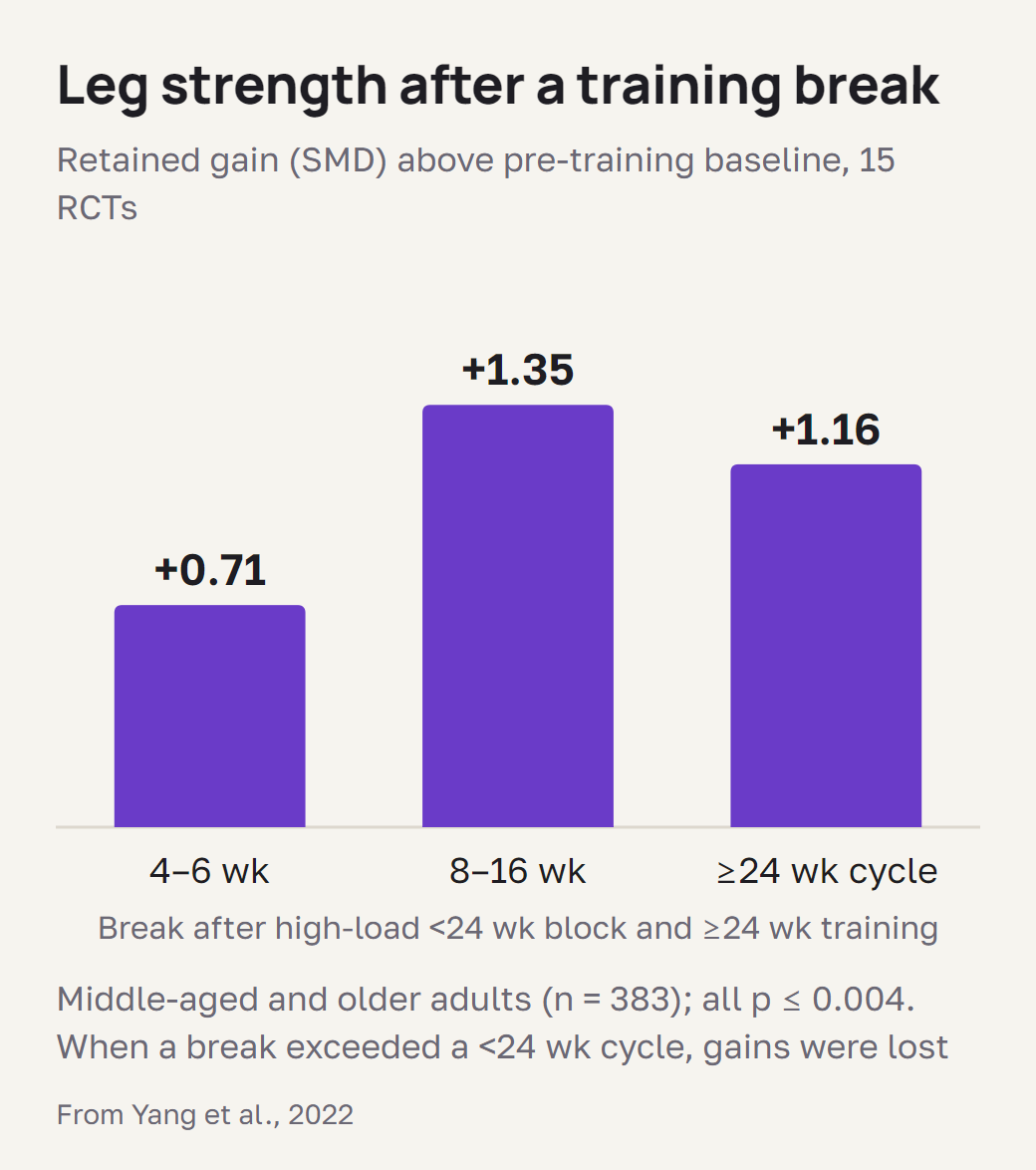
- Leg strength and prior training duration (Yang et al., 2022, meta-analysis of 15 RCTs, 383 middle-aged and older adults). When the prior training program lasted 24 weeks or longer, leg strength remained above baseline even after a break of equal or greater length and at moderate or low intensity (effect size 1.16; p = 0.004). When the program was shorter than 24 weeks, only high-intensity groups preserved strength during breaks no longer than the program itself: 0.71 for 4–6-week breaks (p = 0.0002) and 1.35 for 8–16-week breaks (p = 0.0001). When the break exceeded a short program, gains were lost even with high intensity.
- Muscle size loss during a long layoff (Grgic, 2022, meta-analysis of 6 studies in older adults). After 9–24-week programs, muscle size grew markedly (effect 0.99), and across all breaks it declined significantly (−0.83; 95% CI −1.30 to −0.36). In the small subgroup of 12–24-week breaks, the drop was borderline and did not reach statistical significance (−0.60; 95% CI −1.21 to 0.01). During 31–52-week breaks, losses were pronounced and statistically significant (−1.11).
- Concurrent training and lockdown (Sousa et al., 2019; Washif et al., 2026). In a systematic review of 9 studies on combined strength and aerobic training (Sousa, 2019), most training gains reversed after 2–4 weeks of complete detraining. In a meta-analysis of 14 studies on 261 athletes after lockdown, endurance declined most consistently (Washif, 2026; very low GRADE certainty, and lockdown did not always mean complete inactivity). Relative peak jump power (6 studies) decreased statistically significantly, though the effect size was small (−0.199; p = 0.019). Body mass (11 studies; p = 0.797) and jump height (10 studies; p = 0.097) did not change significantly.
Does muscle memory work in humans
In practice, people with prior training experience really do rebuild working weights faster. In a study by Blocquiaux et al. (2020), 30 older men and 10 controls completed 12 weeks of training, 12 weeks of detraining, and 12 weeks of retraining.
During the 12-week break, knee extension strength and power dropped by 5–15% (p ≤ 0.004). Returning to the prior 1RM took less than 8 weeks. However, science remains cautious about the exact biological mechanism of "muscle memory" in humans:
- Muscle fiber nuclei (Cumming et al., 2024, 12 untrained participants). Over 10 weeks of unilateral arm training, myonuclei increased by 13% in type 1 fibers and by 33% in type 2 fibers, with large individual variation, and remained elevated after 16 weeks of detraining. After 10 weeks of retraining, type 2 fiber area was larger in the previously trained arm (p = 0.035). However, the actual gain during retraining did not differ between arms. The authors explicitly stated that the physiological benefit of retained nuclei in humans remains to be determined.
- Potential proteomic memory (Hulmi et al., 2025, 30 untrained adults, including 17 on a 10+10+10-week protocol). Proteomic memory refers to persistent shifts in muscle protein expression. After the break, many proteins—especially aerobic metabolism proteins—returned to baseline. Still, a subset remained elevated 2.5 months after stopping, including carbonyl reductase 1 (CBR1) as well as contractile, cytoskeletal, and calcium-binding proteins, including calpain-2 (CAPN2).
- Motor learning (Psilander et al., 2019, 19 participants). After 10 weeks of single-leg training, 20 weeks of detraining, and 5 weeks of retraining, muscle thickness and cross-sectional area returned to baseline. Around 60% of the strength gain persisted, which the authors link to long-lasting motor learning. No myonuclear increase or accelerated retraining was found in the previously trained leg; the authors note that without an initial rise in nuclei, the data cannot strictly refute the myonuclear hypothesis.
The practical takeaway is simple: prior experience helps you regain numbers faster (part of strength persists, while the potential role of cellular and proteomic changes in humans is still being studied). Even so, it is not a reason to jump straight back to old maximums on day one.
Why you should not go all out on the first workout: the repeated bout effect
The main trap after a layoff is that your mind remembers old weights while your muscles have deconditioned from mechanical tension and the lowering (eccentric) phase. Going all out right away often sidelines you for days with severe soreness and a noticeable drop in strength.
A meta-analysis of 20 studies on the repeated bout effect in multi-joint muscle-damaging exercises compared the first session with a repeated session (Doma et al., 2023). At 24–48 hours after the first session, muscle soreness and creatine kinase—an enzyme that can rise after muscle cell damage—were significantly higher (p < 0.001; effect size 0.51–1.23).
Strength and jump height also dropped significantly more (p ≤ 0.05; effect −0.27 to −0.40), regardless of changes in intensity or volume between sessions. In an exploratory meta-analysis of 12 studies after eccentric exercise, peripheral contractile force elicited by muscle stimulation showed better recovery at 48 hours (Hayman et al., 2026).
The effect size was 0.50, while at 24 hours the confidence interval crossed zero, and the role of central neural mechanisms remains unclear. Making the first workout calm and introductory triggers protective adaptation without debilitating soreness.
Return plan based on break length
In my practice, when a client returns after a break, we temporarily trim extra isolation work and start with 1–2 calibration weeks. We cut set volume, keep plenty of reps in reserve, and check joint response the next day.
Below are practical guidelines from my coaching work. These are not rigid thresholds from clinical trials: always adjust them to how you feel.
| Break length | Starting weight vs. prior | Volume in weeks 1–2 | Reps in reserve (RIR) | Practical ramp-up window |
|---|---|---|---|---|
| 2–3 weeks | 80–90% | 60–75% of sets | 3–4 reps | 1–2 weeks |
| 1–2 months | 65–75% | 50–60% of sets | 3–4 reps | 3–5 weeks |
| 3–6 months | 50–60% | 2 sets per compound lift | 4–5 reps | 6–10 weeks |
| Over 6 months | Rebuild from light loads | 2 full-body workouts/week | 4–5 reps | 8–12 weeks |
RIR stands for the number of repetitions you could still perform before reaching muscular failure at the end of a set.
Step-by-step algorithm for the first four weeks
- Start with 2–3 full-body workouts per week (2 after a break longer than 6 months, as shown in the table above). In my practice, it is easier at first to train major muscle groups with basic, predictable machine movements and save small isolation work for weeks 3–4. See more on choosing a split in Full-Body vs. Split.
- Spend week one strictly leaving 3–5 reps in reserve. Your goal over the first two or three sessions is to trigger smooth muscle and joint adaptation without severe soreness.
- In week two, add a small load step or one set only where joints and muscles handled the restart comfortably. In my practice, it is better not to raise volume and load at the same time.
- In weeks three and four, return to your working rep range and usual load progression rule. See progression rules in Progressive Overload and program structure in Gym Workout Program.
- In my practice, progress back into routine is judged by your weight log, sleep, and joint response—not by how exhausted you feel. If walking down stairs hurts for three days after a session, starting volume was too high.
If you want to return after a long layoff smoothly, without overload, and with weekly adjustments to loads and video form checks, that format is available in online coaching. For a clear one-month restart plan tailored to your gym and schedule, see individual workout program. I also share short exercise technique breakdowns on my YouTube channel @lobanov_fitness.
How to avoid losing fitness during busy periods: the minimal dose
Often a complete break can be replaced by a drastically reduced maintenance routine. According to a narrative review of minimal exercise doses to preserve fitness in general populations (Spiering et al., 2021)—noting that evidence for elite athletes remains limited:
- Strength and muscle size in younger adults were maintained for up to 32 weeks with just 1 strength session per week and 1 working set per exercise, provided relative load (working weight) was maintained.
- Older adults may need up to 2 sessions per week and 2–3 sets per exercise while maintaining working load to preserve muscle size.
- Endurance was preserved for up to 15 weeks by reducing frequency to 2 sessions per week or cutting volume by 33–66% (down to 13–26 minutes per session), as long as training heart rate intensity was maintained.
The key rule: when time is short, cut sets and sessions, but keep adequate intensity in the sets you still do.
When to see a doctor before returning
In line with the American College of Sports Medicine (ACSM) preparticipation health screening recommendations (Riebe et al., 2015), returning to strength training after surgery, a recent injury, or an infection with cardiac complications requires medical clearance. See a doctor as well if initial workouts trigger undiagnosed pain, pain at rest or at night, numbness, shooting pain, or dizziness.
Sources
- Halonen EJ et al. Does Taking a Break Matter-Adaptations in Muscle Strength and Size Between Continuous and Periodic Resistance Training. Scand J Med Sci Sports, 2024. Article
- Yang Y et al. Training Session and Detraining Duration Affect Lower Limb Muscle Strength Maintenance in Middle-Aged and Older Adults: A Systematic Review and Meta-Analysis. J Aging Phys Act, 2022. Article
- Grgic J. Use It or Lose It? A Meta-Analysis on the Effects of Resistance Training Cessation (Detraining) on Muscle Size in Older Adults. Int J Environ Res Public Health, 2022. Article · Full text
- Washif JA et al. Changes in physical fitness and body composition of athletes after the COVID-19 lockdown: a systematic review, meta-analysis, and meta-regression, with assessment of the certainty of evidence. Biol Sport, 2026. Article · Full text
- Sousa AC et al. Concurrent Training and Detraining: brief Review on the Effect of Exercise Intensities. Int J Sports Med, 2019. Article
- Blocquiaux S et al. The effect of resistance training, detraining and retraining on muscle strength and power, myofibre size, satellite cells and myonuclei in older men. Exp Gerontol, 2020. Article
- Cumming KT et al. Muscle memory in humans: evidence for myonuclear permanence and long-term transcriptional regulation after strength training. J Physiol, 2024. Article
- Hulmi JJ et al. Human skeletal muscle possesses both reversible proteomic signatures and a retained proteomic memory after repeated resistance training. J Physiol, 2025. Article
- Psilander N et al. Effects of training, detraining, and retraining on strength, hypertrophy, and myonuclear number in human skeletal muscle. J Appl Physiol (1985), 2019. Article
- Doma K et al. The Repeated Bout Effect of Multiarticular Exercises on Muscle Damage Markers and Physical Performances: A Systematic Review and Meta-Analyses. J Strength Cond Res, 2023. Article
- Hayman O et al. Neurophysiological and neuromuscular responses associated with the repeated bout effect following eccentric exercise in healthy adults: a systematic review and meta-analysis. Eur J Appl Physiol, 2026. Article
- Spiering BA et al. Maintaining Physical Performance: The Minimal Dose of Exercise Needed to Preserve Endurance and Strength Over Time. J Strength Cond Res, 2021. Article
- Riebe D et al. Updating ACSM's Recommendations for Exercise Preparticipation Health Screening. Med Sci Sports Exerc, 2015. Article




