
An online fitness coach helps you structure your workouts and stick to the plan when coaching is built on live form feedback, tracking working weights, and gradual load progression. According to randomized trials and meta-analyses, regular remote supervision improves adherence markedly better than static PDF plans, and videoconference sessions match in-person training in adverse event rates (mainly in clinical populations and with low certainty of evidence).
I am Demid Lobanov, a fitness coach and training methodology specialist. I have coached clients for more than six years (over 300 people), taught strength training practice at PRO-FG school for over four years (170+ graduates), examined practical tests for over three years, and worked online with clients across different countries. Below, I break down what research actually shows about remote training, how four online formats differ, and how to tell hands-on coaching from a template handout.
What studies show about online training
In studies, the communication format most noticeably affected adherence to the plan, and in individual trials—movement technique quality.
Gavanda et al. (2025) ran a direct comparison of three formats in a 10-week randomized controlled trial on 112 resistance-trained adults with at least one year of experience. All groups did the same full-body program three times a week. The first group trained in person with a coach, the second used an online app with a progress log and time-delayed video feedback on technique, and the third received a PDF plan without feedback.
At least 26 of 30 workouts were completed by 88.2% of participants with an in-person coach (15 of 17), 81.2% in the online app (39 of 48), and only 52.2% with the PDF (25 of 47). Among the 79 completers, bench press strength increased similarly (+9.1, +8.2, and +7.7 kg), while the in-person group gained more in the barbell squat (+26.6 kg vs. +19.2 kg online and +19.4 kg PDF). Supervision satisfaction reached 96.7% in person and 92.0% online. The trial had a limitation: the in-person group happened to be younger (25.9 vs. 31.8 years in the app and 31.9 in the PDF group, p = 0.026) and had less average training experience (2.8 vs. 5.2 years in the app and 4.5 in the PDF group, p = 0.135).
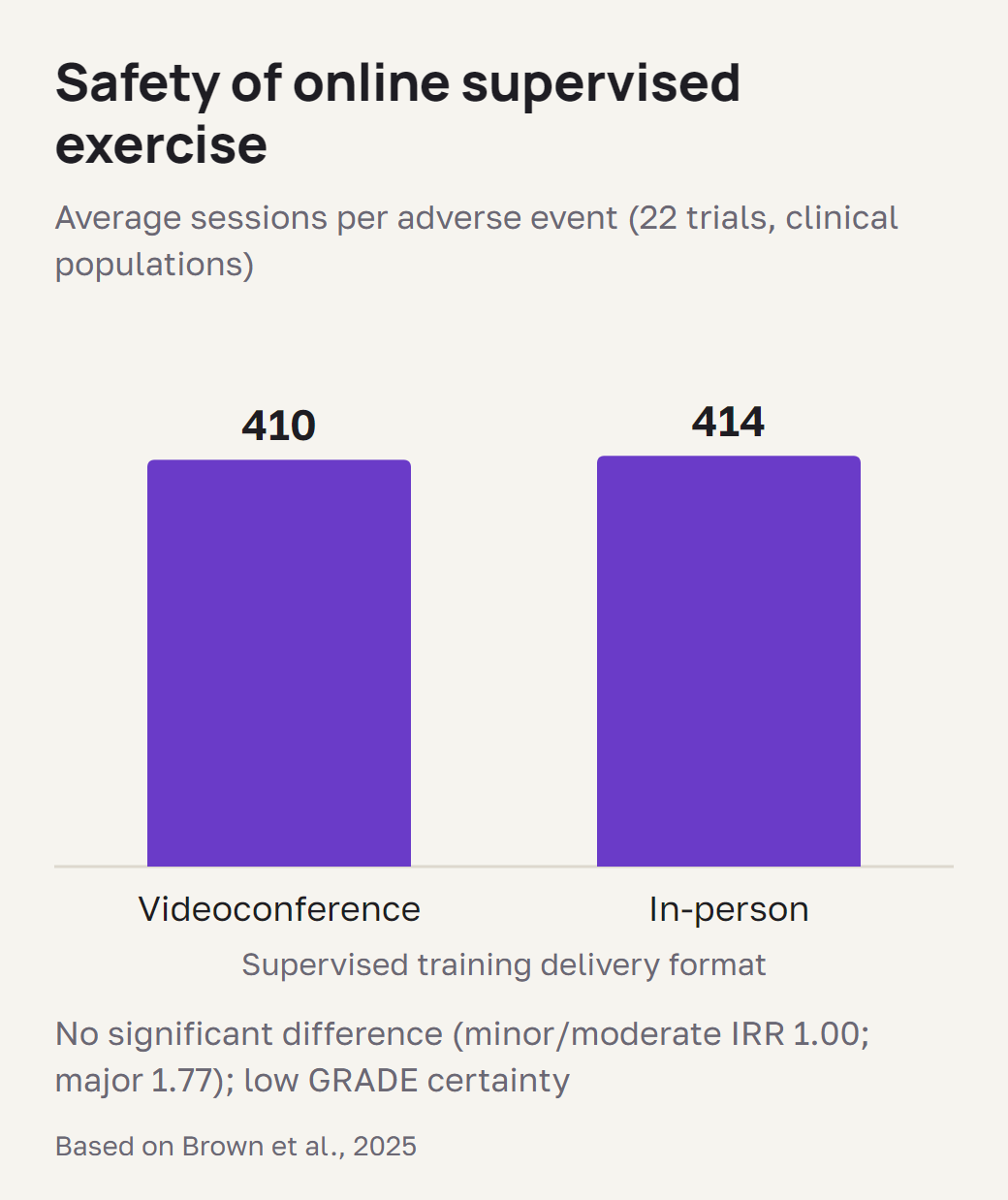
Direct safety data came from a meta-analysis of 22 studies by Brown et al. (2025) comparing videoconference exercise sessions with in-person training. Adverse event rates did not differ statistically for minor and moderate events (incidence rate ratio 1.00; interval 0.71–1.41) or for major events (1.77; interval 0.55–5.70): one event occurred per 410 online sessions and per 414 in-person sessions. The samples consisted of people with chronic conditions or recovering from surgery, and the authors rated GRADE certainty as low due to risk of bias and incomplete adverse-event reporting in 82% of studies, yet the data showed no rise in injuries from videoconferencing.
Three more studies supported the effectiveness of videoconference coaching:
- A meta-analysis of 28 randomized trials by Toledano-Shubi et al. (2025; 2,086 adults over 65): with a specialist over video, attendance averaged 79.7% and completion reached 92.8%. Across 18 higher-quality studies compared with no exercise, muscle strength (standardized mean difference 0.86) and physical function (0.82) improved substantially, and effectiveness was comparable to alternative delivery formats.
- The 16-week MOTION trial (Langeard et al., 2022; 41 healthy older adults): home-based videoconference training was non-inferior to face-to-face sessions for body weight, body fat percentage, aerobic power, knee extension strength, and leg power. For muscle mass, grip strength, trunk extension, and knee flexion, the trial did not confirm that videoconferencing was non-inferior to in-person sessions.
- A review of 32 studies by Brown et al. (2022) in people with chronic conditions: attendance averaged 70%, and the authors recorded no serious adverse events attributable to videoconferencing itself, although technical connection issues occurred in 17% of sessions.
Why apps and PDF plans alone fall short
It often seems enough to download an app or buy a ready-made monthly workout file. Large recent reviews show modest effects from standalone digital programs and apps.
In a meta-analysis of 32 randomized trials by Cox et al. (2025; 15,045 participants, mean age 51.1 years, 65% women), digital strength programs produced a small gain in neuromuscular fitness versus usual care (Cohen's d 0.18 across 18 studies). The effect was moderate for the lower body (0.22) and statistically non-significant for the upper body (0.11, p = 0.15). Most studies involved clinical populations (only 6 of 32 trials studied healthy adults) and relied on bodyweight exercises taught via videos or images, with poorly described training load parameters.
Weight-loss data look similar. A Cochrane review of 18 randomized trials by Metzendorf et al. (2024; 2,703 participants with overweight or obesity) evaluated standalone smartphone apps against minimal support. At 12 months, weight difference was small or zero (−2.5 kg, interval −6.8 to +1.7 kg; low certainty), and at 24 months it was +0.7 kg. In a meta-analysis by Chew et al. (2022), weight loss from apps peaked at 2.18 kg at month three and faded to 1.63 kg by one year. By contrast, a meta-analysis of 42 studies by Tang et al. (2026) found that comprehensive digital lifestyle programs reduced weight by an average of 1.79 kg with no statistically significant difference compared with face-to-face programs (difference −1.73 kg, p = 0.11).
Live correction matters especially for movement quality. In a 6-week study by Klusemann et al. (2012; 38 junior basketball athletes), an online video program and in-person coaching improved speed, jump performance, endurance (3–5%), and push-ups (28%) similarly versus control, yet movement quality on the FMS test improved more under live supervision (+12% over the video program). A meta-analysis of 11 studies by Lacroix et al. (2017) in adults over 65 confirmed that supervised training produces greater strength and power gains (effect 0.51; p = 0.04) than unsupervised workouts.
Four formats of working with an online coach
Different services are sold under the label "online coach," from a static exercise list to daily coaching. Your choice depends on your technical experience and how much regular oversight you need.
| Format | What is included | Form checks | Who it fits |
|---|---|---|---|
| Full online coaching | Plan for gym or home, load tracking, nutrition, measurements, adjustments, daily chat | Weekly review of videos of your working sets | You want systemic results (glutes, muscle gain, fat loss, back) and ongoing contact |
| "Start" | One-month plan for your equipment, guided review of first workouts and progression rules | Intensive video review during week one without ongoing coaching | You need core movement technique set up, then plan to train on your own |
| Custom workout program | Intake questionnaire, limitation checks, one-month plan with demo videos and general nutrition guidelines | No review of your videos or ongoing adjustments | You already train confidently and want a structured plan |
| Live video sessions | Personal training over a video call | Real-time adjustments to stance and joint angles during sets | You need live cues in the moment or troubleshooting of complex lifts |
Full coaching addresses the exact bottlenecks highlighted in studies: staying on schedule, fixing movement mechanics, and progressing load steadily. Full details of each format are listed on the online training coaching page.
How an online coach teaches technique by video
The first question before starting is how a specialist can spot mistakes without standing next to you. Video lets you slow down the replay, freeze the bottom position, and compare your form against last week.
Technique work follows four clear steps:
- Plan for your equipment and camera angle. Exercises match the machines in your gym or your gear at home (see Home Workouts). Place your phone to the side or at a three-quarter angle at waist height so your entire body fits in frame.
- Filming the final working set. At the end of an exercise, you film the final working set so the coach can review your technique on video.
- Adjusting for your proportions. The same squat loads the glutes more in one person, while in another—because of proportions, joint mobility, and technique—it loads the quads more heavily or overloads the back. From your video, the coach adjusts stance width, torso lean, heel elevation, or the exercise choice itself.
- Cues for the next session. Instead of ten corrections at once, you get one or two clear tasks for your next workout, and the next clip checks whether the adjustment worked.
Every set is logged by weight and reps. How a weekly training structure is built is covered in Gym Workout Program.
Who online coaching fits, and when an in-person coach or doctor comes first
An online coach works well for adults who want to train in their own gym or at home on a flexible schedule, travel often for work, or live in another city. Still, there are clear boundaries where remote work falls short of in-person coaching or requires medical clearance first.
When it is better to start in person at a gym:
- You have never held dumbbells or a barbell and feel uneasy approaching machines without physical spotting.
- You find it hard to adjust machines and pick starting weights on your own.
- You are in early rehabilitation after surgery or a recent injury that requires hands-on testing.
When you need an in-person doctor before a program:
The American College of Sports Medicine (ACSM) preparticipation health screening consensus (Riebe et al., 2015) evaluates current activity level, signs, symptoms, or diagnoses of cardiovascular, metabolic, or renal disease, and the desired exercise intensity.
In my practice, medical clearance before starting is required for chest pain or tightness and high uncontrolled blood pressure. The same applies to acute undiagnosed pain, nighttime back or joint pain, numbness or weakness in an arm or leg, and incomplete post-surgical rehabilitation. With disc protrusions, non-acute herniations, or scoliosis, an online coach can work safely by scaling load carefully, while diagnosis and treatment always stay with a doctor.
How my online coaching works without spreadsheets
I used to coach online clients in Google Sheets until I ran into the limits of that workflow. On a phone, wide spreadsheets turn into awkward scrolling, basement gyms lose reception, and form videos get buried in chat apps.
So I moved online coaching clients into my own mobile web app, app.lobanov-fitness.ru. You sign in via a personal link with no passwords, and the app supports offline use in the gym. Weight and reps are logged one-handed, your previous weight fills in automatically, and after the session you attach the video of your final working set directly to the exercise. I leave form feedback under each movement, while a separate tab tracks nutrition, body measurements, and weekly check-in photos.
Real client stories show the different goals this format handles:
- Glute growth and muscle gain: Kristina came after dieting down to 46 kg on her own with low energy and little shape. We raised calories gradually, removed food bans, and built a plan tailored to her proportions focusing on glutes and back with video form checks—her weight grew from 46 to 55 kg, she built muscle, and her posture improved.
- Weight loss without binges: a female client came at 98 kg after several failed diets. We built a meal plan from familiar foods without strict bans—in three months her weight dropped to 83 kg.
- Returning to activity at 54: a male client arrived with knee and back pain and could not perform even a bodyweight squat. Gradual selection of range of motion and load alongside weight loss and daily activity helped him drop 6 kg, straighten his posture, and return to long walks and active travel tours.
I post exercise technique breakdowns on my YouTube channel @lobanov_fitness so you can evaluate my approach in advance. If you are unsure which format fits your goal and limitations, you can book a 30-minute call with no payment or obligations on the free consultation page.
Pre-start checklist: 6 questions for an online coach
Before paying, screen any candidate with six questions (general diploma criteria and gym red flags are covered in How to Choose a Fitness Coach):
- Does the coach ask for a health intake before writing the plan? Questions about blood pressure, injuries, surgeries, and limitations are needed to check risks before starting workouts.
- Are regular video reviews of your sets included? Without regular feedback, a plan turns into an unmonitored file—in Gavanda (2025), nearly half of participants on a PDF plan without feedback failed to reach the workout minimum.
- Where are working weights, reps, and reps in reserve logged? Progression cannot be managed from memory; you need a clear log.
- Is the plan adapted to your gym or home gear? Machines and weights in the program must match what you actually have access to.
- Is nutrition built around habits or around bans? I build meal plans from familiar foods and do not exclude whole food groups without medical indications.
- Does the specialist respect scope of practice? A coach does not prescribe lab panels, medications, or therapeutic diets, and refers you to a doctor when warning signs appear.
Sources
- Gavanda S et al. Optimizing Resistance Training Outcomes: Comparing In-Person Supervision, Online Coaching, and Self-Guided Approaches: A Randomized Controlled Trial. J Strength Cond Res, 2025. Article · Full text
- Brown RC et al. Safety of videoconferencing for physical rehabilitation and exercise: A systematic review and meta-analysis. Clin Rehabil, 2025. Article · Full text
- Toledano-Shubi A et al. Feasibility and effectiveness of physical exercise for older adults delivered remotely via videoconferencing-systematic review and meta analysis. Age Ageing, 2025. Article · Full text
- Langeard A et al. Non-inferiority of a home-based videoconference physical training program in comparison with the same program administered face-to-face in healthy older adults: the MOTION randomised controlled trial. Age Ageing, 2022. Article
- Brown RC et al. Effectiveness of exercise via telehealth for chronic disease: a systematic review and meta-analysis of exercise interventions delivered via videoconferencing. Br J Sports Med, 2022. Article
- Cox ER et al. Effects of mHealth interventions to prescribe resistance training: a systematic review and meta-analysis of randomized controlled trials. Int J Behav Nutr Phys Act, 2025. Article · Full text
- Metzendorf MI et al. Mobile health (m-health) smartphone interventions for adolescents and adults with overweight or obesity. Cochrane Database Syst Rev, 2024. Article · Full text
- Chew HSJ et al. Sustainability of Weight Loss Through Smartphone Apps: Systematic Review and Meta-analysis on Anthropometric, Metabolic, and Dietary Outcomes. J Med Internet Res, 2022. Article · Full text
- Tang Y et al. Impact of mHealth-Based Lifestyle Interventions on Weight Loss in Overweight/Obese Adults: A Systematic Meta-Analysis. J Gen Intern Med, 2026. Article · Full text
- Klusemann MJ et al. Online video-based resistance training improves the physical capacity of junior basketball athletes. J Strength Cond Res, 2012. Article
- Lacroix A et al. Effects of Supervised vs. Unsupervised Training Programs on Balance and Muscle Strength in Older Adults: A Systematic Review and Meta-Analysis. Sports Med, 2017. Article
- Riebe D et al. Updating ACSM's Recommendations for Exercise Preparticipation Health Screening. Med Sci Sports Exerc, 2015. Article