
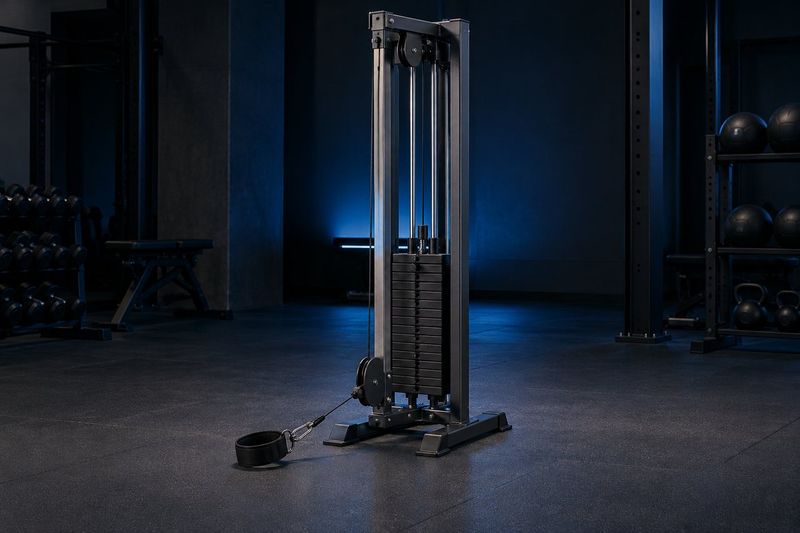
The cable hip extension works the gluteus maximus and the hamstrings. In Russian-speaking gyms it's often called "leg abduction to the back," but anatomically it's hip extension. Where the load peaks depends on pulley height: from the low pulley it increases toward the end of the movement; from the high pulley it's greatest at the start, when the glutes are stretched.
Below: what our high-pulley measurement showed, how to do the exercise, and what to replace it with.
Which muscles work in the cable hip extension
The leg is driven back by the hip extensors: the gluteus maximus and three hamstring muscles, namely the long head of the biceps femoris, the semitendinosus, and the semimembranosus. According to Hall's biomechanics textbook, the gluteus maximus is especially active when the hip extends from a flexed position or against resistance. These hamstring muscles are two-joint muscles, meaning they cross two joints: they extend the hip and flex the knee.
When the cuff is attached to the lower leg, the cable creates torque, a turning effect, not only at the hip but also at the knee. The knee is held in place by the muscles that flex it, including the short head of the biceps femoris. Of the hamstring muscles, it's the only one that crosses just the knee joint.
Hip extension or leg abduction to the back: what's the right name?
The name "leg abduction to the back" comes from Russian-speaking gyms. In anatomy, moving the leg out to the side is abduction, and it's done by the gluteus medius and minimus. Moving the leg back is extension at the hip joint. That's why in my exercise library the low-pulley version is called "Standing low-pulley cable hip extension."
Where the load peaks: why pulley height matters
The load on the hip is set by the moment arm: the perpendicular distance from the joint to the line of the cable. It's largest when the cable runs at a right angle to the line from the joint to the cuff, and it shrinks as the cable lines up with that line. That's why, with a low versus a high pulley, the same movement loads different parts of the range of motion (the leg's full path) more heavily.
| Variation | Where the moment arm is largest | Which part is loaded more |
|---|---|---|
| Low pulley, cuff on the lower leg | near the neutral hip position, when the thigh is in line with the torso | the end of the movement, glutes shortened |
| High pulley, cuff on the lower leg | at the start, with the hip flexed | the start of the movement, glutes stretched |
For the low pulley, this is the result of a geometric calculation in my exercise library. At 45° of hip flexion, the cable runs almost along the leg and the moment arm is small; by the neutral hip position it grows several times over. For the high pulley, we measured the moment arm from video, and the picture is reversed: the maximum is at the start of the movement, where the glutes are stretched.
What our high-pulley measurement showed
We filmed the high-pulley hip extension directly from the side and, frame by frame, traced the line of the cable from the cuff to the point where the cable leaves the sheave, the pulley wheel. As the hip extended, the cable's moment arm about the hip decreased from 1.07 to 0.27 thigh lengths, a fourfold drop; at the end point of the movement it stayed at 0.27–0.33. The maximum came at the start of the movement, where the hip is flexed and the gluteus maximus is at its longest. Over a rep, the cable angle changed from nearly vertical to 54° from vertical.
This is a two-dimensional estimate from one recording of one person: we don't report force in newtons or torque in newton-meters, and we treat cable tension as constant. With a different distance from the machine, a different pulley height, or a torso lean, the numbers will be different. If we had assumed the cable pulls vertically, like gravity on a free weight, the load picture would be reversed. In the end-point frame, the moment arm would be 1.34 thigh lengths instead of 0.30 along the actual cable in that same frame. That's why, in cable exercises, the load is calculated from the cable's actual direction.
This load distribution follows a similar trend to the strength curve of the hip extensors themselves, that is, how their strength changes at different joint angles. In 2017, Kindel and Challis measured maximal hip extension torque at different angles: it was higher in the flexed position and decreased as the hip extended.
What happens at the knee
In our measurement, the knee angle was 73–83° at the start of the movement, and by the end the leg straightened to 160–167° (180° is a straight leg). With the knee bent, the two-joint hamstrings are shortened and less effective at extending the hip. Hall's textbook calls this active insufficiency. Kindel and Challis also found that knee position changes hip extension strength. So the greatest resistance from the high pulley falls in the position where the hamstrings are working at a disadvantage.
Why load the glutes in a stretched position
Some research favors loading a muscle in its stretched position, but there's no direct data on this exercise. A 2026 meta-analysis by Strey and colleagues (8 studies) pooled the results of studies comparing partial reps, movements through part of the full range of motion. Reps in the muscle's stretched position produced more growth than reps in the shortened position; the effect was small, and the glutes weren't measured in these studies.
For the glutes, there's data on squats. In a 2019 study by Kubo and colleagues, over 10 weeks the deep squat increased gluteus maximus volume by 6.7% and the shallow squat by 2.2%, and the difference was statistically significant. How to combine full range of motion and partial reps is covered in the article Full or Partial Range of Motion: Which Is Better for Muscle Growth.
How to do the cable hip extension
- Attach the cuff to the lower leg of your working leg, above the ankle.
- Choose the pulley for your goal: the low pulley loads the end of the movement more, the high pulley loads the start, where the glutes are stretched.
- Stand so the cable is already taut in the starting position; otherwise there will be no load at the start of the movement.
- Extend the leg at the hip, moving it back.
- On the high pulley, don't cut short the start of the range: that's exactly where resistance is greatest.
- Return the leg to the starting position and repeat for the number of reps you need.
How to choose a variation or a substitute
Choose a substitute based on which part of the movement you need to load. If you need the greatest load in the muscle's stretched position, in my exercise library that comes from the gluteus maximus kickback (hip extension from the high pulley) and the Romanian deadlift. If you need it in the shortened position, low-pulley hip extension.
With a resistance band anchored low in front, the geometry is the same as with the low pulley, and the tension also rises as the band stretches. So the load most likely shifts even further toward the end of the movement. This is a conclusion from the mechanics of the movement; we haven't measured the band.
In a 2021 study by Buehler and colleagues (16 people, 3D motion capture and modeling), hip exercises with a band increased the calculated force of the target muscles during the movement but reduced the joint's range of motion.
How I use this with clients
In my exercise library, every exercise has a load profile: the muscle position where the load is greatest, either stretched, mid-range, or shortened. Low-pulley hip extension is tagged as shortened, the gluteus maximus kickback as stretched, and the machine kickback as mid-range.
I track how many exercises of each profile go into a single workout, and I don't build a workout from stretched-profile exercises alone.
I consider the decreasing load from the high pulley a strength of the exercise: peak resistance falls where the glutes are stretched. I formed this hypothesis before the measurement, and the frame-by-frame calculation confirmed it: the moment arm is greatest where the glutes are stretched.
If you need a plan for your goal and your gym, there's the personalized program.
Sources
- Hall SJ. Basic Biomechanics. 9th edition. McGraw Hill, 2022. Chapters 6, 8, and 13.
- Kindel C et al. Joint moment-angle properties of the hip abductors and hip extensors. Physiother Theory Pract, 2017. Article
- Strey B et al. Muscle hypertrophy from partial repetition at long vs. short muscle length: A systematic review and meta-analysis. Sport Sci Health, 2026. Article
- Kubo K et al. Effects of squat training with different depths on lower limb muscle volumes. Eur J Appl Physiol, 2019. Article
- Buehler C et al. Quantifying Muscle Forces and Joint Loading During Hip Exercises Performed With and Without an Elastic Resistance Band. Front Sports Act Living, 2021. Article · Full text




