

A persistent fitness myth claims that when fat loss stalls, you need a cheat meal or carb refeed to "rev up your metabolism" and spike leptin. Controlled clinical trials and the 2026 ISSN Position Stand paint a much calmer picture.
One untracked binge does not restart metabolism, yet it easily wipes out a week's calorie deficit. By contrast, a planned 1–2 week diet break at maintenance calories does help in clinical trials—lowering hunger and eating disinhibition while a one-week break improves lower-body muscular endurance. Short 1–2 day refeeds have a more modest impact.
Cheat meal vs. refeed vs. diet break
These three terms are often used interchangeably, even though they work differently physiologically and psychologically.
| Tool | Duration | Calories & macros | Main effect and risk |
|---|---|---|---|
| Cheat meal | 1 meal or 1 day | Untracked, often high in fats and sugar | High risk of erasing weekly deficit and reinforcing a restrict–binge cycle (Tsang, 2025) |
| Carb refeed | 1–2 consecutive days | Raised to maintenance via carbohydrates, steady protein | Restores glycogen and eases diet fatigue, but does not speed fat loss over 7 weeks (Campbell, 2020) |
| Diet break | 1–2 weeks | Planned maintenance calories (0% deficit), high protein | Lowers hunger, irritability, and disinhibition without fat regain (Peos, 2021; Siedler, 2023) |
Why cheat meals do not "boost" metabolism
The biggest trap of a cheat meal is simple math. Suppose you hold a moderate 400 kcal daily deficit from Monday through Saturday, building a 2,400 kcal weekly deficit. One unrestricted evening of heavy food, dessert, and drinks can easily wipe out that entire weekly deficit—leaving you convinced your metabolism is "broken."
A scoping review in Nutrition Reviews (Tsang et al., 2025) examined evidence across five databases and reached two conclusions: claims that cheat meals preserve muscle, blunt metabolic adaptation, or boost training remain mixed and unsupported, while framing food as "cheating" is linked to disordered eating behaviors. Planned meals built calmly into a flexible nutrition plan affect psychology very differently. If you notice signs of disordered eating—binge episodes, guilt around food, or rigid restrict–binge cycles—work with a qualified specialist rather than experimenting with cheat meals or refeeds alone.
What randomized trials show on refeeds and diet breaks
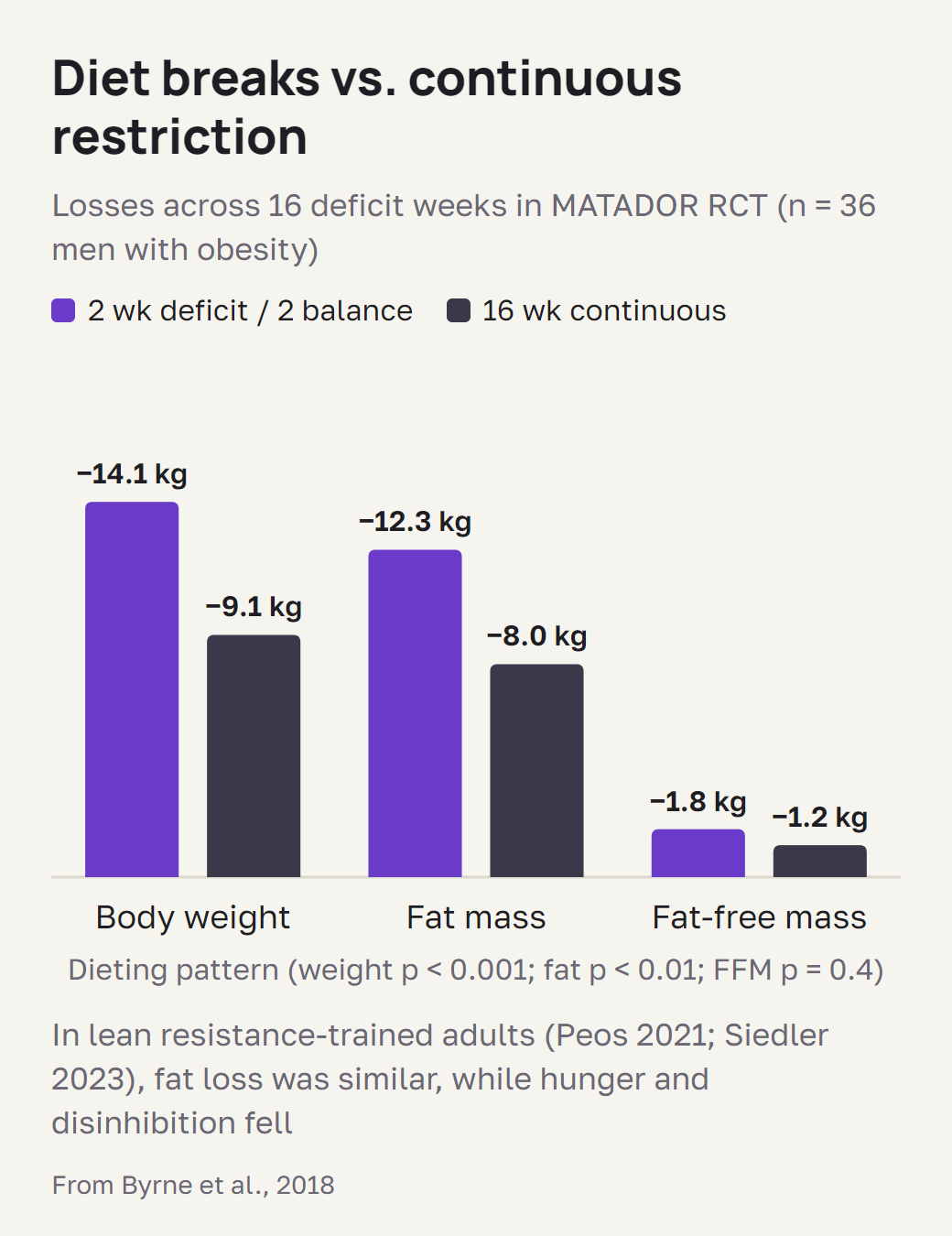
Scientific interest surged after the MATADOR trial (Byrne et al., 2018). Fifty-one men with obesity followed a 33% energy deficit either continuously for 16 weeks or alternating 2 weeks of dieting with 2 weeks at maintenance (30 weeks total). Among 36 completers, the intermittent group lost more body weight (14.1 vs. 9.1 kg; p < 0.001) and more fat mass (12.3 vs. 8.0 kg; p < 0.01) with similar fat-free mass change (1.8 vs. 1.2 kg; p = 0.4). Adjusted resting energy expenditure declined half as much (−360 vs. −749 kJ/day; p < 0.05), and weight stayed flat during the 2-week maintenance blocks (0.0 ± 0.3 kg).
Later trials in leaner, resistance-trained adults added crucial nuance:
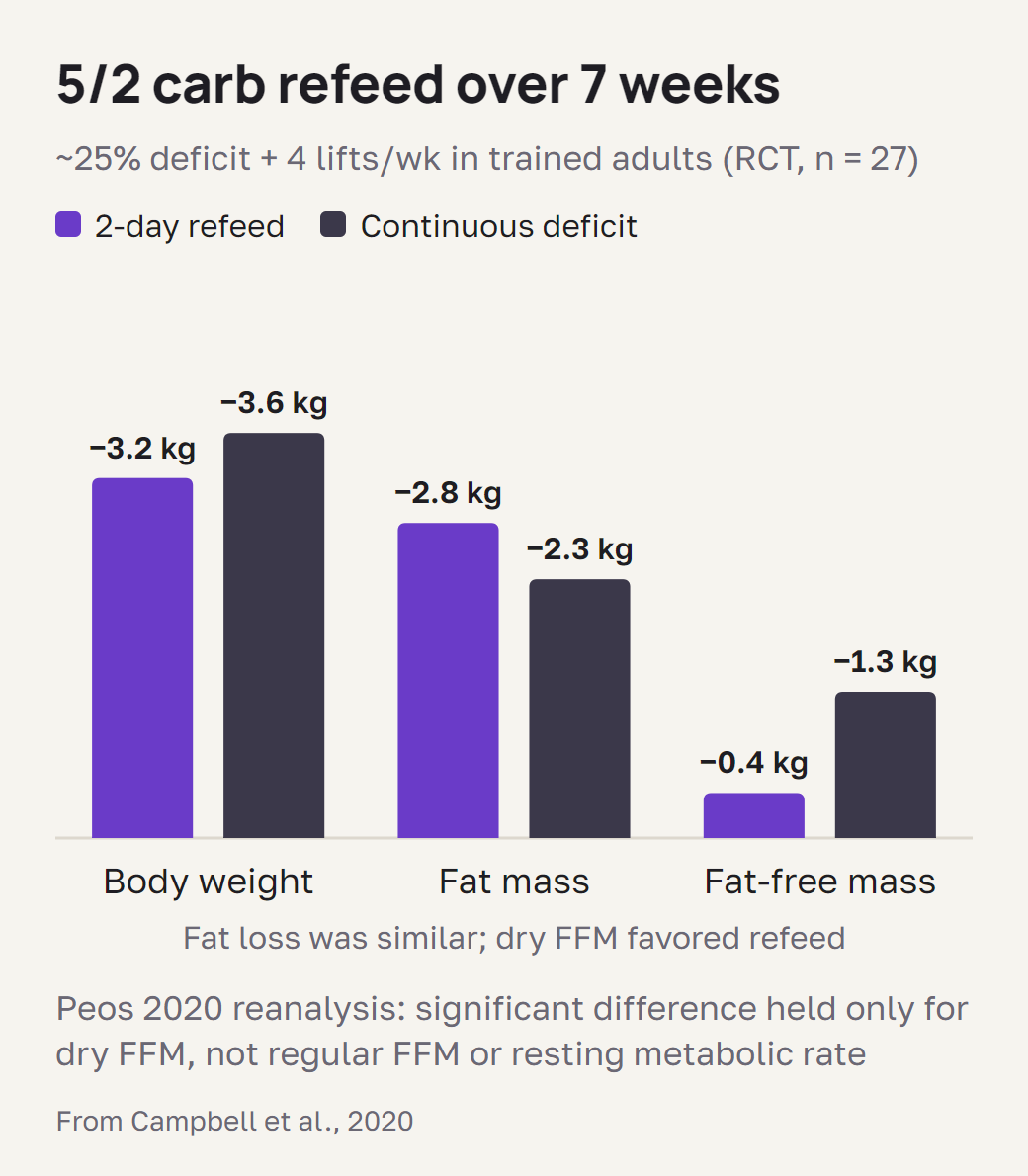
- Two-day carbohydrate refeeds (Campbell et al., 2020). Over 7 weeks at a 25% deficit in 27 trained lifters, fat loss was similar (−2.8 vs. −2.3 kg, non-significant). Although the original paper claimed superior fat-free mass and resting metabolic rate retention, a reanalysis by Peos et al. (2020) showed that only dry fat-free mass differed significantly, while standard fat-free mass and resting metabolic rate did not differ between groups.
- The ICECAP trial (Peos et al., 2021). Sixty-one trained adults (32 women) completed 12 weeks of continuous dieting or 12 weeks interspersed with three 1-week breaks (15 weeks total). Fat loss (p = 0.321), fat-free mass (p = 0.309), resting energy expenditure, leptin, testosterone, and T3 did not differ. However, the intermittent group experienced lower hunger (p = 0.002) and desire to eat (p = 0.014), greater diet satisfaction (p = 0.016), and higher peptide YY satiety hormone (p = 0.034).
- ICECAP secondary analysis (Peos et al., 2021). A single carbohydrate diet-break week added no meaningful fat mass while restoring vigor (p = 0.003), reducing irritability (p = 0.041), improving 25-rep leg muscular endurance (p = 0.018), and modestly raising resting energy expenditure (~48 kcal/day; p = 0.026).
- RCT in resistance-trained women (Siedler et al., 2023). Across 38 women eating 1.8 g/kg protein and lifting 3 times weekly, diet breaks gave no fat-loss or metabolic-rate edge—yet eating disinhibition rose in the continuous group (4.91 to 6.17) while falling in the break group (6.80 to 6.05; p < 0.01).
Other intermittent approaches (5:2, alternate-day fasting, time-restricted eating) show the same big picture. In a meta-analysis of 28 RCTs (Schroor et al., 2024) and the 2026 ISSN Position Stand (Aragon et al., 2026), intermittent protocols did not outperform continuous restriction for weight or fat loss (in Schroor's pooled analysis, fat-free mass declined slightly more by 0.20 kg; p = 0.044). The real anchors for muscle retention remain strength training and adequate protein (1.2–1.6 g/kg generally, 1.6–2.2 g/kg with resistance training, and up to 1.9–3.2 g/kg for lean trained athletes), while ISSN experts suggest treating plateaus as maintenance-practice phases.
Who actually needs a diet break
In my coaching work—I am Demid Lobanov—I do not schedule automatic breaks for everyone because every maintenance week extends total dieting time. A planned break makes clear sense in four situations:
- You have dieted longer than 6–8 weeks and hunger, irritability, or constant thoughts of food are threatening adherence.
- Recovery and lower-body muscular endurance have dipped under a steep deficit. In a small RCT of 11 bodybuilders (Moura et al., 2021), a carb refeed did not change leg-press work capacity overall, but in the 5-person severe-restriction subgroup it lowered perceived soreness and creatine kinase.
- Travel, holidays, or social events are coming up. Planning a maintenance week beats trying to force a strict deficit, binging, and giving up for a month.
- You have already lost 8–10% of starting body weight (practical guideline). Taking 1–2 planned weeks at maintenance offers a mental breather before the next fat-loss phase.
Calculate your maintenance and deficit targets upfront with our calorie and macro calculator. If you want a structured flexible plan without rigid food bans, see our 28-day personalized meal plan or comprehensive online coaching.
Five steps to run a refeed or diet break cleanly
- Raise calories to maintenance (0% deficit). If you dieted at 1,700 kcal with an estimated 2,100 kcal maintenance, add ~400 kcal/day—just like MATADOR and ICECAP.
- Add those calories mainly from carbohydrates. Raising maintenance intake through carbs helps replenish glycogen stores and curb hunger.
- Keep protein steady (1.6–2.0 g/kg). High protein protects satiety and prevents maintenance days from turning into high-fat, high-sugar grazing.
- Maintain lifting and daily steps. Use the extra energy to push quality strength sessions without letting everyday movement drop.
- Set your return date in advance. A refeed lasts 1–2 days; a diet break lasts 7–14 days. A fixed end date prevents a short break from drifting into a two-month rebound.
For related guidance, read How to Stop Diet Slip-Ups and Calorie Deficit for Fat Loss. I also share practical nutrition breakdowns on my YouTube channel @lobanov_fitness.
Why the scale ticks up temporarily after a refeed
Many people panic when the scale bumps up after a refeed or diet-break week and assume they regained body fat. Body-composition data show otherwise.
In the ICECAP secondary analysis (Peos et al., 2021), one week of carbohydrate maintenance raised body mass by an average of 0.6 kg and fat-free mass by 0.7 kg with no significant fat gain. This temporary rise reflects glycogen replenishment and water retention, not new adipose tissue. I (Demid Lobanov) always tell clients upfront: a practical benchmark of a successful break is holding maintenance calmly without overeating; that temporary bump typically fades within 3–5 days back in a deficit, so judging body fat by the scale the morning after extra carbs makes no sense.
Sources
- Aragon AA et al. International Society of Sports Nutrition position stand: diets for body weight reduction. J Int Soc Sports Nutr, 2026. PMID 42867412
- Tsang JH et al. The Role of Cheat Meals in Dieting: A Scoping Review of Physiological and Psychological Responses. Nutr Rev, 2025. PMID 40517327
- Peos JJ et al. Continuous versus Intermittent Dieting for Fat Loss and Fat-Free Mass Retention in Resistance-trained Adults: The ICECAP Trial. Med Sci Sports Exerc, 2021. PMID 33587549
- Peos JJ et al. A 1-week diet break improves muscle endurance during an intermittent dieting regime in adult athletes: A pre-specified secondary analysis of the ICECAP trial. PLoS One, 2021. PMID 33630880
- Siedler MR et al. The Effects of Intermittent Diet Breaks during 25% Energy Restriction on Body Composition and Resting Metabolic Rate in Resistance-Trained Females: A Randomized Controlled Trial. J Hum Kinet, 2023. PMID 37181269
- Byrne NM et al. Intermittent energy restriction improves weight loss efficiency in obese men: the MATADOR study. Int J Obes (Lond), 2018. PMID 28925405
- Campbell BI et al. Intermittent Energy Restriction Attenuates the Loss of Fat Free Mass in Resistance Trained Individuals. A Randomized Controlled Trial. J Funct Morphol Kinesiol, 2020. PMID 33467235
- Peos J et al. Contrary to the Conclusions Stated in the Paper, Only Dry Fat-Free Mass Was Different between Groups upon Reanalysis. J Funct Morphol Kinesiol, 2020. PMID 33467300
- Schroor MM et al. Effects of Intermittent Energy Restriction Compared with Those of Continuous Energy Restriction on Body Composition and Cardiometabolic Risk Markers – A Systematic Review and Meta-Analysis of Randomized Controlled Trials in Adults. Adv Nutr, 2024. PMID 37827491
- Moura RF et al. Carbohydrate refeed does not modify GVT-performance following energy restriction in bodybuilders. Clin Nutr ESPEN, 2021. PMID 34024532