

A dull ache or sharp pain in the front or side of the shoulder during bench presses, dumbbell presses, or overhead pressing is one of the most common complaints in the gym. It usually stems from a combination of an overly wide grip, lost scapular support, and excessive training volume.
In many cases, lifters with shoulder pain keep training by modifying their exercises, though acute signs of injury call for an in-person medical evaluation first. In practice, removing the painful path, scaling load, and strengthening the muscles that stabilize the shoulder joint works far better than stopping everything blindly.
Why pressing triggers shoulder pain
The most common cause of gym-related shoulder discomfort is rotator cuff-related shoulder pain (RCRSP) (Zhang et al., 2025).
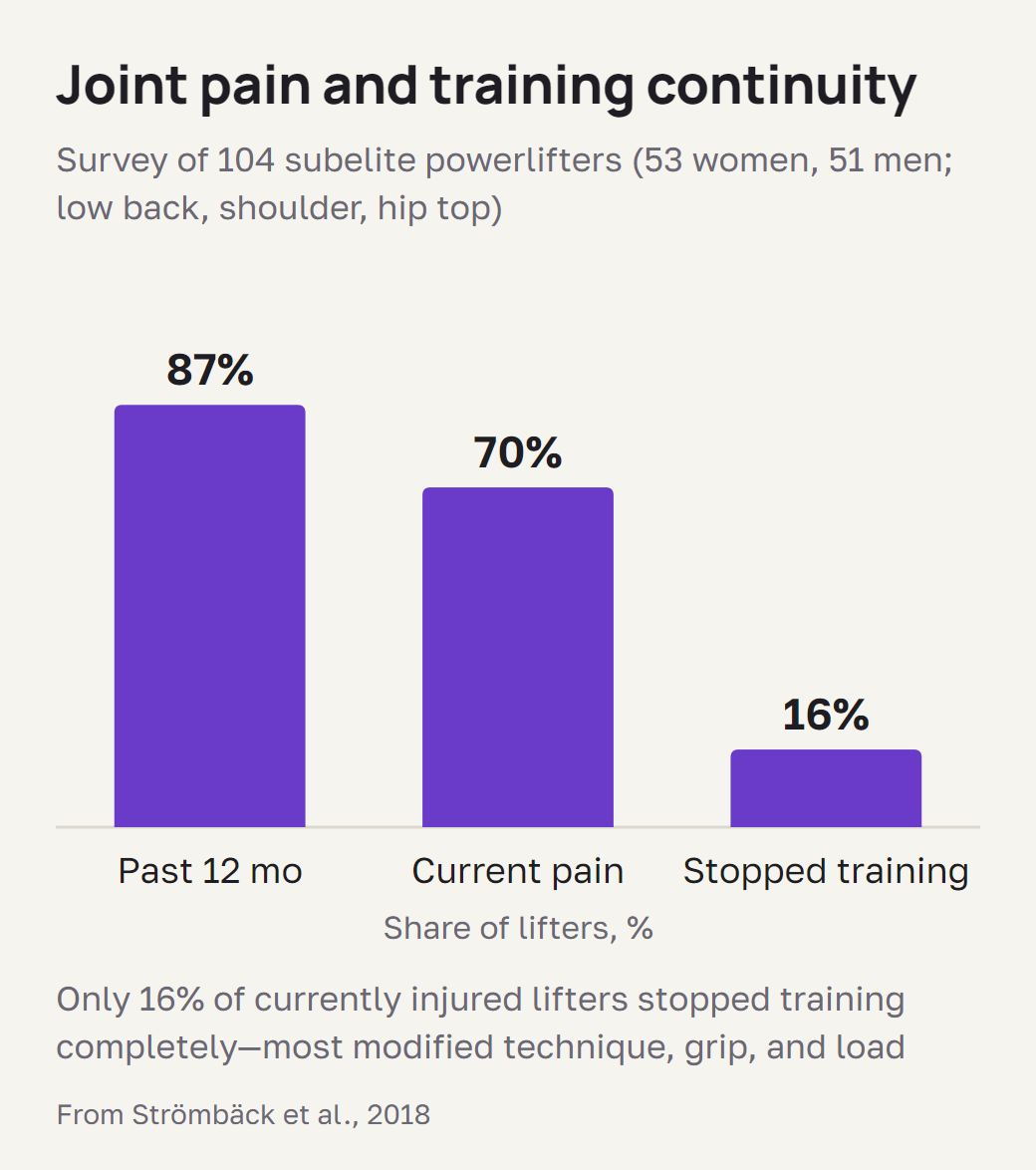
At the bottom of a bench press, the shoulder joint bears high load as the humerus travels behind the torso. Under high pressing volumes, repeated load on the shoulder makes it one of the most frequent gym complaints. In a cross-sectional study of 104 Swedish powerlifters (53 women, 51 men), 87% of respondents (83 of 95) reported pain or injury over the past 12 months, and 70% (73 of 104) had a current complaint; the shoulder, lower back, and hip ranked as the top three regions (Strömbäck et al., 2018). Only 16% of those with a current injury (11 of 70) had to stop training completely—most adjusted their program rather than quitting the gym.
Accumulated fatigue from repeatedly training to failure is another concern. A narrative review by Motlagh and Lipps (2024) notes that direct biomechanical data on the fatigued shoulder during bench pressing remain limited. Accordingly, the authors recommend relying more on autoregulation—RPE, reps in reserve (RIR), and bar velocity monitoring—instead of constant sets to failure to lower overuse risk.
Three bench press technique errors that overload the joint
In 2024, Noteboom et al. (2024) analyzed 10 experienced lifters across 21 bench press variations combining grip widths (1, 1.5, and 2 biacromial widths), shoulder abduction angles (45°, 70°, 90°), and scapular positions using OpenSim musculoskeletal modeling.
Three practical points stood out:
- Grip width. A grip narrower than 1.5 biacromial widths (the distance between the bony outer points of the shoulders) significantly reduced acromioclavicular joint compression (p < 0.05). At the same time, an overly narrow grip (1 biacromial width) paired with tight elbow tucking to 45° can increase superior shear forces, so a practical sweet spot is a medium grip of roughly 1.3–1.5 shoulder widths and 45–70° of shoulder abduction.
- Losing scapular position. Scapular retraction together with a grip below 1.5 shoulder widths lowered posterior glenohumeral shear forces and rotator cuff demand (p < 0.05). When the shoulder blades drift apart on the bench, the shoulder loses a stable base.
- Inconsistent lateral force on the bar. Pulling or pushing unevenly along the barbell shifted joint loads markedly from lifter to lifter.
My name is Demid Lobanov, and I am a fitness coach. In my coaching practice, when a lifter complains of anterior shoulder discomfort, our first step is shifting to a medium 1.3–1.5 shoulder-width grip and restoring calm scapular retraction with moderate 45–70° shoulder abduction instead of flaring to 90°.
Exercise therapy vs. passive modalities
When choosing between passive modalities and exercise, the research consistently points to graded exercise as the foundation of recovery.
In an umbrella review of 16 systematic reviews, Pieters et al. (2020) issued a strong recommendation for therapeutic exercise as first-line care for subacromial shoulder pain. Manual therapy is acceptable as an adjunct early on. For laser, ultrasound, extracorporeal shockwave therapy, and pulsed electromagnetic fields, the authors reported moderate evidence of no effect.
A Bayesian network meta-analysis by Zhang et al. (2025) evaluated seven exercise approaches for RCRSP separately across a pain network (15 RCTs, 913 participants) and a dysfunction network (16 RCTs, 947 participants). Concentric strength training (CST) showed the highest probability of ranking first for pain reduction and also delivered significant functional gains. For improving function, eccentric strength training (ECT) and traditional strength training (TT) yielded moderate gains and outperformed motor control (MCE) and isolated scapular focus (SFT), whereas pain differences across the remaining modes were mostly not statistically significant.
| Approach for shoulder pain | Evidence summary | Practical takeaway |
|---|---|---|
| Graded strength training (CST, ECT, traditional lifting) | Best functional outcomes; CST ranks highest in probability for pain relief (Zhang, 2025; Pieters, 2020) | Core recovery tool |
| Scapular stabilization exercises (SSE) | Greater VAS pain reduction (−0.94) and SPADI improvement (−10.10) vs. standard physiotherapy (Zhong, 2024) | Useful complement to strength work |
| Injury-prevention & dynamic stability programs | Moderate-to-large injury risk reduction (GRADE: very low to moderate; Liaghat, 2023) | Smart warm-up and accessory base |
| Ultrasound, laser, shockwave, magnet without exercise | Moderate evidence of no effect (Pieters, 2020) | Do not replace exercise therapy |
How to modify pressing without quitting the gym
When acute injury has been ruled out, the goal for the next 2–4 weeks is keeping chest and triceps training inside a tolerable range while removing the painful path. The Danish Society of Sports Physical Therapy statement (Liaghat et al., 2023) reports that comprehensive stability and strengthening programs reduce overall athletic shoulder injury risk (GRADE certainty very low to moderate).
Four variations are commonly tolerated better than a flat barbell bench press:
- Seated chest press in a lever machine. The guided track eliminates erratic lateral bar forces and lets you limit bottom depth to a comfortable range.
- Neutral-grip dumbbell press (palms facing each other). A neutral wrist reduces shoulder internal rotation and often eases anterior joint irritation.
- Floor press or board press. Limiting the bottom portion keeps the upper arm from traveling behind the torso, which is often tolerated more comfortably when the front of the shoulder is irritated.
- Leaving reps in reserve. In my practice, keeping 2–3 reps in reserve helps avoid fatigue-driven overload (Motlagh and Lipps, 2024).
Choosing comfortable pressing angles, substitutions, and load progression steps is easiest during a technique review and consultation or inside ongoing online coaching with regular video feedback.
Strengthening the rotator cuff and scapular stabilizers
A meta-analysis of 8 randomized trials (387 participants) showed that scapular stabilization exercises for subacromial pain cut 10-point VAS pain by 0.94 points more than standard physiotherapy (p < 0.001) and improved the SPADI pain-and-disability score by 10.10 points (p = 0.02) (Zhong et al., 2024). They did not add extra range of motion—their value is lowering pain and restoring function alongside broader strength work.
Two staple drills that fit neatly at the start or end of upper-body sessions for 2–3 pain-free sets of 12–15 reps:
- Cable shoulder external rotation with elbow at your side. Set the pulley at elbow height, keep the upper arm pinned to your side, and rotate smoothly without twisting the torso. This directly loads the external rotators (infraspinatus and teres minor).
- High-pulley rope face pull. Combines scapular retraction with shoulder external rotation. Pull with elbows at or slightly below shoulder height without overarching the lower back.
I also post pressing and scapular technique breakdowns on my YouTube channel @lobanov_fitness. For a deeper look at barbell mechanics and rear-shoulder work, read Barbell Bench Press Technique and Rope Face Pulls.
When to see a doctor
Do not try to self-diagnose shoulder pain. Liaghat et al. (2023) highlight that in-person clinical tests show high diagnostic accuracy (low-to-moderate certainty) for anterior shoulder instability, biceps-labral complex lesions, and full-thickness subscapularis tears.
See a sports physician or orthopedic specialist if you notice any red flag:
- sharp pain accompanied by a pop during a set;
- pronounced weakness—difficulty raising your arm or holding an everyday object;
- bruising or swelling around the shoulder;
- night shoulder pain or pain that does not settle at rest;
- numbness in the arm or hand;
- pain lasting longer than 2–3 weeks without improvement.
Five-step return to pressing
Once red flags are ruled out, I (Demid Lobanov) structure the return to pressing in five steps—a practical adaptation of gradual progression principles from the ACSM position stands for healthy adults (ACSM, 2009; Currier et al., 2026).
- Remove the trigger for 2–4 weeks. Temporarily swap flat barbell benching for a lever chest press, neutral-grip dumbbell press, or floor press.
- Use a moderate rep range. Work in the 8–12 rep zone with 2–3 reps in reserve and controlled tempo without bouncing off the chest.
- Add targeted strengthening 2–3 times per week. Perform 2–3 pain-free sets of cable external rotations and face pulls.
- Reintroduce the barbell with a medium grip. Start at 1.3–1.5 shoulder widths (avoiding extremes like 2× or 1× shoulder width), 50–60% of your previous working weight, and steady scapular retraction.
- Increase weight in small increments. While ACSM guidelines cite 2–10% jumps for healthy lifters, after a bout of pain a smaller 2–5% step is safer in practice—only after your current weight feels smooth during sets and causes no flare-up the next morning.
Sources
- Zhang W et al. Effects of seven types of exercise in the treatment of rotator cuff-related shoulder pain (RCRSP): a systematic review and Bayesian network meta-analysis. J Orthop Surg Res, 2025. PMID 41276811
- Noteboom L et al. Effects of bench press technique variations on musculoskeletal shoulder loads and potential injury risk. Front Physiol, 2024. PMID 38974522
- Zhong Z et al. Effect of scapular stabilization exercises on subacromial pain (impingement) syndrome: a systematic review and meta-analysis of randomized controlled trials. Front Neurol, 2024. PMID 38497039
- Pieters L et al. An Update of Systematic Reviews Examining the Effectiveness of Conservative Physical Therapy Interventions for Subacromial Shoulder Pain. J Orthop Sports Phys Ther, 2020. PMID 31726927
- Liaghat B et al. Diagnosis, prevention and treatment of common shoulder injuries in sport: grading the evidence – a statement paper commissioned by the Danish Society of Sports Physical Therapy (DSSF). Br J Sports Med, 2023. PMID 36261251
- Motlagh JG, Lipps DB. The Contribution of Muscular Fatigue and Shoulder Biomechanics to Shoulder Injury Incidence During the Bench Press Exercise: A Narrative Review. J Strength Cond Res, 2024. PMID 39808810
- Strömbäck E et al. Prevalence and Consequences of Injuries in Powerlifting: A Cross-sectional Study. Orthop J Sports Med, 2018. PMID 29785405
- American College of Sports Medicine. Progression models in resistance training for healthy adults. Med Sci Sports Exerc, 2009. PMID 19204579
- Currier BS et al. American College of Sports Medicine Position Stand. Resistance Training Prescription for Muscle Function, Hypertrophy, and Physical Performance in Healthy Adults: An Overview of Reviews. Med Sci Sports Exerc, 2026. PMID 41843416