

Smith machine squats still divide the gym floor. Some call the Smith machine a "safe barbell replacement for beginners," while others insist fixed rails ruin joints and build less muscle. Modern randomized trials and biomechanical models tell a much calmer, more practical story.
I am Demid Lobanov, a fitness coach and strength-training educator. In client programs I use both free-weight squats and Smith machine squats—the choice depends on limb proportions, goals, and accumulated fatigue. You can match exercises to your anatomy and schedule in a training protocol or a structured workout program. Below is what distinguishes the Smith machine from a free barbell in research and real training.
Muscle growth and strength: Smith machine vs. free barbell
The main fear around machines is simple: if rails guide the bar, muscles work less and grow less. A meta-analysis directly compared free weights with machines across 13 studies lasting at least 6 weeks (1,016 participants: 789 men, 219 women, and 8 whose sex was not specified; Haugen et al., 2023). No differences appeared for hypertrophy (5 studies; SMD −0.055; p = 0.751), dynamic strength (SMD 0.084; p = 0.387), isometric strength (SMD −0.079; p = 0.660), or jump height. The only notable gap was skill specificity: free-weight testing slightly favored the free-weight group (SMD −0.210; p = 0.023), while machine testing trended toward the machine group (SMD 0.291; p = 0.064).
Two 8-week trials comparing free-weight and machine programs reinforced that finding:
- In 38 resistance-trained men performing full squats, bench presses, prone bench pulls, and overhead presses (Hernández-Belmonte et al., 2023), both groups grew quadriceps cross-sectional area equally on ultrasound (difference ≤ 2.0%; p ≥ 0.208) and achieved similar overall strength across eight tests (difference ≤ 1.8%; p ≥ 0.216), with each group gaining more on the equipment it trained. Joint discomfort fell in both groups with no difference between them (p ≥ 0.144).
- In a randomized trial of 46 lifters (26 women; 3–4 sets of 4–10 reps; Schwanbeck et al., 2020), quadriceps thickness and strength in free-weight squats, Smith squats, and free-weight bench press (+11–19%) rose equally across both groups. A sharper acute post-workout rise in free testosterone among men lifting free weights gave no extra muscle growth.
A 7-week randomized trial of 59 men echoed these results (Saeterbakken et al., 2019): after three familiarization weeks, squatting in a Smith machine, with a free barbell, or on an unstable surface produced equal gains in muscle thickness, isometric strength, and rate of force development—though the Smith group improved 10RM more specifically in the Smith machine than in less stable tests. In 2025, an 8-week trial of 20 students squatting at 70% 1RM (Marcos-Frutos et al., 2025) checked whether Smith squats chronically distort ground-reaction force direction, found no systematic distortion (only one propulsive-impulse difference in Smith testing at 70% 1RM, p = 0.037), and concluded both variations are interchangeable.
Where the "43% less effective" Smith machine myth came from
The claim almost always points back to a single acute crossover study (Schwanbeck et al., 2009). Six healthy participants performed one 8RM set of free-weight squats and Smith squats while wearing electromyography (EMG) sensors. Average electrical activity across all seven measured muscles was 43% higher with the free barbell: +49% in vastus medialis, +34% in gastrocnemius, and +26% in biceps femoris, with no significant difference in vastus lateralis, tibialis anterior, lumbar erector spinae, or rectus abdominis.
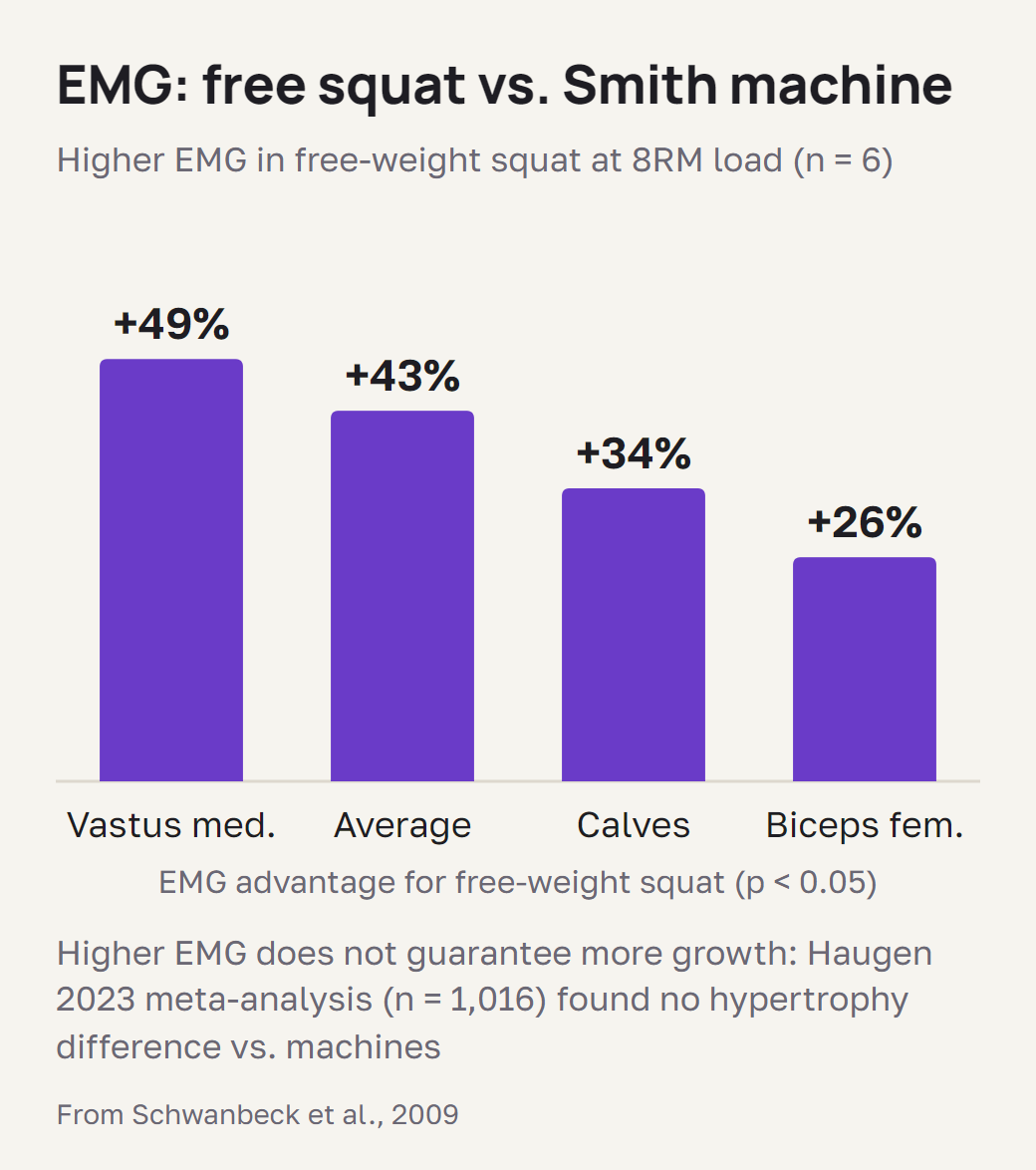
Based on Schwanbeck et al. 2009 (6 participants, 8RM): acute EMG was higher with a free barbell in three muscles, yet longer-term randomized trials from 2019–2023 showed equal quadriceps growth.
Read that paper with two caveats. First, it studied only 6 people. Second, acute EMG captures electrical firing during one set as the body stabilizes balance, which does not automatically translate into superior hypertrophy. Eleven years later, the same research group ran an 8-week muscle-thickness trial (Schwanbeck 2020) and found equal hypertrophy between free weights and machines.
There is also a practical loading detail. In a 32-person 1RM comparison (Cotterman et al., 2005), parallel squat 1RM was higher in the Smith machine overall, though by sex the difference held significantly only in women. Never copy barbell weights directly onto a Smith machine—empty bar weight varies widely depending on each frame's counterbalance system.
Smith biomechanics: how foot placement and rail angle shift load
The defining mechanical feature of a Smith machine is that the bar travels along fixed rails, removing the need to balance the barbell horizontally. That frees you to adjust foot position and torso lean far more than in a free barbell squat, where the combined center of mass must stay over the base of support of the feet.
An analytical biomechanical model mapped this cleanly (Biscarini et al., 2011). At a given knee angle, stepping feet forward ahead of the knees, leaning the torso forward, and shifting weight toward the forefoot increase hip and lumbosacral torque while lowering knee torque and joint compression. Placing feet closer beneath the bar with a more upright torso flips the pattern: the knee travels farther forward, hip torque drops, and the quadriceps and knee take more work.
A follow-up model from the same team analyzed angled Smith machines common in commercial gyms (Biscarini et al., 2013):
- When the bar travels slightly backward on the way up (your back faces the upward slope so the rails tilt up and behind you), knee torque and compression decrease while hip and lower-back torque increase.
- When the bar travels slightly forward on the way up (you face the upward slope), knee torque and compression rise while hip torque drops.
Both Biscarini studies are mathematical models, so exact foot placement always needs tuning to your femur-to-tibia proportions and joint mobility.
| Smith machine setup | Where joint torque is higher | Biomechanical effect |
|---|---|---|
| Feet closer under the bar, torso more upright | Knee joint (quadriceps) | Higher knee torque and stronger emphasis on the quadriceps |
| Feet 15–25 cm forward, slight torso lean | Hip joint (glutes) and lower back | Higher hip torque with reduced knee torque and compression |
| Rails angled backward on the way up | Hip joint | Lower knee torque and compression with greater hip loading |
| Rails angled forward on the way up | Knee joint | Higher knee torque and compression with lower hip demand |
One lower-back caveat: stepping too far forward while squatting rock-bottom often triggers pelvic tucking ("butt wink"), rounding the lumbar spine under load. Stop depth right before the pelvis loses neutrality. For knee travel mechanics, see Can Knees Go Past Toes in a Squat?.
When the Smith machine wins—and when a free barbell fits better
The choice between a Smith frame and a power rack depends on your training block goal rather than an abstract idea of which tool is "better."
The Smith machine shines in four cases:
- Targeting the quadriceps or glutes late in a leg session when lower-back and trunk stabilizers are already fatigued from deadlifts or free squats.
- Working around limited ankle mobility so you can train the quadriceps through fuller knee flexion (heel elevation helps here too).
- Dialing knee loading carefully by adjusting foot forward shift and locking safety stops at an exact height.
- Training without a spotter when pushing close to failure in the 6–12 rep range—the hypertrophy zone with moderate velocity recommended by the 2009 ACSM position stand (ACSM, 2009), adapted to individual goals and capacity.
A free barbell is preferable if you compete in powerlifting or want to build balance and strength specifically in free-weight squats (as Haugen 2023 and Saeterbakken 2019 show, strength gains are specific to the equipment trained). Similar bar-path setup principles are covered in Smith Machine Bench Press.
Step-by-step Smith machine squat technique
- Check the rail angle. If the rails are angled rather than strictly vertical, choose your facing direction by goal: bar moving up-and-forward (down toward heels) emphasizes the quadriceps; bar moving up-and-back (down slightly forward) emphasizes the hips. Test an empty bar facing both ways.
- Set the safety stops. Position the catches a couple of centimeters below your working depth so you can rack the bar calmly if a rep stalls without twisting your spine.
- Set bar height and upper-back tightness. Rest the bar across your upper traps as in a classic back squat, retract your shoulder blades firmly toward the spine, and unrack with a wrist turn.
- Dial in foot placement. Start with feet shoulder-width or slightly wider and 10–15 cm ahead of the bar's vertical line, toes angled slightly out (move out to 15–25 cm if targeting the glutes more). If heels lift at the bottom, step a couple of centimeters forward; if the pelvis tucks or balance feels awkward, step slightly back.
- Control tempo and depth. Lower smoothly over 2–3 seconds, tracking knees in line with toes without dropping or bouncing at the bottom, then drive up powerfully through the whole foot.
To fit Smith squats and free-weight lifts into one progressive plan matched to your joints, use a personal training protocol or pick a structured layout from workout programs.
I also post lower-body and back technique breakdowns on my YouTube channel @lobanov_fitness.
Sources
- Haugen ME et al. Effect of free-weight vs. machine-based strength training on maximal strength, hypertrophy and jump performance - a systematic review and meta-analysis. BMC Sports Sci Med Rehabil, 2023. Article · Full text
- Hernández-Belmonte A et al. Free-Weight and Machine-Based Training Are Equally Effective on Strength and Hypertrophy: Challenging a Traditional Myth. Med Sci Sports Exerc, 2023. Article · PubMed
- Schwanbeck SR et al. Effects of Training With Free Weights Versus Machines on Muscle Mass, Strength, Free Testosterone, and Free Cortisol Levels. J Strength Cond Res, 2020. Article · PubMed
- Marcos-Frutos D et al. Free-Weight and Smith-Machine Squats: Do They Produce Selective Chronic Adaptations in the Effectiveness of Force Application? Int J Sports Physiol Perform, 2025. Article · PubMed
- Schwanbeck S et al. A comparison of free weight squat to Smith machine squat using electromyography. J Strength Cond Res, 2009. Article · PubMed
- Cotterman ML et al. Comparison of muscle force production using the Smith machine and free weights for bench press and squat exercises. J Strength Cond Res, 2005. Article · PubMed
- Biscarini A et al. Modelling the joint torques and loadings during squatting at the Smith machine. J Sports Sci, 2011. Article · PubMed
- Biscarini A et al. Joint torques and joint reaction forces during squatting with a forward or backward inclined Smith machine. J Appl Biomech, 2013. Article · PubMed
- Saeterbakken AH et al. The short- and long-term effects of resistance training with different stability requirements. PLoS One, 2019. Article · Full text
- American College of Sports Medicine. Progression models in resistance training for healthy adults. Med Sci Sports Exerc, 2009. Article · PubMed