
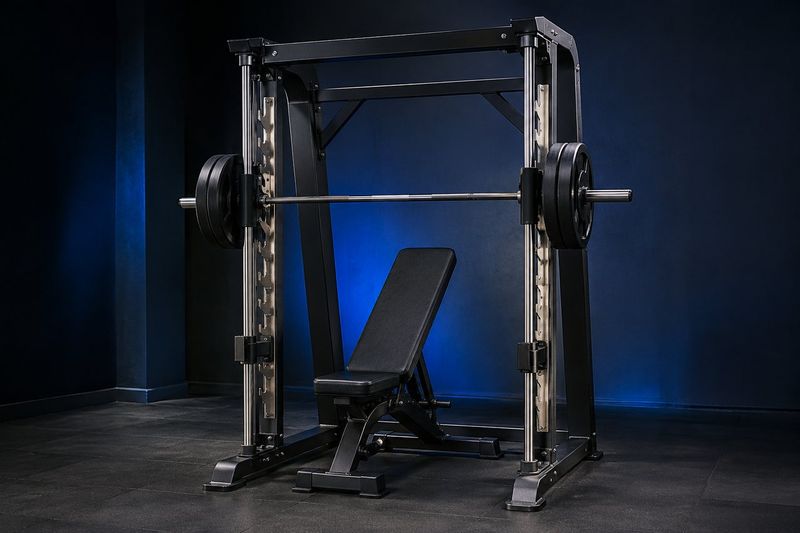
The Smith machine press is a barbell press in a machine where the bar travels along vertical guide rails. It works the pectoralis major, the front delt, and the triceps, and the bench angle shifts the share of work between the chest and the delt: at around 35° the upper chest leads, at around 55° the front delt. The guide rails take away the need to balance. Studies have found no difference in muscle growth between machines and free weights, but there is little data on growth.
The same exercise is also called the Smith machine bench press or the Smith press. I'm Demid Lobanov, a fitness coach. My exercise library has two Smith machine press entries: on a 35° incline bench for the upper chest and on a 55° bench for the front delt.
Muscles worked in the Smith machine press
This is how it's mapped in my exercise library: on a 35° bench, the main work is done by the clavicular head of the pectoralis major, the upper chest. It raises the arm forward and brings the arms together in front of you (Hall, Chapter 7). The front delt assists it and takes on more and more of the work as the angle increases. The middle and lower parts of the pec help bring the arms together, and the triceps extends the elbow in the second half of the lift. The rotator cuff, a group of muscles around the shoulder joint, holds the head of the humerus in place. Based on the mechanics, the guide rails take over part of this job; there is no measurement on the cuff.
On a 55° bench, the front delt becomes the prime mover, and the clavicular head of the pec assists it in the bottom half of the movement. The triceps works harder: a single shared bar lets you handle more weight than dumbbells.
| Bench angle | Prime mover | Assisting muscles |
|---|---|---|
| 0° (bench press), per Hall's textbook | Pectoralis major, sternal (middle) head | Front delt, triceps |
| 35° | Clavicular head of the pec | Front delt, triceps |
| 55° | Front delt | Clavicular head of the pec, triceps |
Which bench angle to choose
For the upper chest, set the bench to about 35°; for the front delt, to about 55°. This is how it's recorded in my exercise library: at 30–35° the clavicular head leads, around 45° is the transition, and by 55–60° the delt leads. Research doesn't give an exact boundary, so treat the angle as a guideline.
- In Trebs 2010, 15 men pressed at 0, 28, 44, and 56° with 70% of their max, presumably in a Smith machine, according to Lauver 2016 and Rodríguez-Ridao 2020. The clavicular head worked harder at 44° than at 0 and 28°. The sternal head worked harder on the flat bench. The front delt worked harder at 28, 44, and 56° than at 0°.
- In Rodríguez-Ridao 2020, 30 people with training experience pressed a free barbell at five angles. The clavicular head didn't differ between 0 and 45° and became less active at 60°, while the front delt worked harder than on the flat bench starting from 30°.
These are data on the electrical activity of muscles recorded by electromyography, not on growth. It has not been confirmed that this activity can predict which angle builds a muscle better (Vigotsky 2022).
Smith machine bench press
My exercise library has no entry for the flat Smith press, but it has been compared with the free barbell. The pectoralis major and front delt work the same way in the Smith machine as with a barbell. Your max in the Smith machine is usually slightly lower.
- Saeterbakken 2011: 12 trained men pressed in the Smith machine, with a barbell, and with dumbbells. The pectoralis major and front delt worked the same. The max with dumbbells was 14% lower than in the Smith machine and 17% lower than with the barbell.
- Schick 2010: Smith machine and free barbell bench press at 70% and 90% of max. The side delt worked harder with the free barbell.
- Cotterman 2005: 32 men and women. In the bench press, the max was higher with a free barbell. The authors derived a conversion formula: Smith machine max = 0.95 × barbell max − 6.76 kg. If your barbell max is 60 kg, your Smith machine max will be about 50 kg.
Smith machines are built differently: on some, the bar is counterbalanced; on others, there is added viscous resistance that depends on movement speed (Arandjelović 2012, a computational model). That's why I don't compare weights between different Smith machines.
Seated Smith machine press
The seated Smith machine press usually means the vertical overhead press. My exercise library has no separate entry for it; the closest is the press on a 55° bench, where the front delt leads. I break down how the vertical press works in the article "Seated Machine Overhead Press".
Smith machine or free barbell
No difference in muscle growth has been found, and strength improves more on the equipment you train with: for free weights this was confirmed, for machines there was only a trend. The Smith machine is handy when you need to work close to failure without having to balance the weight. Dumbbells give you a deeper bottom position and let each arm work on its own.
- Haugen 2023: a meta-analysis of 13 studies, 1,016 people. In direct comparisons, muscle growth from machines and free weights did not differ. Strength in free-weight tests increased more from free-weight training. The authors ask readers to interpret the conclusion about growth with caution: there were 5 comparisons of growth.
- Schwanbeck 2020: 46 people, 8 weeks of training with free weights or on machines. Biceps and quad thickness increased equally.
- Saeterbakken 2019: 59 men, 7 weeks of squats in a Smith machine, with free weights, or on a balance board. Vastus lateralis thickness increased equally, while the Smith machine group improved more in their own exercise.
Where the Smith machine press is hardest
It's hardest at the bottom, near the chest: there, the pec and front delt are stretched, and the bar starts from zero velocity. This is how it's recorded in my exercise library; it's an estimate without measurement.
In the Smith machine, the bar moves vertically, and with your shoulder blades pressed into the bench, the shoulder joint stays in place. So the horizontal distance between the joint and the bar barely changes during a rep: it's set by the bench position and grip width. The point where the bar is hardest to press is not necessarily where the calculated load is greatest (Kompf 2016).
How to do the Smith machine press: step by step
- Set the bench to the angle you need: 35° for the upper chest, 55° for the front delt.
- Position the bench so the bar comes down to the upper chest just below the collarbones at 35°, and to the collarbones at 55°.
- Squeeze your shoulder blades together and press them into the bench.
- Keep your elbows at 45–60° to your torso at 35°, and at 30–45° at 55°.
- Lower the bar until it touches your chest.
- Press until your elbows are almost fully extended.
You can check yourself by two signs: at the bottom, the bar touches your chest at the right point, and your shoulder blades stay pressed into the bench until the end of the set.
Common Smith machine press mistakes
- The shoulder rolls forward and up, and the shoulder blade slides forward. This is usually where technique starts to break down.
- Arching the lower back: the angle effectively decreases, and the press turns into a press at a lower angle.
- Not lowering the bar to the chest: you lose the most heavily loaded bottom part of the movement.
- The bench is in the wrong place: the bar comes down on the middle of the chest or on the neck instead of the upper chest.
- On a 55° bench, the elbows flare out to 90°: the work shifts to the pec, and the front of the shoulder joint takes the load.
Smith machine press with shoulder pain
In my exercise library, the Smith machine press isn't ruled out for shoulder pain based on the diagnosis alone: the phase, tolerance, and dosage decide. If a doctor has made a diagnosis and you currently have a flare-up of pain under the acromion, the bony projection of the shoulder blade above the shoulder joint, the depth is limited. With shoulder instability or a past dislocation, the bottom position is limited and the elbows are kept closer to the torso. After a recent tear or surgery on the pec or the shoulder joint, only with a doctor's clearance. With uncontrolled high blood pressure, only with a doctor's clearance and in any case without holding your breath. Pain at rest or at night, numbness, shooting pains, and weakness in the arm are a reason to stop training and see a doctor. Sharp pain without a clear cause means seeing a doctor first.
How to include the Smith machine press in your training
- Choose the angle for your goal: 35° for the upper chest, 55° for the front delt.
- Count the sets toward your weekly volume: for the chest, 10–20 working sets per week (more in the article "How Many Sets per Week").
- Work close to failure: the guide rails let you do this without having to balance.
- Alternate the Smith machine with dumbbells if you need a deeper range at the bottom and work for each arm on its own.
If you need a plan for your goal and your gym, there's the personalized program.
I post exercise breakdowns on my YouTube channel @lobanov_fitness.
Sources
- Hall SJ. Basic Biomechanics. 9th edition. McGraw Hill, 2022. Chapter 7, the upper extremity.
- Trebs AA et al. An electromyography analysis of 3 muscles surrounding the shoulder joint during the performance of a chest press exercise at several angles. J Strength Cond Res, 2010. Article
- Rodríguez-Ridao D et al. Effect of Five Bench Inclinations on the Electromyographic Activity of the Pectoralis Major, Anterior Deltoid, and Triceps Brachii during the Bench Press Exercise. Int J Environ Res Public Health, 2020. Article · Full text
- Vigotsky AD et al. Longing for a Longitudinal Proxy: Acutely Measured Surface EMG Amplitude is not a Validated Predictor of Muscle Hypertrophy. Sports Med, 2022. Article
- Saeterbakken AH et al. A comparison of muscle activity and 1-RM strength of three chest-press exercises with different stability requirements. J Sports Sci, 2011. Article
- Schick EE et al. A comparison of muscle activation between a Smith machine and free weight bench press. J Strength Cond Res, 2010. Article
- Cotterman ML et al. Comparison of muscle force production using the Smith machine and free weights for bench press and squat exercises. J Strength Cond Res, 2005. Article
- Arandjelović O. Common variants of the resistance mechanism in the Smith machine: analysis of mechanical loading characteristics and application to strength-oriented and hypertrophy-oriented training. J Strength Cond Res, 2012. Article
- Haugen ME et al. Effect of free-weight vs. machine-based strength training on maximal strength, hypertrophy and jump performance - a systematic review and meta-analysis. BMC Sports Sci Med Rehabil, 2023. Article · Full text
- Schwanbeck SR et al. Effects of Training With Free Weights Versus Machines on Muscle Mass, Strength, Free Testosterone, and Free Cortisol Levels. J Strength Cond Res, 2020. Article
- Saeterbakken AH et al. The short- and long-term effects of resistance training with different stability requirements. PLoS One, 2019. Article · Full text
- Kompf J et al. Understanding and Overcoming the Sticking Point in Resistance Exercise. Sports Med, 2016. Article · Full text