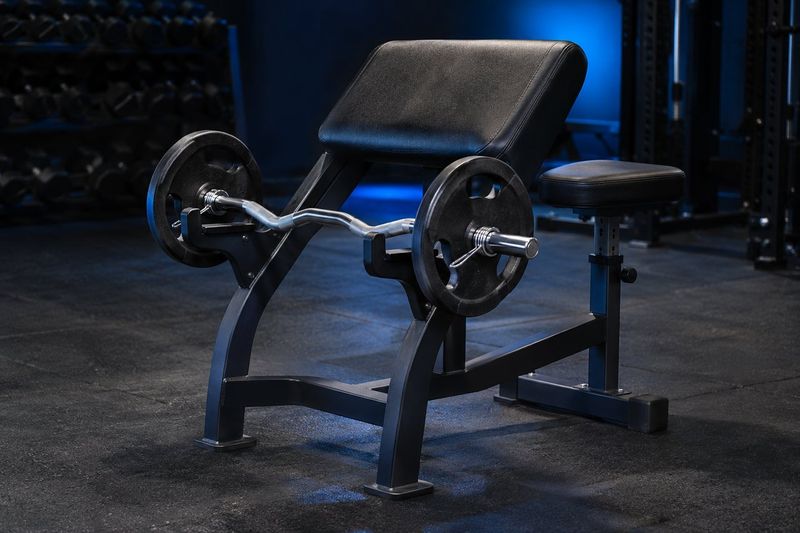
The preacher curl is elbow flexion with the upper arm resting on an angled pad. The pad locks the upper arm in place, so you can't swing your torso: only the elbow works. According to research, after preacher curls the elbow flexors get thicker closer to the elbow, and the brachialis grows slightly more than with incline curls. The biceps itself grows a bit more from incline curls. Total elbow flexor growth is the same.
I'm Demid Lobanov, a fitness coach. My exercise library includes the machine preacher curl, rated beginner level. The preacher bench is also called a Scott bench, and the exercise a Scott curl.
Which muscles preacher curls work
The order according to my exercise library:
- biceps brachii, or the biceps: flexes the elbow and turns the palm up. With the upper arm on the pad, it's positioned forward, so the biceps is shortened at the shoulder end and loses some of its force;
- brachialis: the strongest elbow flexor, according to Hall's biomechanics textbook. It attaches to the ulna and works the same in any forearm position. Its length depends only on the elbow angle;
- brachioradialis helps flex the elbow. With a palms-up grip, it's in a less favorable position than with a neutral grip;
- pronator teres and wrist flexors: accessory elbow flexors;
- triceps stabilizes the elbow, especially at the bottom when the arm is almost straight;
- finger and wrist flexors hold the handle, and the rotator cuff and front delt keep the upper arm on the pad.
How preacher curls differ from regular curls
There are two differences. The first is the upper arm position: it's brought forward, so the biceps is shorter, while the brachialis isn't affected by this.
The second is where the hardest point is. It's set by the equipment, not by the pad itself:
- with a barbell or dumbbells, it's hardest when the forearm is horizontal. With the pad at about 45°, that's 40–50° of elbow flexion: the bottom part of the movement, where the flexors are stretched;
- on a pulley, when the cable comes from in front and below, the load shifts toward the bent elbow;
- on a machine, it depends on the design: a cam built "to the strength curve" puts the peak in the middle of the movement.
What the research shows
In studies, muscle cross-sectional area and thickness are measured with ultrasound or MRI. There are several studies comparing preacher curls with other curls:
- Kassiano and colleagues, 2025: 63 young women trained 2 times a week for 8 weeks with preacher curls or incline curls. After incline curls, the elbow flexors got thicker closer to the shoulder; after preacher curls, closer to the elbow. Strength increased more in the exercise that was trained;
- Zabaleta-Korta and colleagues, 2023: 38 recreationally trained women did dumbbell curls for 9 weeks: 4 sets of 12 reps to failure, 3 times a week. In the preacher curl group, muscle thickness near the elbow increased from 2.7 to 2.94 cm; in the incline curl group, no region grew. Still, there was no significant difference between the groups;
- Kobayashi and colleagues, 2026: 21 untrained people trained one arm with incline curls and the other with preacher curls for 12 weeks. The biceps grew more from incline curls: 22.1% vs. 18.9%. The brachialis and brachioradialis grew more from preacher curls: 21.1% vs. 17.1% and 17.6% vs. 13.5%. All the flexors combined grew with no significant difference: 17.6% and 19.2%. The regions within each muscle (near the shoulder, in the middle, near the elbow) grew equally with both exercises, and the difference between the exercises is small;
- Attarieh and colleagues, 2025: for 10 weeks, 15 men did preacher curls on a pulley with one arm and, with the other, curls also on a pulley but seated, with the upper arm pulled back about 50°. The load across the range of motion was matched. The biceps grew by 6–7% and 9%, the brachialis by 10 and 8%, with no significant difference.
The Attarieh study found no significant difference between a biceps shortened and a biceps stretched at the shoulder end.
Which part of the movement is loaded also matters. In a 2020 study by Nunes and colleagues, 35 young adults did preacher curls with a barbell or on a pulley for 10 weeks. Biceps thickness at mid-upper arm increased equally: by 8% with the barbell and by 7% on the pulley; the region near the elbow wasn't measured in this study. Strength with the elbow almost straight (20° of flexion) increased more with the barbell: by 39% vs. 30%.
In a 2023 study by Pedrosa and colleagues, 19 untrained young women did dumbbell preacher curls for 8 weeks: one arm only in the initial range of motion (0–68° of flexion), the other only in the final range (68–135°). The initial range produced more biceps growth near the elbow and more than twice the strength gain: 42.8% vs. 19%.
The takeaway: the preacher curl is a good exercise for the brachialis and the lower part of the elbow flexors, but not the only one. When you rotate exercises for a muscle group, all its regions grow; when you stick to the same ones, not all of them do. Costa and colleagues showed this in 2021 in 22 men. That's why preacher curls pair well with incline curls.
How to do preacher curls: step by step
- Adjust the seat so your upper arms rest firmly on the pad. On a machine, the lever's pivot should line up with your elbow; otherwise the handles slide around in your hands.
- Take the handle with a palms-up grip. Keep your wrist straight; don't bend it back.
- Curl to 120–130° at the elbow without lifting your upper arms off the pad.
- Lower the weight smoothly until your elbow is almost fully straight. Don't lock it out completely under load, and don't let the weight drop onto the pad with a jerk.
A palms-up grip suits the biceps best. If the machine has neutral-grip handles, the brachioradialis works more.
Where the preacher curl is hardest
With a barbell and dumbbells, it's hardest at the bottom, at 40–50° of flexion. The bottom degrees are the most valuable for growth if the equipment loads them. Sato and colleagues showed the same in 2021, as did a 2026 review by Pedrosa and colleagues: the stretched position builds more muscle when it's under load.
But the bottom degrees are also the riskiest: the elbow is almost straight under load, and the biceps tendon at the elbow is taut. Video recordings of ruptures of this tendon show that almost all of them happen with the palm up and the elbow almost straight (Lappen 2022, Jukes 2022). Most often it's the deadlift, but biceps curls are among the causes too. These are observations, not an experiment. So go through the bottom position only under control.
On a pulley and on many machines, the load is shifted toward the middle or the top of the movement. The stretched position gets less load.
Common preacher curl mistakes
- Dropping the weight: the elbow snaps straight under load.
- Upper arms come off the pad, and the top of the rep is finished with the torso.
- The wrist bends back at the bottom.
- The machine's pivot doesn't line up with the elbow: the handles slide in your hands, and the load across the range of motion gets distorted.
Preacher curls with elbow pain
During a flare-up of already diagnosed biceps tendinopathy at the elbow or medial epicondylitis (pain on the inner side of the elbow), limit the bottom degrees and the weight. These are restrictions for the flare-up period, not a ban based on the diagnosis.
After a rupture of or surgery on the biceps tendon at the elbow, start the exercise only once your doctor clears you. If your elbow hyperextends, don't lower the weight until your arm is fully straight.
Pain that has no established cause, is severe, or is getting worse is a reason to see a doctor first.
How many sets and reps to do
Count preacher curls together with your other curls. A guideline for experienced lifters is 10–20 working sets per muscle per week, taking recovery into account.
Any number of reps works as long as your sets end close to failure: the point where you can no longer do another rep with proper form. More in the articles How to Build Your Biceps and How Many Sets per Week.
How to add preacher curls to your training: step by step
- Check your elbow: during a flare-up, reduce the weight and don't lower your arm all the way; if the pain has no established cause, see a doctor first.
- Adjust the seat and the machine's pivot to your elbow.
- Do preacher curls alongside incline curls, or alternate them.
- Count sets together with your other curls.
- Go through the bottom part of the movement slowly and without jerking.
If you need a plan for your goal and your gym, there's the personalized program.
I post exercise breakdowns on my YouTube channel @lobanov_fitness.
Sources
- Hall SJ. Basic Biomechanics. 9th edition. McGraw Hill, 2022. Chapter 7: upper extremity.
- Kassiano W et al. Distinct muscle growth and strength adaptations after preacher and incline biceps curls. Int J Sports Med, 2025. Article
- Zabaleta-Korta A et al. Regional Hypertrophy: The Effect of Exercises at Long and Short Muscle Lengths in Recreationally Trained Women. J Hum Kinet, 2023. Article · Full text
- Kobayashi Y et al. Exercise-specific preferential hypertrophy of individual elbow flexor muscles after incline versus preacher dumbbell curl training. J Sports Sci, 2026. Article
- Attarieh P et al. Comparison Between Shoulder Flexed and Extended Positions in Elbow Flexion Resistance Training on Regional Hypertrophy and Maximum Strength: Preacher versus Bayesian Cable Curls. Eur J Sport Sci, 2025. Article · Full text
- Nunes JP et al. Placing Greater Torque at Shorter or Longer Muscle Lengths? Effects of Cable vs. Barbell Preacher Curl Training on Muscular Strength and Hypertrophy in Young Adults. Int J Environ Res Public Health, 2020. Article · Full text
- Pedrosa GF et al. Training in the Initial Range of Motion Promotes Greater Muscle Adaptations Than at Final in the Arm Curl. Sports (Basel), 2023. Article · Full text
- Costa BDV et al. Does Performing Different Resistance Exercises for the Same Muscle Group Induce Non-homogeneous Hypertrophy? Int J Sports Med, 2021. Article
- Sato S et al. Elbow Joint Angles in Elbow Flexor Unilateral Resistance Exercise Training Determine Its Effects on Muscle Strength and Thickness of Trained and Non-trained Arms. Front Physiol, 2021. Article · Full text
- Pedrosa GF et al. The interplay between muscle length, range of motion, and exercise selection: a review. Sports Med Int Open, 2026. Article · Full text
- Lappen S et al. Distal biceps tendon ruptures occur with the almost extended elbow and supinated forearm - an online video analytic study. BMC Musculoskelet Disord, 2022. Article · Full text
- Jukes C et al. Challenging the mechanism of distal biceps tendon rupture using a video analysis study. Bone Jt Open, 2022. Article · Full text