
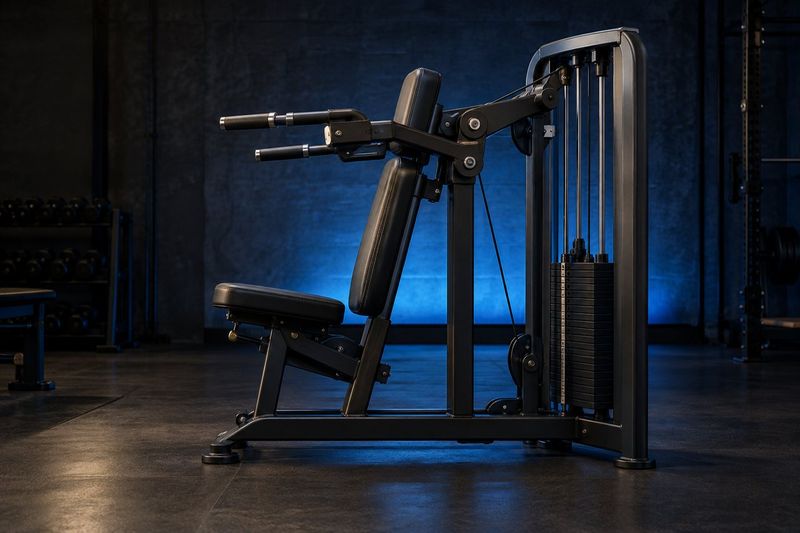
The seated machine overhead press, or seated shoulder press, is an exercise where you press the handles up with your back against the backrest. The front head of the deltoid does the main work, the side head assists, and the triceps often tire first. It's hardest at the bottom, near your shoulders. Your back should stay on the backrest; otherwise, the press turns into an incline press. For the side head, this press is no substitute for lateral raises.
I'm Demid Lobanov, a fitness coach. This press shows up 5 times in the programs I've written. The path is fixed and your back is supported, so the exercise suits beginners. It lets you safely train close to failure—the point where you can't do one more rep—without a spotter. Below are the setup, the technique, and the research findings.
Which muscles work
The work is divided as described in my exercise library:
- the front head of the deltoid lifts the upper arm up and forward and takes the main load;
- the side head of the deltoid makes a noticeable but not maximal contribution;
- the triceps straighten the elbow. On a machine, the load on the elbow is usually greater than on the shoulder, so the triceps are often the first to tire;
- the upper traps and other muscles around the shoulder blade rotate the shoulder blade upward.
If you're after the side delt, this exercise isn't enough: abduction movements should be your main exercises. More in the article Dumbbell Lateral Raises.
How to set up the machine
Seat height is the key setting. The handles should travel in the plane of your shoulders without drifting forward or back.
| Setting | What changes |
|---|---|
| Lower seat | the path becomes inclined, and the clavicular part of the pecs works more |
| Wider grip | more abduction of the upper arm and a bigger share for the side delt |
| Narrower or neutral grip | more forward raising of the upper arm and a bigger share for the front delt and triceps |
These mechanics are described in my exercise library. I didn't find any measurements on the machine.
How to do the overhead press: step by step
- Set the seat so the handles are roughly at shoulder level and move in the plane of your shoulders.
- Sit down and press your back into the backrest and your pelvis into the seat.
- Grab the handles.
- Press them up until your elbows are almost fully straight. Don't arch your lower back.
- Don't hike your shoulders toward your ears: the movement comes from the shoulder blade rotating.
- Lower the handles under control to shoulder level.
Where it's hardest
It's hardest at the bottom and over the first 20–30° of the press. The upper arm is close to horizontal, so the moment arm—the distance from the joint to the line of resistance—is at its largest. Toward the top, the load on the delt drops and the triceps take over. This is a calculation from my library; there are no measurements. On a particular machine, the load curve can be changed by the cam, a part that alters the resistance over the course of the movement.
At the same time, the delt works in mid-range and shortened positions. The front head is stretched when the arm is behind the plane of the body, while on the machine the movement starts at shoulder level. To load the delt closer to its stretched position, add a different exercise to your program, for example the 55° incline dumbbell press, where it works at a greater length.
Machine, dumbbells, or barbell
For muscle growth, the choice of equipment appears to be secondary, judging by the data. In a 2023 meta-analysis by Haugen and colleagues (13 studies, 1,016 participants), direct comparisons of free weights and machines found no difference in strength. Only 5 studies compared muscle growth, and they measured it in different ways, from ultrasound to circumferences. They found no difference either, but the authors advise interpreting this conclusion with caution. Strength improved more on the same equipment people had trained with. For free weights, this difference was significant; for machines, it was only a trend.
In a 2023 study by Hernández-Belmonte and colleagues, 38 trained men did squats, bench presses, prone rows, and overhead presses for 8 weeks, either with a barbell or on machines. Strength and muscle cross-sectional area increased equally. The delts weren't measured.
Muscle activity, the electrical signal recorded from the skin during an exercise, does differ, however. In a 2013 study by Saeterbakken and colleagues, 15 men did seated and standing overhead presses with a barbell and dumbbells at 80% of their maximum. The delts were most active in the standing dumbbell press. For the front head, the main mover in this exercise, the difference between seated and standing was about 8% and was not statistically confirmed. In the seated dumbbell press, the side delt worked 15% less and the rear delt about 24% less. But the maximum weight in the standing dumbbell press was also about 10% lower than seated. This study didn't look at machines, and it didn't measure growth either.
The choice depends on your goal. This is my assessment, not the result of a comparison:
| Option | Strengths | Limitation |
|---|---|---|
| Machine | fixed path, back supported, you can train close to failure without a spotter | the handles rarely go below shoulder level |
| Seated dumbbells | free path, each arm works on its own | takes skill; heavy dumbbells are hard to get into the starting position |
| Standing barbell | heavy loads, the whole trunk works | more load on the lower back, takes skill |
Common mistakes
The main mistake is arching your lower back and lifting your back off the backrest. The vertical press quietly turns into an incline press. Other mistakes:
- shoulders rising toward the ears through the upper traps instead of shoulder blade rotation;
- wrong seat height: the handles drift forward or back from the plane of the shoulders;
- the press as your only shoulder exercise: the side head doesn't get enough load, and the rear head barely works in the press.
When to hold off on the overhead press
In my library, restrictions depend on the stage. There are no bans that apply at every stage:
- acute phase of impingement (compression of the tendons under a bony process of the shoulder blade), if you've already been diagnosed: press at an angle for now. Repetitive overhead movements can provoke impingement (Hall textbook, Chapter 7);
- recent shoulder dislocation or surgery: only after your doctor clears you;
- anterior shoulder instability or a past dislocation: limit the top of the range;
- uncontrolled high blood pressure: overhead work with straining only after your doctor clears you;
- acute low back pain: put it off; in remission, reintroduce it gradually;
- pain with no established cause, severe or getting worse: see a doctor first.
Pain at rest or at night, numbness, shooting pains, and weakness in the arm are a reason to stop training and see a doctor.
How many sets to do
I didn't find any studies specifically on sets, reps, and frequency for this press. My database guidelines for the delts: 10–20 reps, 1–3 reps in reserve, 2 times a week. Reps in reserve are the number of reps you could still do with good technique. Count your sets using the article How Many Sets per Week: the front head already gets part of its load from bench presses.
How to add the press to your workout: step by step
- Check the conditions. Pain with no established cause, severe or getting worse: see a doctor first.
- Set the seat: the handles should be at shoulder level and move in the plane of your shoulders.
- Usually, do the press before lateral raises and rear delt exercises. If your rear head is lagging, start with it.
- Do 10–20 reps with 1–3 in reserve.
- Make sure your back stays on the backrest and your shoulders stay away from your ears.
- Add lateral raises and reverse flyes: this press doesn't replace them.
If you need a plan for your goal and your gym, there's the personalized program.
I post exercise breakdowns on my YouTube channel @lobanov_fitness.
Sources
- Hall SJ. Basic Biomechanics. 9th edition. McGraw Hill, 2022. Chapter 7: the upper extremity.
- Haugen ME et al. Effect of free-weight vs. machine-based strength training on maximal strength, hypertrophy and jump performance - a systematic review and meta-analysis. BMC Sports Sci Med Rehabil, 2023. Article · Full text
- Hernández-Belmonte A et al. Free-Weight and Machine-Based Training Are Equally Effective on Strength and Hypertrophy: Challenging a Traditional Myth. Med Sci Sports Exerc, 2023. Article
- Saeterbakken AH et al. Effects of body position and loading modality on muscle activity and strength in shoulder presses. J Strength Cond Res, 2013. Article