
Bent-over dumbbell lateral raises are a rear delt exercise: you bend over until you're almost horizontal and raise your arms out to the sides. The key to the technique is the torso angle. The closer your torso is to horizontal, the more the rear delt works. If you come up higher, the work shifts to the side delt and the trapezius.
I'm Demid Lobanov, a fitness coach. My exercise library has two versions: unsupported bent-over raises for intermediate lifters and chest-supported raises on an incline bench for beginners. The same exercise is also called rear delt raises or bent-over dumbbell reverse flyes.
Which muscles work in bent-over lateral raises
This is horizontal shoulder abduction: the arm moves out to the side while the torso is bent over. Gravity pulls the arm toward the floor, and the rear delt lifts it. Here's how the work is distributed among the muscles according to my exercise library:
- rear delt: the main muscle of the exercise;
- infraspinatus and teres minor assist horizontal abduction and rotate the shoulder outward;
- side delt assists, especially if the torso is higher;
- rhomboids and middle trapezius pull the shoulder blades together in the top third of the movement;
- teres major and lats kick in more if the elbows travel toward the hips, and then the raise turns into a row;
- lower trapezius keeps the shoulders from rising toward the ears;
- back extensors, glutes, and hamstrings hold the bent-over position. In the chest-supported version, the bench takes over this work.
Torso angle: why it matters most
The load from the dumbbell can be split into two parts: horizontal abduction for the rear delt and regular abduction for the side delt. The ratio between them depends on the angle of your torso or of the bench back. Here's the calculation in my exercise library:
- 15–30° from horizontal: the load goes mostly into horizontal abduction, that is, to the rear delt. At 15°, almost all of it does; at 30°, the side delt already takes a noticeable share;
- 45°: by calculation, the load is split evenly between the rear and side delts;
- 60° and above: this is already a lateral raise, and most of the load goes to the side delt.
That's why, toward the end of a set, as you get tired and straighten up, the work quietly shifts from the rear delt to the side delt and upper trapezius.
What the research shows
I didn't find any studies on rear delt growth from bent-over raises specifically. There are data on muscle activity and force calculations.
Muscle activity is recorded with sensors on the skin or with fine electrodes inside the muscle. This method is called electromyography:
- Campos and colleagues, 2020: 13 trained men. The rear delt worked at 3.5% of maximum in the bench press, 11.4% in the overhead press, and 24% in lateral raises. The bench press barely loads the rear head, and the overhead press loads it half as much as lateral raises. My conclusion from this: the rear head needs dedicated work;
- Schoenfeld and colleagues, 2013: 19 trained men did reverse flyes on a reverse pec deck machine. With a neutral grip, palms facing each other, the rear delt worked slightly harder than with a palms-down grip;
- Reinold and colleagues, 2004: 10 healthy people, sensors inside the muscles. Peak rear delt activity was 88% of maximum when the arm was moved out to the side while lying face down, at 100° of abduction and with the shoulder fully rotated outward. The side delt worked at 87% in the same movement: external rotation and the arm above shoulder level load both heads. This is a similar but different version of the movement.
Muscle forces can be calculated with a computer model. In a 2025 paper by Zhu and colleagues, in 10 men, rear delt force was 58.6 N in bent-over lateral raises, 58.2 N in face pulls, and 47.9 N in bent-over dumbbell rows. This is a model calculation; there was no direct measurement.
Muscle activity shows which muscles are engaged, but it doesn't predict their growth.
Where bent-over raises are hardest
The hardest point is the top, when your arms are out at shoulder level. The load depends on how far the arm has moved away from vertical. When it hangs under the shoulder, there's no load. At 45° from vertical, the load is about 0.7 of maximum, and the maximum is reached when the arm is horizontal.
At the top, the rear delt is already shortened. It's stretched when the arm crosses in front of the chest, and in bent-over raises that position isn't loaded. It is loaded by reverse flyes on the cable machine and single-arm reverse flyes on a machine; more in the article Reverse Pec Deck.
How to do bent-over dumbbell lateral raises: step by step
- Take light dumbbells. Bend over so that your torso is 15–30° above horizontal, with your back straight.
- Let your arms hang under your shoulders, bend your elbows slightly, and lock in that angle.
- Raise your arms out to the sides, perpendicular to your torso, up to shoulder level. Your torso stays still.
- Lower the dumbbells smoothly, without dropping them.
- Hold the torso angle for the whole set. Once you straighten up, the set is over.
Start the movement from the shoulder. If you start by squeezing your shoulder blades together, your back does the work.
Chest-supported raises
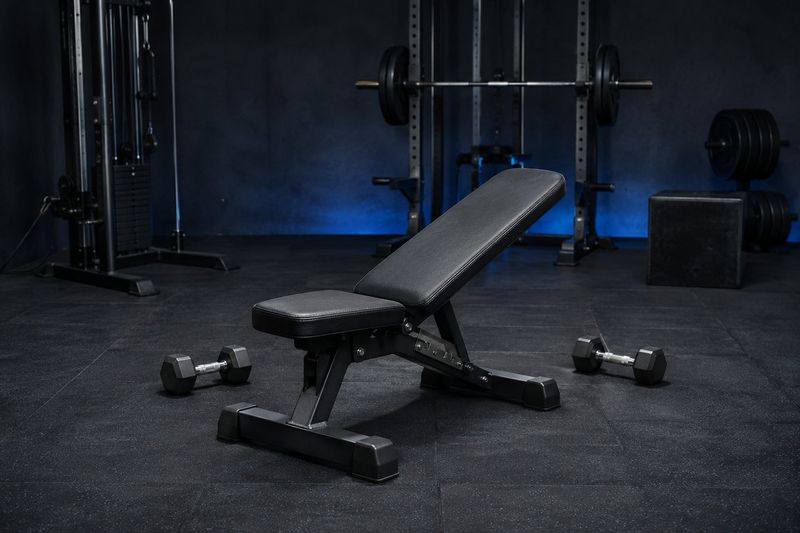
Resting your chest on an incline bench takes the load off your lower back: you don't have to hold the bent-over position. That's why this version suits beginners and people with lower back limitations.
- Set the bench back to 30° if your goal is the rear delt. At 45°, by calculation, the load is split evenly between the rear and side delts.
- Lie with your chest on the bench back and let your arms hang under your shoulders.
- Raise your arms out to the sides up to shoulder level without lifting your chest off the pad.
- Lower the dumbbells smoothly.
Here, the first thing to break down is your position on the bench: your chest lifts, your head comes up, and your torso straightens. If the pad presses on your sternum or ribs hard enough to hurt, add padding or switch to reverse flyes on the cable machine.
Common mistakes in bent-over raises
- The torso straightens up toward the end of the set: the work shifts to the side delt and upper trapezius.
- Swinging the torso to start the rep.
- The elbows travel toward the hips: the raise turns into a row for the lats.
- Starting by squeezing the shoulder blades: the back does the movement.
- The elbow bends during the movement: the lever gets shorter, and the load quietly drops.
- The shoulders rise toward the ears.
Bent-over raises with lower back or shoulder pain
In the unsupported version, the back muscles hold the bent-over position. During a flare-up of lower back pain, these raises are replaced with the chest-supported version, and in remission the unsupported version is brought back gradually.
During a flare-up of pain under the acromion, the bony process of the shoulder blade above the shoulder joint, the top of the movement is limited to a pain-free level. Pain with no established cause, or pain that is severe or getting worse, is a reason to see a doctor first.
How many sets and reps to do
The rear delt is a separate head, and sets for it are counted separately. The guideline in my database for delts is 10–20 sets per week per head and 10–20 reps per set with 1–3 reps in reserve. If your rear delts are lagging, put bent-over raises at the start of your workout.
Choose a deliberately light weight: the movement is hardest at the top, where the rear head is shortened. Failure, meaning you can't do one more rep, comes right there. More in the article How to Build Your Shoulders.
How to add bent-over raises to your workout: step by step
- Choose the version: if you have lower back limitations, and when you're starting out, go chest-supported.
- Take light dumbbells and hold the torso angle for the whole set.
- Count your rear delt sets separately from presses.
- For the stretched position, add reverse flyes on the cable machine or single-arm reverse flyes on a machine.
- If your rear delts are lagging, do bent-over raises at the start of your workout.
If you need a plan for your goal and your gym, there's the personalized program.
I post exercise breakdowns on my YouTube channel @lobanov_fitness.
Sources
- Hall SJ. Basic Biomechanics. 9th edition. McGraw Hill, 2022. Chapter 7: upper extremity.
- Campos YAC et al. Different Shoulder Exercises Affect the Activation of Deltoid Portions in Resistance-Trained Individuals. J Hum Kinet, 2020. Article · Full text
- Schoenfeld B et al. Effect of hand position on EMG activity of the posterior shoulder musculature during a horizontal abduction exercise. J Strength Cond Res, 2013. Article
- Reinold MM et al. Electromyographic analysis of the rotator cuff and deltoid musculature during common shoulder external rotation exercises. J Orthop Sports Phys Ther, 2004. Article
- Zhu Q et al. Biomechanical evaluation of posterior deltoid exercises and kinematic trajectory modeling. Acta Bioeng Biomech, 2025. Article