
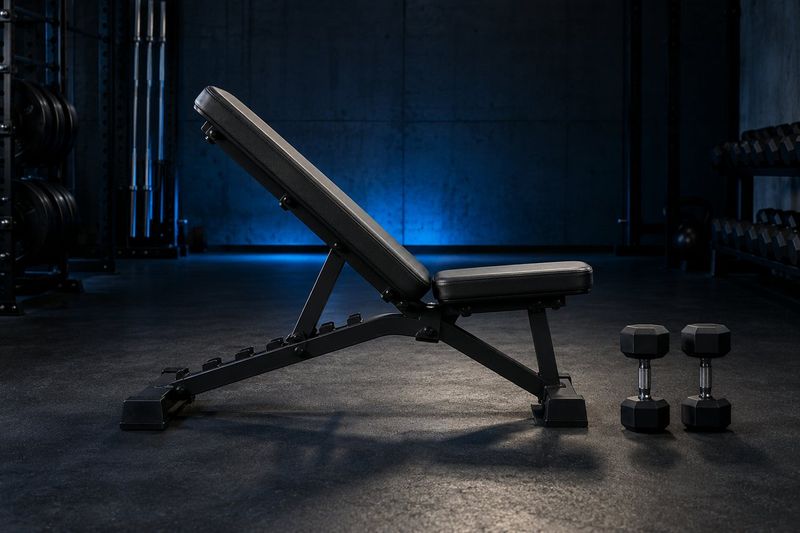
The incline dumbbell press, also called the incline dumbbell bench press, primarily loads the upper pectoralis major (its clavicular head) and the front head of the deltoid. The bench angle changes how the load is distributed: the steeper it is, the more of the work the delt takes over. In a 2020 study by Rodríguez-Ridao and colleagues, the front delt worked harder than on a flat bench starting at 30°. At 60°, the clavicular head worked less. The press is hardest at the bottom, where the pec is stretched.
I'm Demid Lobanov, a fitness coach. In the programs I've written, the 45° incline dumbbell press appears 9 times, more often than any other chest exercise in my library.
Which muscles the incline dumbbell press works
The clavicular head of the pectoralis major does the main work: it raises the arm forward and brings the arms together in front of the body (Hall, chapter 7). The front delt also raises the arm forward, and as the bench angle increases, it takes over more and more of the work. The triceps extends the elbow in the second half of the lift. The middle and lower trapezius and the rhomboids hold the shoulder blades in place. The rotator cuff muscles hold the head of the humerus in place. That's how it's recorded in my exercise library.
| Muscle | What it does in the press | When it works more |
|---|---|---|
| Pectoralis major, clavicular head | raises the arm forward and brings the arms together | at a bench angle of 30–45° |
| Front delt | raises the arm forward | the steeper the bench angle |
| Pectoralis major, sternal head | brings the arms together | on a flat bench |
| Triceps | extends the elbow | in the second half of the lift |
| Middle and lower trapezius, rhomboids | keep the shoulder blades pulled together and down | throughout the exercise |
| Rotator cuff muscles | hold the head of the humerus in the joint | throughout the exercise, especially at the bottom |
Which bench angle to choose: 30 or 45°
For the upper chest, set the bench at about 30°; for the upper chest together with the front delt, set it at 45°. That's how it's recorded in my library: as the angle increases, the front delt takes over more and more of the work. In the Rodríguez-Ridao study, 30 trained young adults bench pressed 60% of their max at five angles, from 0 to 60°. The clavicular head worked the same from 0 to 45° and less at 60°. The middle and lower portions of the pectoralis major worked less with each step up in incline. The front delt was already working harder than on a flat bench from 30°.
| Bench angle | What works more |
|---|---|
| 0°, flat bench | middle and lower portions of the pectoralis major |
| 30° | clavicular head and front delt; middle and lower portions less |
| 45° | clavicular head and front delt; middle and lower portions even less |
| 60° | front delt; clavicular head less |
The studies disagree here. In Trebs and colleagues (2010), with 15 men, the clavicular head worked harder at 44° than at 28° or on a flat bench. In Lauver and colleagues (2016), 30° and 45° produced more upper-chest activity than a flat bench only during part of the lift. Over the whole lift, there was no difference. Rodríguez-Ridao and Lauver attribute the discrepancy to different equipment: Trebs used a Smith machine, while they used a free barbell.
There's less data on dumbbells. In Luczak and colleagues (2013), 24 women pressed 4.5 kg dumbbells. At 45°, both the front delt and the clavicular head worked harder than on a flat bench, on both the way up and the way down.
All of these studies measured electromyography, a method that records a muscle's electrical activity during exercise. In a 2022 review, Vigotsky and colleagues showed that it has not been confirmed as a predictor of muscle growth. So the angle is a guideline for your choice. The studies don't give a precise cutoff between 30 and 45°: in Rodríguez-Ridao, neither the clavicular head nor the front delt differed significantly between these angles.
My programs use 45°: this angle loads both the upper chest and the front delt. If the goal is to target the upper chest specifically, my library specifies 30° for that.
Does the incline press build the upper chest
Yes, and this has been shown by more than electromyography. In a 2020 study by Chaves and colleagues, 47 untrained men did the bench press once a week for 8 weeks: on a flat bench, on a 44° incline, or both. The upper pectoralis major grew more in those who pressed on the incline: 0.62 cm more than with the flat press. There was no difference in the middle and lower parts of the muscle. More on this in the article How to build your chest.
Dumbbells or barbell
Dumbbells let you go deeper: the bar stops at your chest, while dumbbells can go below the line of your shoulders. Each arm works on its own, so the stronger side can't help the weaker one. That's how it's recorded in my exercise library.
You'll lift less weight with dumbbells. In a 2011 study by Saeterbakken and colleagues, 12 trained men bench pressed with a barbell, with dumbbells, and on a Smith machine. Their max with dumbbells was 17% lower than with the barbell and 14% lower than on the Smith machine. The pectoralis major and front delt worked the same in all three variations; the triceps worked less with dumbbells.
Weight also drops as the angle increases. In Rodríguez-Ridao, the average max was 81 kg on a flat bench, 63 kg at 30°, and 58 kg at 45°. Don't compare your incline weights with your flat bench press.
Where the press is hardest
It's hardest at the bottom, when the line from the shoulder joint to the hand is horizontal. At that point, the dumbbell's moment arm relative to the joint is at its longest. At the top, the dumbbells are over your shoulders, and the load on the pecs almost disappears. At the bottom, the clavicular head of the pectoralis major and the front delt are stretched, so the load falls on the muscles in their stretched position. That's how it's calculated in my exercise library.
The last 10–15° of the lift barely load the pecs. There's no point in bringing the dumbbells together at the top.
How to do the incline dumbbell press: step by step
- Set the bench back to 30° or 45°, depending on your goal.
- Lie on the bench with the dumbbells and press your head and back into it.
- Pull your shoulder blades together and down, and keep them there for the whole set.
- Lower the dumbbells until your hands are slightly below the line of your shoulders.
- Press the dumbbells up until your elbows are almost straight, without bringing them together.
- Keep your elbows out to the sides if your goal is the chest; with the elbows closer to the body, the front delt and triceps do more of the work.
Common incline dumbbell press mistakes
| Mistake | What happens | How to fix it |
|---|---|---|
| Shoulder blades drift forward and up | the shoulder slides forward, and depth comes at the joint's expense | pull your shoulder blades together and down, use lighter dumbbells |
| Dumbbells clank together at the top | the work shifts to where the pecs are barely loaded | stop the dumbbells over your shoulders without bringing them together |
| Not going low enough | you lose the part of the movement you use dumbbells for | lower until your hands are below the line of your shoulders |
| 45° angle for the upper chest | the front delt takes over more of the work | for the upper chest, set the bench at about 30° |
Incline dumbbell press with shoulder pain
In my library, pressing with shoulder pain isn't ruled out by the diagnosis itself: the phase, tolerance, and dosage decide. During a flare-up of subacromial pain syndrome and with anterior shoulder instability, the depth at the bottom is limited. After a recent tear of or surgery on the pectoralis major, don't press until a doctor clears you. Don't push through acute pain without an established diagnosis; see a doctor first.
Pain at rest or at night, numbness, shooting pains, and weakness in the arm are reasons to stop training and see a doctor.
How to add the press to your workout: step by step
- If the upper chest is a priority, put the incline press first in your chest workout.
- Add an exercise with a more even load, for example a lever chest press machine.
- Use a weight that lets you keep your shoulder blades pulled together for the whole set.
- Choose the number of sets using the article How many sets per week.
- Add weight when, for two workouts in a row, you complete all sets in your target rep range and the last one at the top of that range with clean technique.
If you need a plan for your goal and your gym, there's the personalized program.
I post exercise breakdowns on my YouTube channel @lobanov_fitness.
Sources
- Hall SJ. Basic Biomechanics. 9th edition. McGraw Hill, 2022. Chapter 7: upper extremity.
- Rodríguez-Ridao D et al. Effect of Five Bench Inclinations on the Electromyographic Activity of the Pectoralis Major, Anterior Deltoid, and Triceps Brachii during the Bench Press Exercise. Int J Environ Res Public Health, 2020. Article · Full text
- Trebs AA et al. An electromyography analysis of 3 muscles surrounding the shoulder joint during the performance of a chest press exercise at several angles. J Strength Cond Res, 2010. Article
- Lauver JD et al. Influence of bench angle on upper extremity muscular activation during bench press exercise. Eur J Sport Sci, 2016. Article
- Luczak J et al. Shoulder Muscle Activation of Novice and Resistance Trained Women during Variations of Dumbbell Press Exercises. J Sports Med (Hindawi Publ Corp), 2013. Article · Full text
- Vigotsky AD et al. Longing for a Longitudinal Proxy: Acutely Measured Surface EMG Amplitude is not a Validated Predictor of Muscle Hypertrophy. Sports Med, 2022. Article
- Chaves SFN et al. Effects of Horizontal and Incline Bench Press on Neuromuscular Adaptations in Untrained Young Men. Int J Exerc Sci, 2020. Article · Full text
- Saeterbakken AH et al. A comparison of muscle activity and 1-RM strength of three chest-press exercises with different stability requirements. J Sports Sci, 2011. Article




