
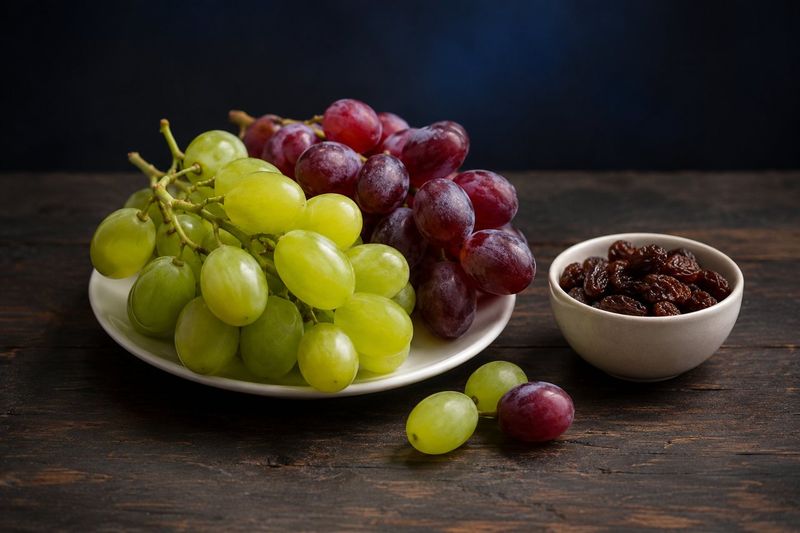
You can eat grapes while losing weight as long as you count their calories in your daily intake. There are about 75 kcal in 100 g of grapes and about 113 kcal in a 150 g serving. That's more than in an apple and less than in a banana. Raisins have about 4 times as many calories as grapes, so you need to weigh your portion.
I'm Demid Lobanov, a fitness coach. The database I use to build meal plans for clients includes a "grapes with cheese" snack: 150 g of grapes and 40 g of cheese come to 252 kcal and 10.7 g of protein.
Calories in grapes
According to USDA, 100 g of grapes contains 0.7 g of protein, 0.2 g of fat, and 18 g of carbs, of which 0.9 g is fiber. By my database's formula, that's about 75 kcal; USDA gives 69. Below is a comparison with other fruits from the same database:
| Food | Kcal per 100 g | Kcal per 150 g |
|---|---|---|
| Apple | 53 | 80 |
| Pear | 57 | 86 |
| Grapes | 75 | 113 |
| Banana | 93 | 140 |
| Raisins | 323 | 485 |
In a 150 g serving, the difference between grapes and an apple is about 33 kcal. What matters more is how many grams of grapes you eat at a time.
Do grapes get in the way of weight loss?
No, as long as they fit into your calories for the day. The carbs in grapes are mostly sugars: 15.5 g per 100 g, according to USDA. But weight goes down because of a daily calorie deficit.
There are few studies in which fresh grapes were given for weight loss. In a 2025 meta-analysis by Soltani and colleagues, grapes and grape products didn't significantly change weight. The authors rated the quality of the studies as low.
In the 2015 cohort studies by Bertoia and colleagues, grapes and raisins were among the fruits associated with less weight gain. The rest of the data is about fruit in general.
In a 2017 systematic review by Hebden and colleagues (11 randomized trials and 6 cohorts), whole fruit in long-term observational studies was associated with a lower risk of weight gain in middle-aged people.
In Guyenet's 2019 systematic review, eating more fresh fruit over 3–24 weeks helped people maintain their weight or lose a little. In the same Bertoia studies (133,468 people), participants gained an average of 1 to 2.3 kg over 4 years.
Each additional daily serving of fruit was associated with less weight gain, by about 0.24 kg over 4 years. This is an observation: it shows an association but doesn't prove cause.
If you simply add fruit to your usual food, your weight usually doesn't go down. In a 2014 meta-analysis by Kaiser and colleagues (7 randomized trials), people were advised to eat more vegetables and fruit or were given them, with no restrictions on the rest of their food. Their weight didn't change.
So grapes don't get in the way of weight loss when they replace higher-calorie food, such as dessert or cookies.
Grapes before bed while losing weight
You can eat grapes before bed. For your weight, calories over the day matter more than meal timing. In the study I covered in the article Is It OK to Eat Before Bed, people with the same deficit lost the same amount of weight whether they had a big breakfast or a big dinner.
If you want something sweet in the evening, a 150 g serving of grapes is about 113 kcal. It's convenient to weigh it in advance and put it on a separate plate.
Grapes, raisins, or juice
Raisins are dried grapes: they contain much less water, so they have more calories per 100 g. By my database's formula, 100 g of raisins has 323 kcal, USDA gives 299, and 30 g has about 97 kcal. In terms of calories, 30 g of raisins roughly equals 130 g of grapes.
Juice is different from whole fruit. In the review by Hebden and colleagues, fruit juice was associated with weight gain in long-term observational studies. Whole fruit was associated with a lower risk of weight gain.
In a 2024 meta-analysis by Nguyen and colleagues, weight gain from juice in adults appeared only in studies without adjustment for calories. In randomized trials, there was no significant gain.
That means weight gain from juice comes down to calories, and juice needs to be counted too. Whole grapes are more practical when you're losing weight: a portion is easier to weigh and track.
How many grapes you can eat per day
There's no specific amount set for grapes. The WHO advises adults to eat at least 400 g of vegetables and fruit a day. Grapes can be part of that amount along with other fruits and vegetables. Exactly how much depends on your calories for the day: in my snack, it's 150 g.
If you have diabetes or another condition for which your diet is prescribed by a doctor, work out the amount of fruit together with them.
Grapes and weight loss: step by step
- Count grapes in your calories for the day: about 75 kcal per 100 g, 113 kcal per 150 g.
- Weigh your portion: it's convenient to put grapes on a separate plate.
- Eat grapes instead of a higher-calorie dessert or cookies: that way you eat fewer calories over the day.
- Weigh raisins especially carefully: 30 g is about 97 kcal.
- Count juice in your calories too, and when losing weight, choose whole grapes.
- After two weeks, compare your average weight for the week with your average for the previous week. If your weight isn't going down, cut back on portions of calorie-dense food.
I post breakdowns on nutrition and training on my YouTube channel @lobanov_fitness.
Sources
- Hebden L et al. Fruit consumption and adiposity status in adults: A systematic review of current evidence. Crit Rev Food Sci Nutr, 2017. Article
- Guyenet SJ. Impact of Whole, Fresh Fruit Consumption on Energy Intake and Adiposity: A Systematic Review. Front Nutr, 2019. Article · Full text
- Bertoia ML et al. Changes in Intake of Fruits and Vegetables and Weight Change in United States Men and Women Followed for Up to 24 Years: Analysis from Three Prospective Cohort Studies. PLoS Med, 2015. Article · Full text
- Soltani S et al. Whole grapes or grape products on body weight, anthropometrics, and adipokines: systematic review and meta-analysis of randomized controlled trials. Int J Food Sci Nutr, 2025. Article
- Nguyen M et al. Consumption of 100% Fruit Juice and Body Weight in Children and Adults: A Systematic Review and Meta-Analysis. JAMA Pediatr, 2024. Article · Full text
- Kaiser KA et al. Increased fruit and vegetable intake has no discernible effect on weight loss: a systematic review and meta-analysis. Am J Clin Nutr, 2014. Article · Full text
- World Health Organization. WHO updates guidelines on fats and carbohydrates, 2023. WHO news