


The debate over whether it is better to work out in the morning or in the evening has lasted for decades. Morning fans point to a "metabolism boost" and faster fat loss. Evening fans point to heavier working weights and feeling better prepared for hard effort.
Looking at 2019–2026 meta-analyses and randomized trials, the answer is far calmer. Over the long run, morning and evening workouts produce comparable muscle growth, strength gains, and weight loss. Consistency remains the decisive factor.
A few real physiological nuances do exist, however. They relate to acute peak power output and nighttime sleep quality.
Strength and muscle growth: morning vs. evening
Single-session peak performance genuinely shifts across the day. In a systematic review and meta-analysis of 29 studies (from 63 screened, Knaier et al., 2022), peak scores were higher in the afternoon and evening:
- jump height: effect size 0.79 (95% CI 0.28–1.30), peaking between 13:00 and 20:00;
- Wingate anaerobic power: effect size 0.73 (95% CI 0.37–1.09), peaking between 13:00 and 20:00;
- handgrip strength: effect size 0.39 (95% CI 0.18–0.60), peaking between 14:00 and 21:00;
- maximum endurance: only a small effect of 0.23 (95% CI 0.05–0.40), with no sharp peak.
The Wingate test measures peak anaerobic power during a short all-out cycling sprint.
At first glance, that looks like a clear win for evening training. Yet a one-off lab test and multi-week adaptation are two different things.
A systematic review and meta-analysis of 11 moderate-to-good-quality studies (Grgic et al., 2019) directly compared groups training with weights in the morning or evening at matched volume and frequency.
The main findings were clear:
- Baseline strength is indeed higher in the evening.
- Over weeks of regular training, muscle growth was similar in morning and evening groups.
- Overall strength gains were also comparable regardless of time of day.
- In people who trained consistently in the morning, morning strength rose to match evening strength.
In short, with regular morning sessions, morning strength catches up to evening levels, and long-term muscle growth matches evening training.
Weight loss: does morning training burn more fat?
A popular myth claims that morning workouts "fire up metabolism all day" and make weight drop faster. Direct randomized controlled trials (RCTs) test this simply by comparing body weight after 3–4 months.
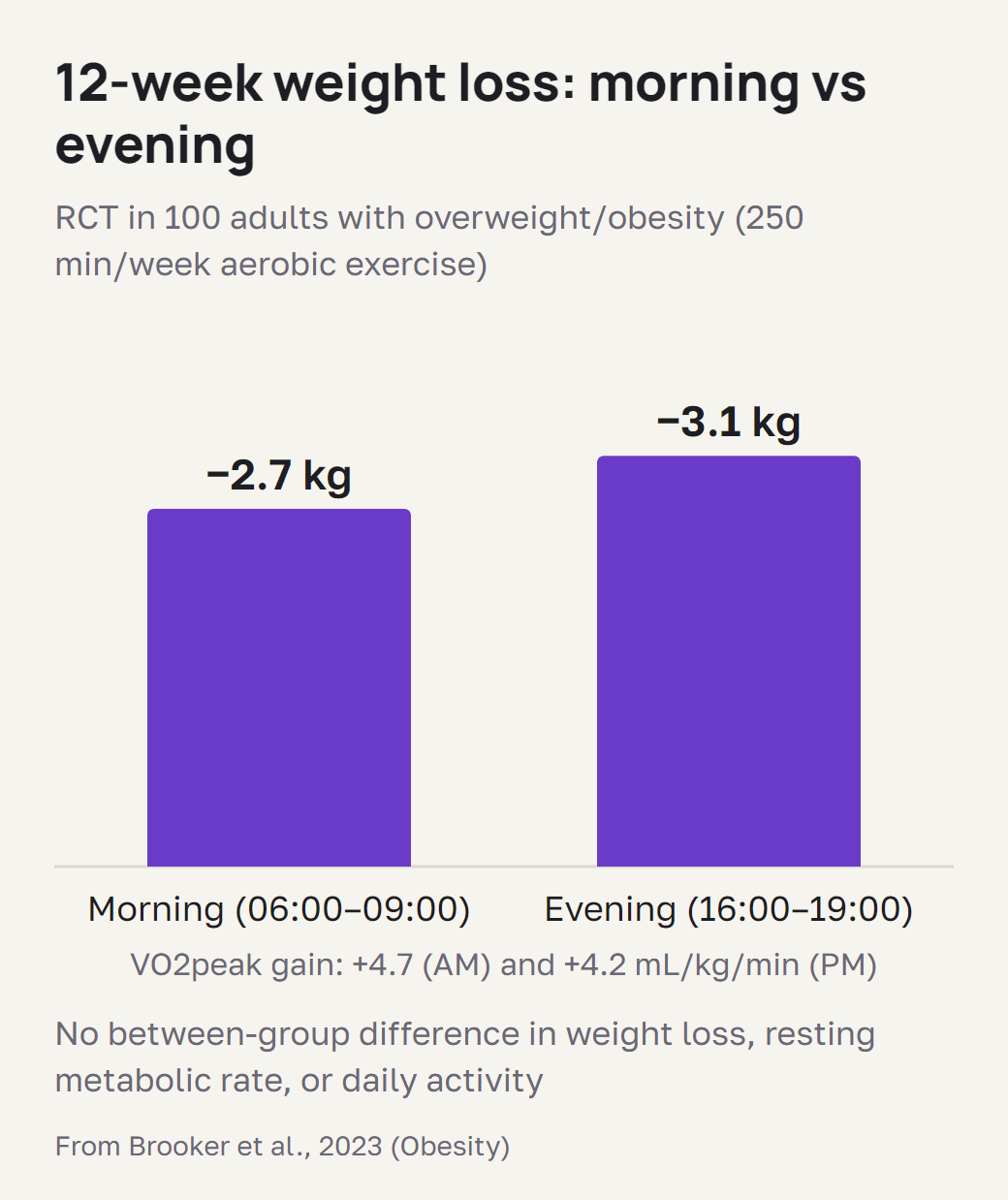
A 12-week RCT enrolled 100 inactive adults with overweight or obesity (Brooker et al., 2023). Participants were assigned to morning exercise (06:00–09:00), evening exercise (16:00–19:00) at 250 minutes of aerobic exercise per week, or a control group.
The results were nearly identical:
- the morning group lost 2.7 ± 2.5 kg (p < 0.001) and the evening group lost 3.1 ± 3.4 kg (p < 0.001);
- VO2peak improved by +4.7 mL/kg/min in the morning (p = 0.034) and +4.2 mL/kg/min in the evening (p = 0.045);
- no between-group differences were found in resting metabolic rate or total daily physical activity.
A 15-week pilot RCT of 33 adults with overweight or obesity training 4 days per week showed a similar pattern (Creasy et al., 2022).
Sessions between 06:00 and 10:00 produced −0.9 ± 2.8 kg, and sessions between 15:00 and 19:00 produced −1.4 ± 2.3 kg, with high adherence (90% or more) in both groups. According to the ISSN position stand (Aragon et al., 2017), fat loss is driven by a sustained daily calorie deficit. In practice, clock time plays a secondary role compared with consistency.
Do evening workouts ruin sleep?
For years, conventional wisdom held that any evening workout inevitably caused insomnia. Four meta-analyses from 2019 to 2026 give a sharper picture: what matters is intensity and how close the session ends to bedtime:
- In a meta-analysis of 23 studies (Stutz et al., 2019), a single evening workout did not harm sleep in healthy adults overall. It slightly increased slow-wave deep sleep (+1.3 percentage points; p = 0.041) and lowered light stage 1 sleep (−0.9 pp; p = 0.001). Sleep-onset latency and sleep efficiency could worsen after vigorous exercise ending 1 hour or less before bedtime.
- In a meta-analysis of 15 studies with 194 healthy adults (Frimpong et al., 2021), acute evening high-intensity exercise 0.5–4 hours before bed slightly reduced REM sleep (−2.34%; p = 0.002). When finished 2–4 hours before bed, it did not disrupt nighttime sleep overall, and regular evening high-intensity training did not impair sleep.
- In a network meta-analysis of 28 studies with 325 participants (Yue et al., 2022), moderate-intensity evening exercise ranked best for potential sleep improvement, while high intensity reduced REM sleep (−1.95%).
- A 2026 meta-analysis combined 25 comparative studies (16 RCTs pooled, Souabni et al., 2026). Again, there was no clear overall advantage of morning over evening exercise for most sleep metrics. Evening or late-night sessions were linked to slightly more wake time after sleep onset—WASO (SMD −0.51; 95% CI −0.89 to −0.12), particularly with high intensity close to bedtime, though the authors noted potential small-study effects. SMD stands for standardized mean difference, a common scale for comparing differences between groups.
The practical takeaway is simple: calm, moderate strength training in the evening usually does not disturb sleep. Meta-analyses point to risk within 1 hour of bedtime and general safety at 2–4 hours; as a cautious practical rule, I recommend leaving at least 1.5–2 hours before bed and skipping caffeinated pre-workouts in the evening.
Morning vs. evening: summary table
| Factor | Morning workouts | Evening workouts | What matters in practice |
|---|---|---|---|
| Muscle growth | Equal effect (Grgic, 2019) | Equal effect | Matched weekly volume and consistency |
| Long-term strength | Catches up to evening with regular sessions | Higher at baseline and in acute power tests (Knaier, 2022) | Consistency and total weekly volume |
| Weight loss | Comparable (−2.7 kg in 12 weeks) | Comparable (−3.1 kg in 12 weeks, Brooker, 2023) | Calorie deficit and consistency |
| Sleep | No clear advantage over evening (Souabni, 2026) | Usually fine with 2–4 h buffer; hard work ≤1 h before bed may disrupt (Stutz, 2019) | Intensity, time before bed, and avoiding caffeine |
| Consistency | Fits people whose mornings are free | Fits people who prefer training after work | Steady 2–4 sessions per week (coaching practice) |
How to tailor workouts to your schedule
My name is Demid Lobanov, and I am a fitness coach. When building a plan for a client, we settle morning versus evening with one question: at what time can you reliably get to the gym 2–4 times a week?
From there, you simply adjust the session to your chosen slot:
- If you train in the morning: in my practice, a slightly more gradual warm-up with 2–3 warm-up sets on your first compound lift works better. If training fasted makes you lightheaded or cuts performance, add a light snack before the gym.
- If you train in the evening: as a cautious practical guideline, finish intense strength sessions at least 1.5–2 hours before bed (research most consistently supports a 2–4 hour window, while risk rises under 1 hour) and cut out caffeine in the second half of the day.
- If your schedule shifts: in my practice, moving individual sessions between morning and evening is fine—total weekly volume matters more than locking every workout to the same hour.
- How to check if your slot fits: evaluate your chosen time after 2–4 weeks using four measurable signs—consistent attendance without skipped sessions, progress in working weights or reps, expected body-weight trend, and nighttime sleep quality.
I help tailor volume and exercise order to a morning or evening schedule in an individual training program. If you coach clients yourself and want a systematic approach to load planning and recovery, check out continuing education for fitness coaches.
I also recommend reading related recovery guides: sleep and weight loss, overtraining and recovery, progressive overload, and what to eat before and after a workout. I post short coaching breakdowns on my YouTube channel @lobanov_fitness.
Sources
- Grgic J et al. The effects of time of day-specific resistance training on adaptations in skeletal muscle hypertrophy and muscle strength: A systematic review and meta-analysis. Chronobiol Int, 2019. Article
- Knaier R et al. Diurnal Variation in Maximum Endurance and Maximum Strength Performance: A Systematic Review and Meta-analysis. Med Sci Sports Exerc, 2022. Article · Full text
- Brooker PG et al. The efficacy of morning versus evening exercise for weight loss: A randomized controlled trial. Obesity (Silver Spring), 2023. Article · Full text
- Creasy SA et al. Effect of Morning and Evening Exercise on Energy Balance: A Pilot Study. Nutrients, 2022. Article · Full text
- Stutz J et al. Effects of Evening Exercise on Sleep in Healthy Participants: A Systematic Review and Meta-Analysis. Sports Med, 2019. Article
- Frimpong E et al. The effects of evening high-intensity exercise on sleep in healthy adults: A systematic review and meta-analysis. Sleep Med Rev, 2021. Article
- Yue T et al. Different Intensities of Evening Exercise on Sleep in Healthy Adults: A Systematic Review and Network Meta-Analysis. Nat Sci Sleep, 2022. Article · Full text
- Souabni M et al. Effects of morning versus evening exercise on sleep: a systematic review of comparative studies with a meta-analysis of randomized controlled trials. Sleep Med Rev, 2026. Article