
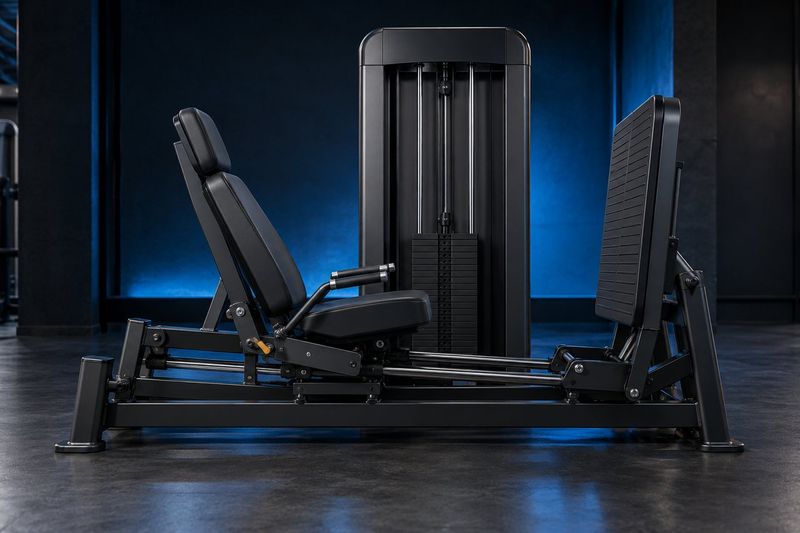
The leg press, or machine leg press, is an exercise in which you push the machine's platform away, extending your knees and hips at the same time. In an MRI study, 12 weeks of leg presses grew the quads, gluteus maximus, and adductor magnus. Foot placement shifts the emphasis: the higher your feet on the platform, the more work at the hip; the lower, the more at the knee. Lower the platform until your pelvis starts to lift off the back pad.
I'm Demid Lobanov, a fitness coach. My exercise library has three leg press variations. The high, narrow foot placement, on both the horizontal and the 45° leg press, is filed under glute exercises; the mid-height, wide placement is filed under quad exercises. Below is why, and what the research says about it.
Muscles worked in the leg press
The quads extend the knee; the gluteus maximus and hamstrings extend the hip (Hall, Chapter 8). Which of them grow was shown by a 2026 study by Kinoshita et al.: 17 untrained young adults, 6 of them women, trained twice a week for 12 weeks, doing the leg press with one leg and leg extensions with the other, 5 sets of 10 reps. Muscle volume was measured by MRI.
| Muscle | Leg press | Leg extension |
|---|---|---|
| Vasti (three heads of the quads) | +4.4–6.2% | +5.0–7.2% |
| Quads overall | +4.9% | +7.1% |
| Rectus femoris | +1.1%, not significant | +13.2% |
| Gluteus maximus | +15.4% | +0.2%, not significant |
| Adductor magnus | +6.2% | no significant growth |
| Hamstrings | +3.1%, long head of the biceps femoris +5.3% | +1.5%, long head of the biceps femoris +2.0% |
The difference between the two exercises for the quads overall was not significant. The rectus femoris barely grew from the leg press, so the authors consider leg extensions essential for it. The hamstrings grew only slightly: according to the authors, much less than in studies where they were trained with leg curls.
An important detail: participants placed their feet hip-width apart with their toes at the top edge of the platform, that is, high. The range of motion was short: the knee and hip flexed to 90°, and at the top the hip stayed flexed at 60°. This study didn't test how the glutes grow with a deeper press.
Leg press foot placement: high or low, narrow or wide
Foot placement varies along two axes: height and width. For height, there's EMG data (electromyography, which records a muscle's electrical signal): with the feet high, the gluteus maximus is more active; with the feet low, the rectus femoris is. Width and toe angle had almost no effect on quad activity. The gluteus maximus wasn't recorded when width was compared. So I choose stance width based on mechanics and the goal of the exercise.
| Placement | What changes | Where this comes from |
|---|---|---|
| Feet high | the hip flexes more, the knee less; the gluteus maximus is more active than with the feet low | mechanics; EMG, Da Silva 2008 |
| Feet low | the knee flexes more; the rectus femoris is more active than with the feet high, and at 80% of max, so is the vastus lateralis | EMG, Da Silva 2008 |
| Narrow, feet parallel | the upper fibers of the gluteus maximus stay stretched | mechanics, my exercise library |
| Wide, toes out | the adductor magnus takes over part of hip extension, and the glutes work in a shorter position | mechanics, my exercise library |
| Width and toe angle on the incline leg press | activity of three quad heads and the gluteus medius doesn't change | EMG, Martín-Fuentes 2022 |
The 2008 study by Da Silva et al. included 14 women, who pressed at 40% and 80% of their max. Martín-Fuentes et al. (2022) recorded three quad heads and the gluteus medius in men and women. In Escamilla et al. (2001), 10 experienced male athletes turned their toes out 30°, and neither muscle activity nor knee forces changed; with a wide, high stance, the hamstrings were more active than with a narrow one.
But it hasn't been confirmed that the EMG signal can predict muscle growth (Vigotsky 2022). So I treat foot height as a lever backed by data, and width as a guideline from mechanics: I don't cite any studies of glute growth at different stance widths to support this conclusion.
Leg press for glutes
For the glutes, place your feet high and narrow: hip-width apart, parallel. That's exactly how the participants in Kinoshita's study stood, and their gluteus maximus grew by 15.4%. In my exercise library, the wide stance with the toes turned out is set up not for the glutes but against them: the width shortens the upper glute fibers before you even start, and part of hip extension shifts to the adductor magnus.
The leg press has a limit. Your pelvis is pressed against the back pad and your hip doesn't fully extend at the top, so the glutes work from a stretched position to a mid position, and the short end of the range goes untrained. The glute bridge and the hip thrust cover it. Other exercises are covered in How to Build Your Glutes.
Leg press for quads
For the quads, place your feet below the middle of the platform or in the middle: the knee flexes more, and knee extension becomes what limits the set. In my exercise library, this is the mid-height, wide placement. The leg press barely grows the rectus femoris, so it gets extra work with leg extensions; more on that in How to Build Your Legs.
How to do the leg press on a machine: step by step
- Adjust the back pad and set the sled's safety stops before the set.
- Sit or lie back so your lower back and pelvis are pressed firmly against the back pad.
- Place your feet on the platform according to your goal: high and narrow for the glutes, lower for the quads. Your knees point the same way as your toes.
- Release the sled from the safety catches by hand.
- Lower the platform as long as your pelvis stays pressed against the back pad. As soon as it starts to lift and your lower back starts to round, that's your bottom position.
- Press the platform away with your whole foot; your heels stay down.
- At the top, don't lock your knees out hard: stop just short.
How deep to go
Your pelvis sets the bottom position. When it lifts off the back pad and your lower back rounds, the glutes shorten because of the pelvic tilt and lose their stretch exactly where the load on them is highest. There's no point lowering the platform past that point.
You don't have to chase depth for the quads either. In a 2025 study by Larsen et al., 23 people with about 7 years of training experience did single-leg presses to failure for 8 weeks: one leg with knee flexion to 100°, the other with their own maximum range of motion, on average to 154°. Quad thickness increased equally. Only the quads were measured.
Incline or seated leg press: 45° or horizontal
On the 45° machine, your torso lies on an inclined back pad, which is why this version is called the incline leg press. On the horizontal machine, you sit leaning against the back pad: that's the seated leg press. Both machines work the same muscles. On the 45° sled you can usually go deeper, but the weight of the sled pushes toward your pelvis, and the pelvis lifts off the pad sooner, so watch it more closely here. With acute low back pain, the horizontal version is better tolerated, provided your doctor has cleared the exercise.
Leg press vs. squats
In Escamilla's 2001 study, the squat produced more quad and hamstring activity than the leg press. In the 2023 meta-analysis by Haugen et al., machines and free weights didn't differ in muscle growth. But only 5 studies compared growth, they measured it in different ways, from ultrasound to girth measurements, and the authors ask readers to interpret this conclusion with caution. The 2022 meta-analysis by Heidel et al. included 3 of these studies and came to the same conclusion. In my exercise library, the leg press is a working substitute for the squat when the squat skill hasn't been learned yet or when a back in remission limits axial loading.
Common leg press mistakes
| Mistake | What happens | How to fix it |
|---|---|---|
| Pelvis lifts off the back pad at the bottom | the lower back rounds, the glutes lose their stretch | end the range while your pelvis is still pressed down |
| Heels lift | pressure shifts to the toes, and a high foot placement turns into a mid one | press with your whole foot |
| Hard knee lockout at the top | the load at the top is almost zero, and the knee straightens under the weight | stop just short of full extension |
| Knees cave in with a wide stance | the knee doesn't track over the foot | point your knees the same way as your toes, or narrow your stance |
Who should be more careful
Low back pain or a herniated disc. In the acute phase, see a doctor first. If they clear the exercise, cut out the deep end of the range, where the pelvis tucks under, and work in a shortened range. In remission, bring the depth back gradually.
High blood pressure. In a 1985 study by MacDougall et al., in 5 experienced bodybuilders doing double-leg presses to failure, blood pressure rose on average to 320/250 mmHg, and in one of them above 480/350. If your blood pressure is high, don't hold your breath and don't take sets to failure. Under the rule I use in my work, a resting blood pressure of 160/100 or higher, or 140/90 or higher with known uncontrolled hypertension, requires clearance from a doctor.
Knee or leg joint pain. Forces at the knee increase as it flexes (Escamilla 2001), so if you have pain, range of motion and weight are chosen together with your doctor. If your doctor has restricted the exercise, the program is built within those limits.
Calves on the leg press machine
The leg press machine is also used to train calves: you push the platform with the front of your foot, moving only at the ankle. In a 2023 study by Kassiano et al., 42 young women did calf raises this way for 8 weeks. The medial, or inner, head of the gastrocnemius grew by 15.2% when they worked in the bottom part of the range, where the muscle is stretched, and by 6.7% with a full range.
How to add the leg press to your workout: step by step
- Choose your foot placement by goal: high and narrow for the glutes, low to mid-height for the quads.
- If your goal is glutes, add an exercise for the short end of the range: a bridge or hip thrust.
- If your goal is quads, add leg extensions for the rectus femoris.
- How many sets to do per week is covered in How Many Sets per Week, and how many reps in How Many Reps to Do.
If you need a plan for your goal and your gym, there's the personalized program.
I post exercise breakdowns on my YouTube channel @lobanov_fitness.
For complementary quad work, see Leg Extension Machine and How to Build Legs. You can have your foot placement and knee mechanics checked on video in a training audit.
Sources
- Hall SJ. Basic Biomechanics. 9th edition. McGraw Hill, 2022. Chapter 8: the lower extremity.
- Kinoshita M et al. Hypertrophic Effects of Single- versus Multi-Joint Exercise: A Direct Comparison between Knee Extension and Leg Press. Med Sci Sports Exerc, 2026. Article · Full text
- Da Silva EM et al. Analysis of muscle activation during different leg press exercises at submaximum effort levels. J Strength Cond Res, 2008. Article
- Martín-Fuentes I et al. Influence of Feet Position and Execution Velocity on Muscle Activation and Kinematic Parameters During the Inclined Leg Press Exercise. Sports Health, 2022. Article · Full text
- Escamilla RF et al. Effects of technique variations on knee biomechanics during the squat and leg press. Med Sci Sports Exerc, 2001. Article
- Vigotsky AD et al. Longing for a Longitudinal Proxy: Acutely Measured Surface EMG Amplitude is not a Validated Predictor of Muscle Hypertrophy. Sports Med, 2022. Article
- Larsen S et al. Knee flexion range of motion does not influence muscle hypertrophy of the quadriceps femoris during leg press training in resistance-trained individuals. J Sports Sci, 2025. Article
- Haugen ME et al. Effect of free-weight vs. machine-based strength training on maximal strength, hypertrophy and jump performance - a systematic review and meta-analysis. BMC Sports Sci Med Rehabil, 2023. Article · Full text
- Heidel KA et al. Machines and free weight exercises: a systematic review and meta-analysis comparing changes in muscle size, strength, and power. J Sports Med Phys Fitness, 2022. Article
- MacDougall JD et al. Arterial blood pressure response to heavy resistance exercise. J Appl Physiol, 1985. Article
- Kassiano W et al. Greater Gastrocnemius Muscle Hypertrophy After Partial Range of Motion Training Performed at Long Muscle Lengths. J Strength Cond Res, 2023. Article




