"How to build glutes without growing your thighs" is one of the most common requests in the gym. Usually two goals sit behind it. First, adding fullness to the upper and outer glute area, where the upper gluteus maximus and gluteus medius work. Second, avoiding extra size in the front and inner thighs.
You cannot completely "shut off" your legs during strength training because the hip and knee joints work together. Still, 2023 and 2026 MRI studies show that exercise mechanics genuinely shift how growth is distributed between the glutes and thighs. To move the focus, build the core of your program around hip extension with minimal knee loading and add direct hip abduction exercises.
Glute anatomy and why the upper glutes often lag behind
According to basic lower-limb biomechanics (Hall, Chapter 8), the gluteal region consists of three muscles, each with its own role at the hip joint:
- Gluteus maximus creates most of the overall volume and drives hip extension and external rotation. Its upper segment also assists in hip abduction.
- Gluteus medius sits higher and more laterally, partially covered by the gluteus maximus. It stabilizes the pelvis during single-leg stance and abducts the hip, shaping the upper-outer contour.
- Gluteus minimus lies deeper, beneath the medius. It assists the gluteus medius in abducting the hip and stabilizing the pelvis on one leg.
In practice, many people build lower-body workouts around deep squats. In studies, squats grow the gluteus maximus well, yet they also deliver a strong stimulus to the quads and hip adductors. Hip abduction demand stays low in those movements, so in my coaching experience the upper-outer glute contour often lags behind the thighs.
A brief word about "hip dips" on the sides of the hips: their depth depends largely on pelvic bone structure, the height of the greater trochanter, and subcutaneous fat distribution. Strength training adds muscle volume to the upper and outer glute area, but it cannot reshape bone structure.
What MRI studies show about glute and thigh growth
For a long time, glute exercises were selected almost entirely from electromyography (EMG), a method that records electrical muscle activity. In recent years, direct MRI measurements of muscle cross-sectional area and volume have made exercise selection far more precise.
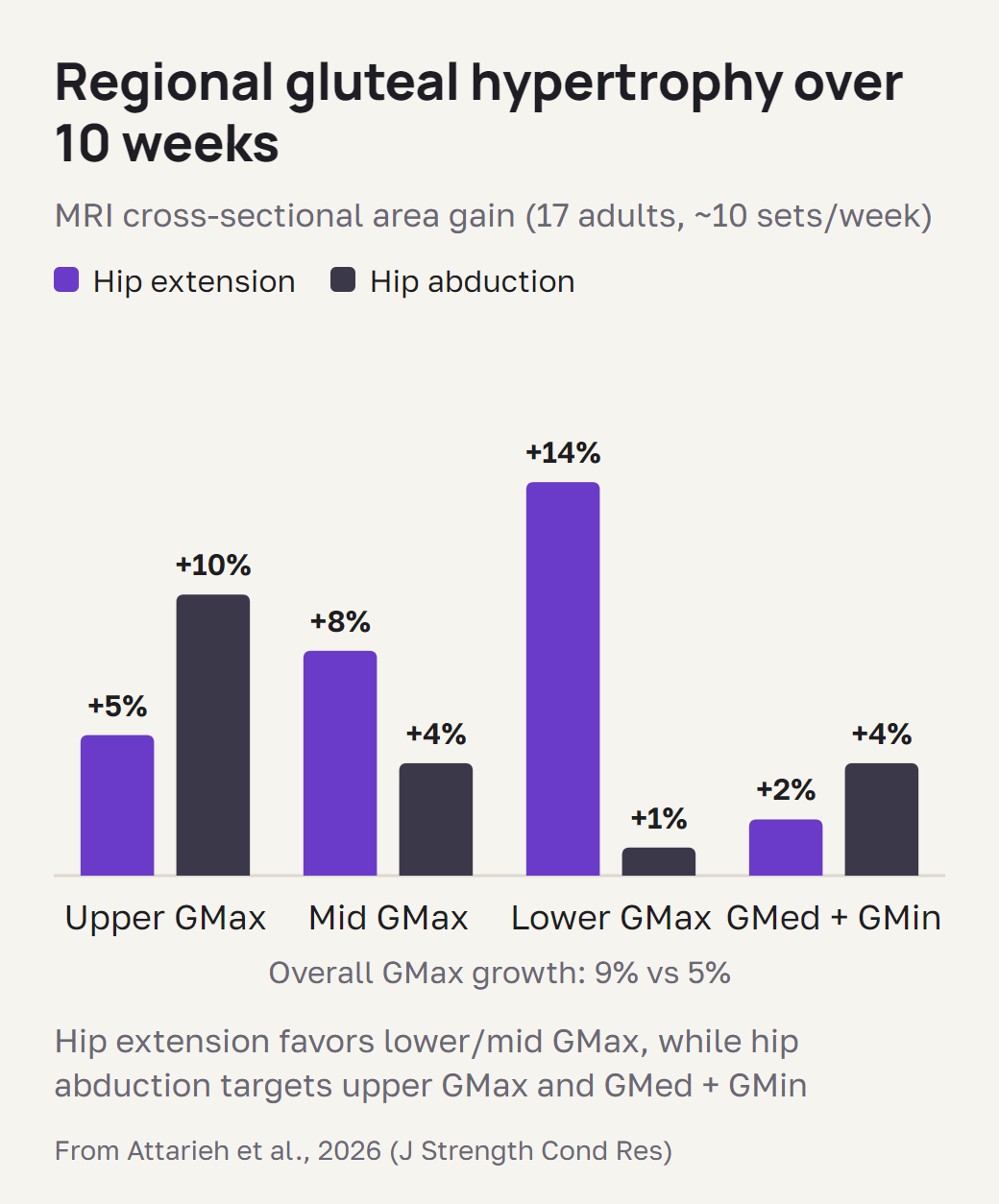
Direct MRI data on regional glute hypertrophy came from a 10-week within-subject study of 17 young adults comparing two exercises on opposite legs of the same person (Attarieh et al., 2026).
Each participant trained one leg with single-leg cable hip extension and the other leg with cable hip abduction. Sessions took place twice a week at roughly 10 working sets per week. MRI results diverged clearly:
- Hip extension produced a larger total increase in gluteus maximus area (9% vs. 5% for abduction), with a clear lower-region bias: upper +5%, middle +8%, lower +14%. Growth of the gluteus medius and minimus during hip extension was +2%.
- Hip abduction shifted growth toward the upper gluteus maximus (upper +10%, middle +4%, lower +1%). It also produced a modest increase in the gluteus medius and minimus complex (+4% vs. +2% with hip extension).
The second key piece is a direct comparison between barbell back squats and barbell hip thrusts (raising the hips with the upper back supported on a bench). In a 9-week randomized trial of 34 untrained participants (Plotkin et al., 2023), both groups achieved comparable gluteus maximus growth at equal set volume.
However, the squat group gained significantly more muscle in the quads (3.6 cm² more, 95% CI 0.7–6.4) and hip adductors (2.5 cm² more, 95% CI 1.2–3.9). The gluteus medius and minimus showed little to no growth from either squats or hip thrusts, so in practice dedicated hip abduction work is added for them.
A 10-week squat depth study in 17 men points in the same direction (Kubo et al., 2019). Full squats increased gluteus maximus volume by 6.7 ± 3.5% (versus 2.2 ± 2.6% for half squats). At the same time, knee extensor volume grew by 4.9 ± 2.6% and adductor volume by 6.2 ± 2.6%. In both of these MRI studies, squats effectively grew the gluteus maximus while also causing noticeable quad and adductor hypertrophy.
Why EMG rankings should not be read literally
Dozens of online "top 5 EMG exercise" lists claim that glute bridges beat squats by a wide margin. In the Plotkin et al. (2023) trial, surface EMG was indeed higher during the first hip thrust set. Yet that advantage did not translate into greater MRI muscle growth after 9 weeks.
For that reason, higher surface EMG amplitude on its own does not guarantee more muscle hypertrophy.
Still, systematic EMG reviews help filter out movements that are too light for the gluteus medius and minimus:
- In a systematic review and meta-analysis of 56 EMG studies (Moore et al., 2020), high activity was defined as above 40% of maximal voluntary isometric contraction (MVIC).
- For the middle gluteus medius segment, side-lying hip abduction, standing resisted hip abduction, single-leg bridges, lateral step-ups, and resisted side-steps reliably crossed that threshold. All gluteus medius segments reached high activity during standing pelvic drop/lift variations (hip hitch). All gluteus minimus segments did so in hip hitch variations and isometric standing hip abduction.
- In a review of 20 studies covering 33 exercises (Ebert et al., 2017), bilateral bridges and prone or quadruped drills generally produced low (0–20% MVIC) or moderate (21–40% MVIC) gluteus medius loading. Dedicated hip abduction and loaded single-leg stance exercises produced high (41–60%) and very high (>61% MVIC) levels.
- In a review of 23 studies (Macadam et al., 2015), the highest gluteus medius readings (81–103% MVIC) came from three exercises: side plank with hip abduction, standing hip abduction with resistance at the ankle, and side-lying hip abduction.
How to structure glute training without overloading your legs
My name is Demid Lobanov, and I am a fitness coach. When a client comes to me wanting fuller upper and overall glutes without major quad growth, I move heavy squats and leg presses out of the priority slot. We build the weekly plan around two patterns: hip extension with minimal knee loading and dedicated hip abduction.
| Goal and region | Suitable exercises | Quad contribution | Reps and progression |
|---|---|---|---|
| Overall gluteus maximus volume | Barbell or machine hip thrust, bench glute bridge | Minimal (shins nearly vertical at the top) | 3–4 sets × 8–12 reps, add load |
| Focus on lower and middle gluteus maximus | Standing cable hip extension, 45-degree hip extension | Low | 3 sets × 10–15 reps, controlled tempo |
| Upper gluteus maximus, medius, and minimus | Seated hip abduction machine, standing cable hip abduction, bench-supported glute medius kickback | Minimal | 3–4 sets × 12–15 reps, gradual load increase |
| Stability and unilateral work | Single-leg bridge, Romanian deadlift with modest knee bend | Low (main load on glutes and hamstrings) | 2–3 sets × 10–12 reps |
Three practical exercises from this setup and their key form cues:
- Barbell hip thrust. Keep your shins vertical at the top, chin slightly tucked, and pelvis neutral without overarching the lower back. This movement gives the gluteus maximus a strong stimulus without the quad growth seen in squats.
- Bench-supported glute medius kickback. In my coaching practice, bracing your hands on a bench makes it easier to keep the torso steady and control the pelvis, letting you move the hip along an extension-and-slight-abduction path without swinging.
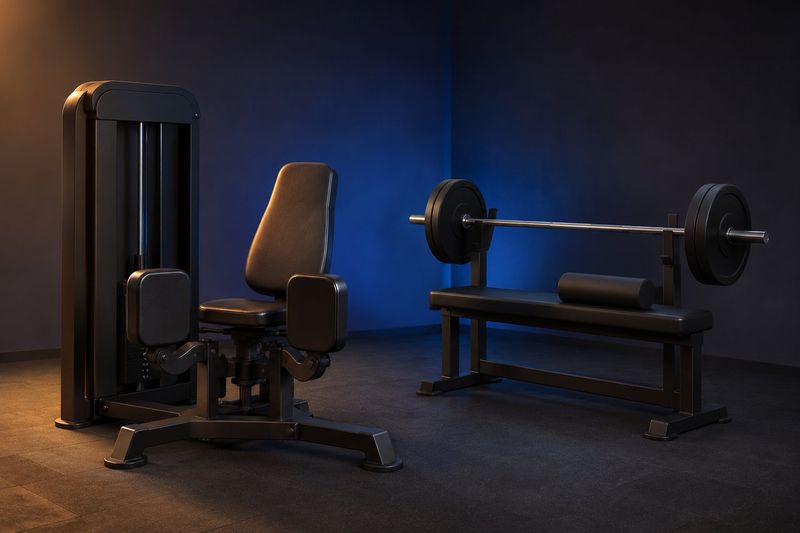
- Seated hip abduction machine. Keep your back pressed firmly against the pad and drive the movement through hip abduction rather than jerking your torso. It complements hip extension and targets the upper-outer glute region.
I help tailor angles, load, and exercise balance to your proportions in an individual training program. You can also have your hip and knee angles checked on video through a technique and training protocol review.
Common mistakes that stall growth
- High-rep light band kickbacks (25–30 reps) with no progression. Feeling a burn does not reliably show whether a muscle will grow. Following strength training principles, the gluteus medius needs sets taken close to failure in roughly the 8–15 rep range with gradual increases in machine or cable resistance.
- Trying to "turn off" the quads with foam rolling before squats. In my practice, myofascial release (foam rolling) does not stop knee extension during a squat. If an exercise involves deep loaded knee flexion, the quads will still do the work.
- Pelvic tilt and losing the line of pull. In my practice, when your toes turn sharply outward and your pelvis rolls back and up during standing or side-lying hip abduction, the movement loses precision. Lower the weight, lock in your pelvis, and keep your foot neutral without turning the toes out aggressively.
- Relying on hip abduction alone. In Attarieh et al. (2026), isolated abduction produced 4 percentage points less overall gluteus maximus growth than hip extension (5% vs. 9%). The best combination for glute shape includes both patterns.
Practical weekly plan
For this goal, I usually schedule two focused glute workouts per week spaced 72 hours apart:
- Day 1 (hip extension and upper-glute focus): barbell hip thrust (3–4×8–12), seated hip abduction machine (3×12–15), dumbbell or barbell Romanian deadlift (3×8–10).
- Day 2 (abduction and unilateral focus): single-leg or machine glute bridge (3×10–12), bench-supported glute medius kickback (3×12–15 per side), standing cable hip abduction (3×12–15 per side).
- Progression and tracking results: once you comfortably hit the top of the rep range with steady form and pelvic control, add the smallest weight increment. Every 4–6 weeks, check progress using two markers: rising working weights on abductions and hip thrusts, plus tape measurements of your glutes and mid-thigh taken in the same stance.
For deeper technique breakdowns of the staple lifts, read how to build glutes, glute bridge and hip thrust, seated hip abduction machine, and Romanian deadlift. I also post short technique breakdowns on my YouTube channel @lobanov_fitness.
Sources
- Attarieh P et al. Regional Hypertrophy of the Gluteal Muscles Is Task-Specific: Differential Responses to 10 Weeks of Hip Extension Versus Hip Abduction Training. J Strength Cond Res, 2026. Article
- Plotkin DL et al. Hip thrust and back squat training elicit similar gluteus muscle hypertrophy and transfer similarly to the deadlift. Front Physiol, 2023. Article · Full text
- Kubo K et al. Effects of squat training with different depths on lower limb muscle volumes. Eur J Appl Physiol, 2019. Article
- Moore D et al. A SYSTEMATIC REVIEW AND META-ANALYSIS OF COMMON THERAPEUTIC EXERCISES THAT GENERATE HIGHEST MUSCLE ACTIVITY IN THE GLUTEUS MEDIUS AND GLUTEUS MINIMUS SEGMENTS. Int J Sports Phys Ther, 2020. Article · Full text
- Ebert JR et al. A Systematic Review of Rehabilitation Exercises to Progressively Load the Gluteus Medius. J Sport Rehabil, 2017. Article
- Macadam P et al. AN EXAMINATION OF THE GLUTEAL MUSCLE ACTIVITY ASSOCIATED WITH DYNAMIC HIP ABDUCTION AND HIP EXTERNAL ROTATION EXERCISE: A SYSTEMATIC REVIEW. Int J Sports Phys Ther, 2015. Full text
- Hall SJ. Basic Biomechanics, 9th edition. Chapter 8 – Biomechanics of the Lower Extremity.