
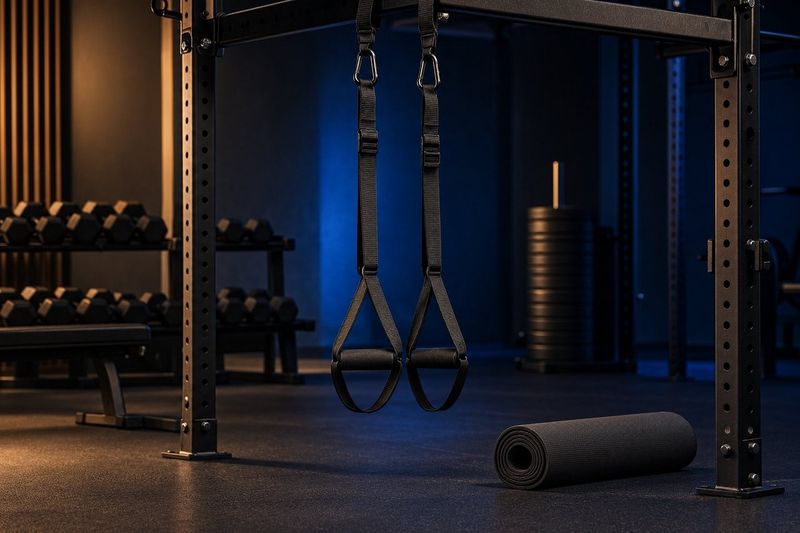
TRX suspension straps are often marketed as an all-in-one gym replacement that fires up "deep stabilizers." In reality, they are a practical, portable tool with clear strengths and real limits.
Research shows that suspension training challenges the core and upper body well and matched traditional resistance training for muscle and strength gains in an RCT of untrained older adults. When your goal is maximal strength, major leg and glute hypertrophy, or fine load progression, experienced lifters quickly hit a bodyweight ceiling.
How TRX straps work and why body angle decides everything
In suspension training, resistance comes from a fraction of your bodyweight. Standing closer to vertical makes a movement lighter; stepping deeper under the anchor toward horizontal raises load substantially.
Direct measurements confirm this. In Vural et al. (2023) (12 male athletes), feet-suspended variations reached 70.5% 1RM in push-ups and 72.6% 1RM in inverted rows. An EMG analysis of suspension push-ups across five body angles from +30° to −30° in 19 trained men (Lin et al., 2026) showed higher pectoralis major activation on TRX at +30° to 0° (p < 0.05), whereas a −30° decline (feet elevated) boosted anterior deltoid, triceps, upper trapezius, and serratus anterior activation on both TRX and stable ground.
That is why guessing foot placement undermines progress: shifting half a step closer or farther noticeably changes load. Marking the floor with tape or using a tile line keeps progression measurable.
What TRX genuinely delivers for the core and upper body
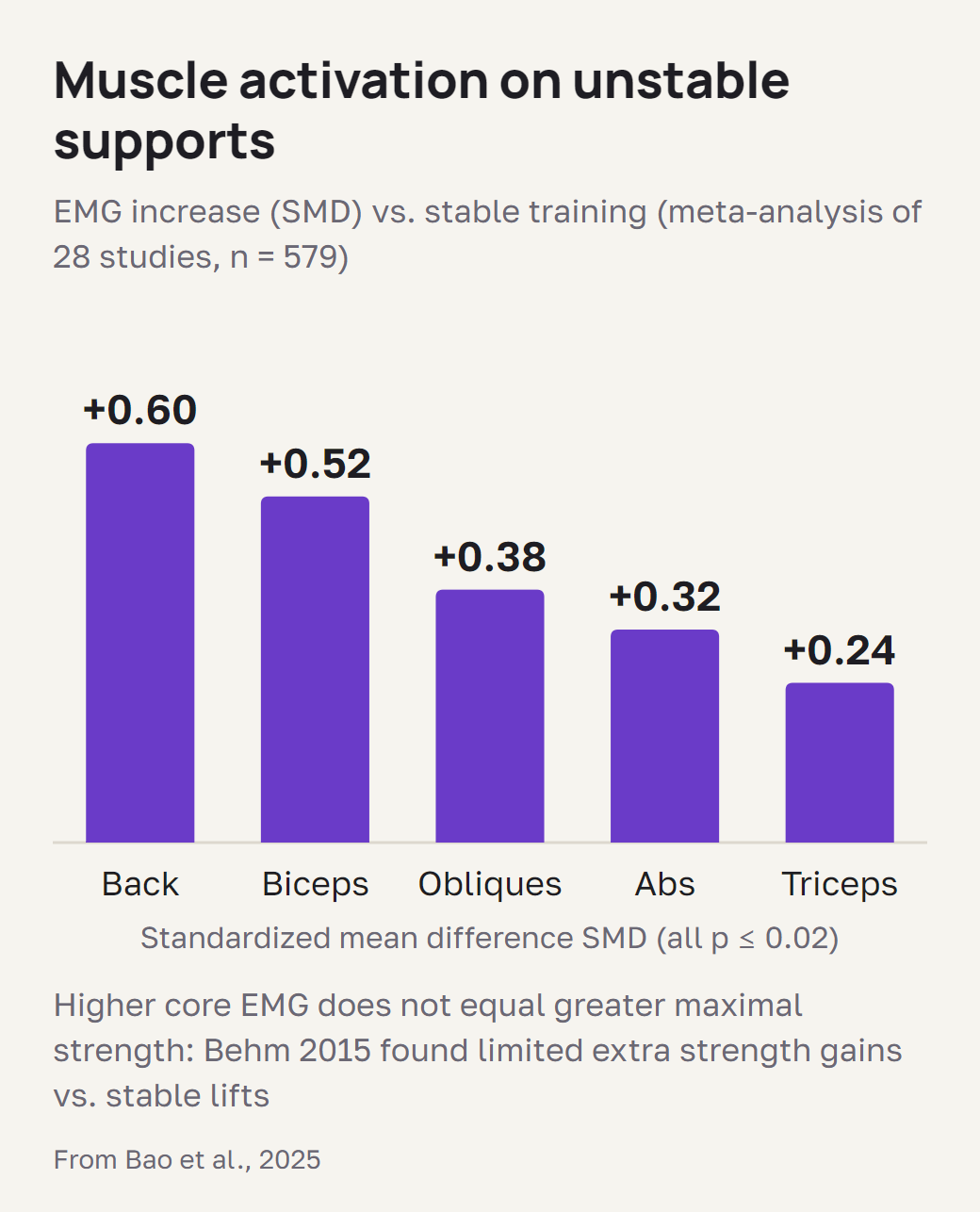
The clearest evidence-backed advantage of suspension straps is heightened core and selected upper-body activation while stabilizing the body. In a meta-analysis of 28 EMG studies (579 participants), Bao et al. (2025) found unstable supports—including TRX—significantly increased activation of the erector spinae (SMD = 0.60), biceps (0.52), obliques (0.38), serratus anterior (0.33), rectus abdominis (0.32), gluteus medius (0.28), and triceps (0.24; all p ≤ 0.02). Remember that acute surface EMG reflects electrical activity in a single set, not guaranteed superior long-term hypertrophy.
Two exercise-specific studies add detail. A systematic review of 18 EMG studies (Aguilera-Castells et al., 2020) found moderate (21–40% MVIC) to very high (>60% MVIC) activation during suspended push-ups, inverted rows, planks, and leg curls, exceeding stable versions in every drill except inverted rows. In a trial of 25 adults (Harris et al., 2017), TRX significantly increased oblique activity in planks (p = 0.021), rectus abdominis and erector spinae in bridges (p ≤ 0.013), chest, abs, obliques, and back in push-ups (p ≤ 0.019), and middle deltoid (p = 0.016) and obliques (p = 0.027) in rows.
One important shoulder caveat: in a meta-analysis of 23 studies (498 participants), Mendez-Rebolledo et al. (2022) found suspension push-ups sharply spiked upper trapezius activation (ES = 2.92; p = 0.004) without increasing serratus anterior activity (GRADE certainty low to very low). The authors cautioned against using suspension push-ups specifically to target the serratus anterior in shoulder dysfunction.
Can you build muscle and strength with TRX?
It depends on your starting level and target muscle group. Per the 2026 ACSM Position Stand (Currier et al., 2026, 137 systematic reviews), hypertrophy is driven primarily by progressive loading, sufficient weekly volume (≥10 sets per muscle group), and eccentric overload rather than one specific machine.
In a 12-week RCT of 42 untrained older adults, Soligon et al. (2020) compared TRX training, traditional resistance training (3 sets to failure), and a control group. Both active groups achieved comparable gains: biceps thickness grew +21.6% vs. +23.4%, vastus lateralis +14.1% vs. +13.0%, elbow-flexion strength +14.3% vs. +16.1%, and knee-extension strength +18.1% vs. +14.9%.
For core performance, a meta-analysis of 12 trials (Gao et al., 2025) found that unstable core training improved trunk strength and sprint performance in athletes more than standard floor exercises (p < 0.05).
Where TRX falls short of barbells and machines
In my coaching practice—I am Demid Lobanov—suspension straps shine during travel, home sessions, and as gym accessories, yet carry three structural limits:
- Limited maximal strength and power. In a meta-analysis of 22 controlled studies (Behm et al., 2015), unstable resistance training outperformed no training but offered little extra gain over stable lifting—and stable compound lifting held the edge for muscular power in young adults. Moreover, Bao et al. (2025) noted that pairing unstable surfaces with heavy external loads (≥60% 1RM on a Swiss ball or Bosu squats) actually reduced activation in several prime movers.
- Low lower-body ceiling for trained lifters. Bodyweight squats and lunges holding straps quickly get too light, pushing you into balance challenges rather than true leg and glute loading.
- Harder progression tracking. Without fixed strap length and floor markers, it is easy to mistake a slightly easier angle for strength progress.
| Criterion | TRX suspension straps | Machines & free weights |
|---|---|---|
| Home & travel convenience | Compact kit for gym, home, or travel | Requires a gym or home equipment |
| Core demand | Higher in planks and push-ups (Bao, 2025) | Depends on exercise selection; compound free weights also load the core |
| Upper-body progression | Up to ~70% 1RM in feet-suspended drills (Vural, 2023) | Precise, gradual load increments |
| Leg, glute & max-strength growth | Hits bodyweight ceiling quickly | Easy to load heavy weights (≥80% 1RM for max strength, Currier, 2026) |
| Range-of-motion control under fatigue | Demands strict trunk bracing | Easier to hold a consistent path |
For more on unstable training and home workouts, read Functional Training Explained and Home Workouts. To fit TRX smartly into your weekly schedule, see our individual training programs or online coaching.
Who TRX fits best
- Beginners and returning lifters. Stepping forward or back scales rows, push-ups, and squats smoothly without intimidation.
- Older adults. As shown in the RCT by Soligon et al. (2020), suspension training improves strength, muscle thickness, and functional test scores.
- Frequent travelers and home exercisers. A compact kit makes it easy to keep upper-body and core work going away from the gym.
- Experienced gym lifters as accessories. TRX Y-raises, hamstring curls, inverted rows, and rollouts pair cleanly with heavy stable lifts.
Basic 6-exercise full-body TRX routine
Following foundational beginner guidelines from ACSM (2009), I (Demid Lobanov) recommend starting with 6 clear movements 2–3 times weekly for 3 sets with 60–90 seconds rest and 1–2 reps in reserve. I also publish short exercise breakdowns on my YouTube channel @lobanov_fitness.
- TRX inverted row: 3×10–15. Keep the body in a straight line and pull elbows back and slightly down without shrugging toward the ears.
- TRX push-ups: 3×8–15. Pick a foot angle where the last two reps feel challenging without sagging at the lower back.
- Split squats (back foot suspended or hands on straps): 3×10–12 per leg. Track the front knee over the toes with a smooth 2–3 second descent.
- Supine TRX hamstring curl: 3×10–15. Bridge the hips in line with the torso and curl heels toward the glutes.
- TRX Y-raises: 3×12–15. Raise straight arms into a Y to target the rear deltoids, trapezius, and rhomboids.
- TRX plank or knee tucks: 3×30–45 seconds or 3×10–12 reps with a braced pelvis and steady breathing.
For fat loss, TRX straps do not burn more fat than regular strength training—outcomes still depend on a consistent calorie deficit, adequate protein, and regular training (see How to Lose Weight).
Sources
- Bao Z et al. Effects of unstable training on muscle activation: a systematic review and meta-analysis of electromyographic studies. PeerJ, 2025. PMID 40718776
- Gao J et al. Instability core training vs traditional core training on trunk strength and sprint performance among athletes: a systematic review and meta-analysis. PeerJ, 2025. PMID 41180480
- Lin YC et al. Angle-specific upper body muscle activation in suspension push-ups: an electromyographic analysis across different body angles. BMC Sports Sci Med Rehabil, 2026. PMID 41673781
- Vural F et al. Can different variations of suspension exercises provide adequate loads and muscle activations for upper body training? PLoS One, 2023. PMID 37738266
- Mendez-Rebolledo G et al. Electromyographic analysis of the serratus anterior and upper trapezius in closed kinetic chain exercises performed on different unstable support surfaces: a systematic review and meta-analysis. PeerJ, 2022. PMID 35791364
- Aguilera-Castells J et al. Muscle activation in suspension training: a systematic review. Sports Biomech, 2020. PMID 29902124
- Soligon SD et al. Suspension training vs. traditional resistance training: effects on muscle mass, strength and functional performance in older adults. Eur J Appl Physiol, 2020. PMID 32700098
- Harris S et al. Muscle activation patterns during suspension training exercises. Int J Sports Phys Ther, 2017. PMID 28217415
- Behm DG et al. Effects of Strength Training Using Unstable Surfaces on Strength, Power and Balance Performance Across the Lifespan: A Systematic Review and Meta-analysis. Sports Med, 2015. PMID 26359066
- Currier BS et al. American College of Sports Medicine Position Stand. Resistance Training Prescription for Muscle Function, Hypertrophy, and Physical Performance in Healthy Adults: An Overview of Reviews. Med Sci Sports Exerc, 2026. PMID 41843416
- American College of Sports Medicine. Progression models in resistance training for healthy adults. Med Sci Sports Exerc, 2009. PMID 19204579