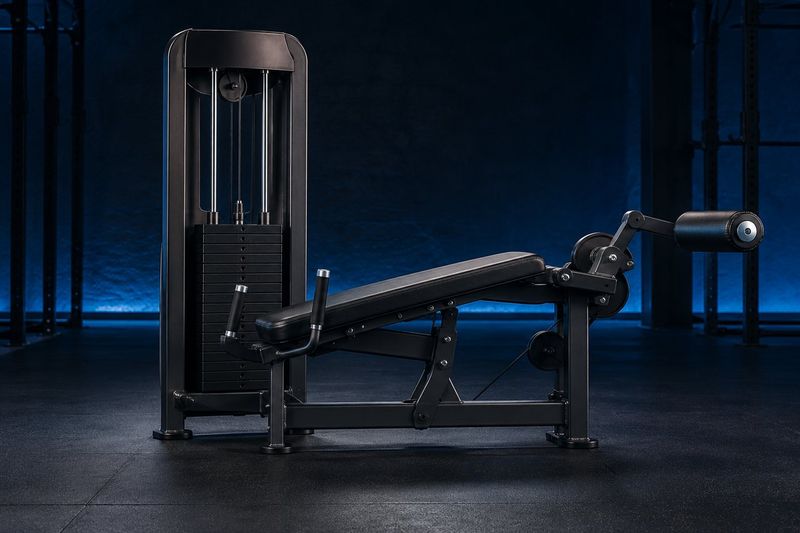
The machine leg curl, also called the hamstring curl, is an exercise in which you bend your knee against the machine's roller pad, either seated or lying down. It works the hamstrings, with help from the gastrocnemius. When you're seated, the hamstrings are additionally stretched at the hip. In a 2021 study by Maeo, the hamstrings grew 14% over 12 weeks from seated curls and 9% from lying curls. What matters is the hip flexion angle; the label on the machine makes no difference.
I'm Demid Lobanov, a fitness coach. In my exercise library, seated and lying leg curls serve different purposes, so there's no point in ranking them as "better" and "worse." The seated version is for the muscles that cross two joints. Lying down, those muscles are shortened, and a relatively larger share of the work goes to the short head of the biceps femoris. Below I explain why, and how to do both versions.
Which muscles work in the machine leg curl
The knee is flexed by the hamstrings: the semitendinosus, the semimembranosus, and the biceps femoris with its long and short heads (Hall, chapter 8). Three of them cross two joints, the hip and the knee. They don't just flex the knee; they also extend the hip. The short head of the biceps femoris crosses only the knee.
| Muscle | Joints it crosses | What matters in the leg curl |
|---|---|---|
| Semimembranosus | hip and knee | according to my library, the main source of force in the seated version |
| Semitendinosus | hip and knee | works in a lengthened position when the hip is flexed |
| Biceps femoris, long head | hip and knee | same |
| Biceps femoris, short head | knee only | doesn't depend on hip position: in Maeo's study it grew equally seated and lying |
| Gastrocnemius | knee and ankle | contributes more when the toes are pulled toward the shins |
That's why, for the hamstrings, it matters how much the hip is flexed: the more it's flexed, the longer the muscle stays throughout the entire movement.
Seated or lying leg curl: which is better
For hamstring growth, the better option is the one with more hip flexion, and that's usually the seated version. In a 2021 study by Maeo and colleagues, 20 untrained people spent 12 weeks curling one leg seated, with the hip flexed about 90°, and the other leg lying, with the hip flexed about 30°. The hamstrings as a whole grew 14% from seated curls and 9% from lying curls. The difference came from the muscles that cross two joints. The short head of the biceps femoris grew equally: 10% and 9%.
In a 2024 study by Maeo and colleagues, untrained young men did seated leg curls for 12 weeks with the backrest inclined so that the hip was flexed more, and with an emphasis on lowering the weight. Their hamstrings grew 18%, compared with 11% in the Nordic curl group. Each of the two groups had 14 people.
| Version | Hip | Hamstrings | What it's for |
|---|---|---|---|
| Seated | flexed about 85–90° | the three two-joint muscles work in a lengthened position | the main option for hamstring growth |
| Lying | extended, or flexed 20–30° on an angled bench | the same muscles are shortened, the short head does relatively more of the work | a different muscle length within your week, a substitute when the seated version is uncomfortable |
My exercise library states this explicitly: Maeo's data shouldn't be turned into a rule that "seated is always better." The difference comes down to the hip flexion angle and the design of the specific machine.
Why the hip angle is what matters
A muscle's length is set by the angles of both joints it crosses. The knee bends the same way in both versions, but the hip doesn't. Seated, the hamstrings are, even at the end of the movement, about as long as they are in the lying version only at the very start.
This leads to three practical conclusions:
- if the backrest is reclined or your pelvis slides forward and your hip is flexed 50–60° instead of 90°, the advantage of the seated version shrinks;
- for lying curls, an angled bench where your torso is higher than your pelvis is better than a flat one;
- in the lying version, a pad under your pelvis partly restores the muscles' length: this is a conclusion from mechanics, and I'm not citing any studies to support it.
Seated leg curl with a forward lean
You can flex the hip even more by leaning your torso forward. The hip then flexes beyond 90°, and the muscles that cross two joints work at the greatest length of any leg curl in my exercise library. Lean from the pelvis while keeping your back straight. If your back rounds, your pelvis tilts back and the gain in length is lost.
Add the lean once you've mastered the regular seated version. It's a way to progress through muscle length without adding weight. I haven't found any comparison of muscle growth from seated curls with and without the lean, so greater growth from leaning is not proven. If you already have sciatic nerve irritation and symptoms appear when you lean, reduce the lean or do the curl without it. If numbness or shooting pains in the leg keep coming back, skip the exercise until you've seen a doctor.
How to do the seated leg curl: step by step
- Set the backrest: unless a doctor has limited your hip flexion, the more your hip is flexed, the better. Press your pelvis against the backrest.
- Lower the thigh pad onto your thighs so that your pelvis doesn't slide forward.
- Start without jerking: the beginning of the movement, where the muscles are stretched, is the most valuable part.
- Bend your knees to about 90–110°.
- Keep your foot neutral or pull your toes toward your shins.
- Return the pad under control until your legs are almost straight.
Pelvic position is what breaks down most often: to grind out the weight, people slide forward on the seat. The hip then flexes less, and in terms of muscle length the exercise starts to resemble the lying version.
How to do the lying leg curl: step by step
- Lie down so that the edge of the bench doesn't press on your knees.
- Position the roller pad on your Achilles tendons.
- Press your hips into the bench pad; they stay down for the entire set.
- Start with your legs straight, without jerking.
- Bend your knees to about 90–120°.
- Keep your foot neutral or pull your toes toward your shins, and return the pad under control.
The most common mistake in the lying version is lifting your hips off the pad. At the top, the muscles run out of strength before the lever reaches the end of its travel. People make up the last few degrees by raising their pelvis. This shortens the two-joint muscles even further, and the short head takes over more and more of the work.
Foot position and toe angle
Foot position changes how much the gastrocnemius contributes. Pull your toes toward your shins, and the gastrocnemius kicks in more. Point your toes, and it shortens, works less, and cramps easily.
According to my library, turning your toes out shifts the work toward the biceps femoris, and turning them in shifts it toward the semitendinosus and semimembranosus. The effect is small, and you shouldn't rely on it alone.
In general, it's hard to predict exactly where a muscle will grow. In a 2024 study by Frouin and colleagues, 45 people were split into three groups. Two of them did seated leg curls and stiff-legged deadlifts for 9 weeks. One group trained with heavy weights, the other with light weights and blood flow restriction. Even with the same exercises, gains in the individual hamstring muscles varied widely from person to person. The authors write that it's very hard to determine in advance where a muscle will grow.
What to use instead of the leg curl machine: stability ball leg curls
If you don't have a machine, do leg curls on a stability ball. Lie on your back, put your legs on the ball, and lift your pelvis into a bridge. Keep your pelvis up and roll the ball toward you by bending your knees, then slowly roll it back out. It's easiest with your calves on the ball and harder with your heels.
In my exercise library, this version is closer to the lying curl in terms of hip position: the hip is extended, and by the end of the movement the muscles that cross two joints are very short. Nothing holds your hips in place: the hamstrings themselves hold the bridge, together with the gluteus maximus. So the stability ball is a substitute at home or while traveling, and an addition to the machine. For hamstring growth, the main choice is the seated curl.
The pelvis is the first thing to break down: it drops as you curl, your hip flexes, and the exercise quietly gets easier. The second mistake is bridging by arching your lower back: keep your ribs down. Make the exercise harder in steps: move from calves on the ball to heels, then curl with both legs and return with one, then do the whole movement with one leg. Slowly rolling the ball back out is the main way to progress when there's no weight to add.
Leg curl or Romanian deadlift
These are different movements: the leg curl loads the hamstrings through the knee, the Romanian deadlift through the hip. In a 2017 study by Bourne and colleagues, muscle activity in 24 men was measured with EMG, or electromyography, which records a muscle's electrical signal. During the lifting phase of the leg curl, the share of lateral hamstring activity relative to medial was the lowest of the ten exercises. According to MRI data from the same study, the 45° hip extension targeted the muscles that cross two joints more selectively than Nordic curls did. In a 2015 study by Schoenfeld and colleagues in 10 trained men, the lying leg curl engaged the lower hamstrings more than the stiff-legged deadlift did. These are activity data: it hasn't been confirmed that activity can predict muscle growth (Vigotsky 2022).
The leg press doesn't replace the leg curl. In a 2026 study by Kinoshita and colleagues, the leg press grew the hamstrings by only 3.1%, which, by the authors' assessment, is far less than in studies where they were trained with leg curls. So your program needs both types of exercises. For more, see Romanian Deadlift and How to Build Your Legs.
Common leg curl mistakes
| Mistake | What happens | How to fix it |
|---|---|---|
| Seated: pelvis slides forward | the hip flexes less, and the version loses its advantage | pelvis pressed against the backrest, thigh pad snug on your thighs |
| Lying: hips lift off the pad | the muscles shorten at two joints, and the short head takes over the work | lower the weight, keep your hips down for the entire set |
| Jerking at the start of the movement | you lose the most valuable part; in the lying version, the load on your lower back increases | start smoothly |
| Toes pointed for the entire set | the gastrocnemius cramps, and its contribution drops | foot neutral or toes pulled toward the shins |
Who should be careful
With a fresh hamstring strain, skip the exercise: see a doctor first, and come back to it once you're cleared. If you have pain at the back of the knee, shorten the end range of the curl and see a doctor. If the front of your knee hurts in the lying version, check whether the edge of the bench is pressing on your kneecap. For lower back discomfort in the lying version, a pad under your pelvis or the seated version helps. If your hip flexion is noticeably limited (after a joint replacement, or with groin pain in deep flexion), recline the backrest so your hip is flexed less, or do the lying version. If a doctor has restricted the exercise, the program is built within those limits.
How to add leg curls to your workouts: step by step
- Make the seated leg curl your main hamstring exercise.
- Add the lying version as a second exercise, or do it instead of the seated one if you don't have a seated leg curl machine or sitting is uncomfortable. If you have no machines at all, do stability ball leg curls.
- Add a hip extension exercise: the Romanian deadlift or the 45-degree hip extension (hyperextension).
- How many sets to do per week is covered in How Many Sets per Week.
If you need a plan for your goal and your gym, there's the personalized program.
I post exercise breakdowns on my YouTube channel @lobanov_fitness.
Sources
- Hall SJ. Basic Biomechanics. 9th edition. McGraw Hill, 2022. Chapter 8.
- Maeo S et al. Greater Hamstrings Muscle Hypertrophy but Similar Damage Protection after Training at Long versus Short Muscle Lengths. Med Sci Sports Exerc, 2021. Article · Full text
- Maeo S et al. Hamstrings Hypertrophy Is Specific to the Training Exercise: Nordic Hamstring versus Lengthened State Eccentric Training. Med Sci Sports Exerc, 2024. Article · Full text
- Frouin A et al. Individual distribution of muscle hypertrophy among hamstring muscle heads: Adding muscle volume where you need is not so simple. Scand J Med Sci Sports, 2024. Article
- Bourne MN et al. Impact of exercise selection on hamstring muscle activation. Br J Sports Med, 2017. Article
- Schoenfeld BJ et al. Regional Differences in Muscle Activation During Hamstrings Exercise. J Strength Cond Res, 2015. Article
- Vigotsky AD et al. Longing for a Longitudinal Proxy: Acutely Measured Surface EMG Amplitude is not a Validated Predictor of Muscle Hypertrophy. Sports Med, 2022. Article
- Kinoshita M et al. Hypertrophic Effects of Single- versus Multi-Joint Exercise: A Direct Comparison between Knee Extension and Leg Press. Med Sci Sports Exerc, 2026. Article · Full text