
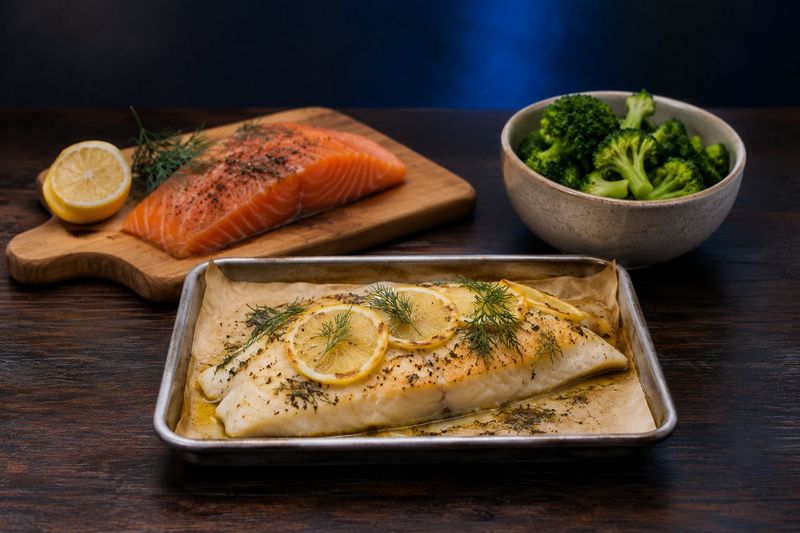
Yes, you can eat fish while losing weight: 100 g of cod has 78 kcal and 17.8 g of protein, and Atlantic salmon has 202 kcal and 20.4 g of protein. Weight goes down when you're in a calorie deficit over the day; fish by itself doesn't reduce weight. In studies, fish eaten during a deficit helped people lose an extra 1–1.7 kg over 4–8 weeks, and not in every group.
I'm Demid Lobanov, a fitness coach. The recipe database for the meal plans I put together has 32 fish dishes out of 260. Another 9 dishes include shrimp, squid, mussels, and imitation crab. Most often these are lunches and dinners.
How many calories and how much protein fish has
I take the nutrient composition from the food database for my meal plans and calculate calories using the Russian formula. Values are per 100 g of fish: raw, and for tuna and herring, in the form they're sold:
| Fish | Kcal | Protein, g | Fat, g |
|---|---|---|---|
| Pollock | 76 | 17.2 | 0.8 |
| Cod | 78 | 17.8 | 0.7 |
| Pike | 84 | 19.3 | 0.7 |
| Hake | 85 | 18.3 | 1.3 |
| Canned tuna in water | 87 | 19.4 | 1.0 |
| Tilapia | 96 | 20.1 | 1.7 |
| Chum salmon | 115 | 20.1 | 3.8 |
| Pink salmon | 122 | 20.5 | 4.4 |
| Trout | 135 | 19.9 | 6.2 |
| Salted herring | 145 | 17.0 | 8.5 |
| Mackerel | 200 | 18.6 | 13.9 |
| Atlantic salmon | 202 | 20.4 | 13.4 |
| For comparison: chicken breast | 113 | 22.5 | 2.6 |
Fish has no carbs. Different kinds of fish contain almost the same amount of protein, 17–20.5 g per 100 g, while calories differ because of fat.
Lean fish or salmon for weight loss
In a calorie deficit, lean fish is more convenient: 200 g of cod has about 155 kcal, and 200 g of Atlantic salmon has about 404 kcal, with a similar amount of protein. You can eat salmon too; a portion with the same calories will just be smaller. In my meal plans, Atlantic salmon goes into sandwiches and rolls in portions of 40–60 g. Pink and chum salmon I use as a full 190 g portion: they have 40% fewer calories than Atlantic salmon.
The fat in salmon contains the omega-3 fatty acids EPA and DHA, two types of omega-3. Details in the article “Omega-3”. The American Heart Association recommends eating fish and seafood 1–2 times a week to prevent heart disease. That's a recommendation for the heart; it has nothing to do with weight loss.
Does fish help you lose weight: what research shows
Fish doesn't reduce weight by itself. In studies, during a calorie deficit it slightly increased weight loss. A network meta-analysis, which compares the results of many studies, rates this effect as trivial, with low certainty. The authors of the Kristoffersen 2025 umbrella review found no meta-analyses on fish and the risk of excess weight.
What the studies show:
- Thorsdottir 2007: 324 overweight people aged 20–40 from Iceland, Spain, and Ireland spent 8 weeks on a diet with a calorie deficit. Participants were split into four groups: no fish (sunflower oil capsules), cod 3 times a week at 150 g, salmon 3 times a week at 150 g, and fish oil capsules. By the authors' calculation, a 95 kg man on 1,600 kcal lost 3.6 kg over the first 4 weeks without fish and 4.4–5.0 kg in the groups with fish or fish oil, about a kilogram more. In women, there was no difference between the groups.
- Ramel 2009: 126 people aged 20–40 from the same research program spent 8 weeks on a diet with a 30% deficit. Participants were split into groups: no fish, or 150 g of cod 3 or 5 times a week. With five servings a week, weight dropped 1.7 kg more than without fish: the more cod, the greater the loss.
- Jayedi 2023: a network meta-analysis of 152 randomized trials on individual foods. With fish, weight went down 0.85 kg more than in the control groups. The authors set the threshold for a noticeable effect at 3.9 kg and rated their certainty in the finding as low. In people with overweight and obesity, no single food produced a noticeable weight reduction.
- Liaset 2019: a review without a meta-analysis. When lean white meat and fish were eaten instead of red meat, people ate 4–9% fewer calories. The difference was statistically significant in one study out of three, and some of the data come from mice.
The practical takeaway: fish helps with weight loss the same way as any low-calorie protein food. It has no special fat-burning effect.
Is fish more filling than meat
Possibly, but the evidence is weak and mixed: these are small studies of a single meal. In Borzoei 2006, 23 normal-weight men had lunches with fish or beef that were identical in calories. Hunger and fullness ratings on the scales didn't differ. But at dinner 4 hours later, after the fish, participants ate about 10% less: around 661 kcal vs. 736 kcal. In the older Uhe 1992 study, six men felt fuller after fish than after beef and chicken. In Nielsen 2018, 23 overweight people ate a meal with cod or veal. Neither fullness nor the amount of food eaten at lunch 3.5 hours later differed.
How to cook fish for weight loss
In my meal plans, fish is baked, steamed, braised, or cooked in soup. A dish has no more than 14 g of oil, and soups and sandwiches have none. A dish's calories go up mainly because of oil and the side dish: 10 g of oil adds about 90 kcal.
- Bake or steam fish, and weigh the oil.
- Frying in oil and batter noticeably raise a dish's calories.
- Tuna in water has fewer calories than tuna in oil. For canned fish, check the calories on the label.
- Salted herring is close to trout in calories, at 145 kcal per 100 g. You can eat it, keeping the portion and the salt in mind, if your doctor hasn't restricted salt.
- Imitation crab isn't pure fish: it has 7.6 g of protein and 14.5 g of carbs per 100 g.
How much fish you can eat while losing weight
There's no separate amount for weight loss: it depends on your daily calories. In my meal plans, a serving of lean fish is 200–220 g, canned tuna 100–150 g, and salmon in a sandwich 40–60 g. You can eat fish for dinner if it fits into your daily calories. In my database, half of the fish dishes are dinners. Details in the article “Is it okay to eat before bed”.
During pregnancy, with kidney disease, or with a fish or seafood allergy, your diet should be chosen by a doctor.
Examples of fish dishes from my meal plans
| Dish | Fish per serving | Kcal |
|---|---|---|
| Steamed cod with vegetables | cod 200 g | 330 |
| Baked pollock with cauliflower | pollock 220 g | 315 |
| Baked cod with potatoes | cod 200 g | 437 |
| Baked pink salmon with broccoli | pink salmon 190 g | 394 |
| Baked trout with vegetables | trout 180 g | 384 |
| Tuna and egg salad | tuna 150 g | 408 |
| Sandwich with salmon and cream cheese | Atlantic salmon 50 g | 324 |
At lunch and dinner, fish becomes the base of a dish with vegetables or a side. At breakfast, I add a small portion of salmon to a sandwich.
How to eat fish and lose weight: step by step
- Count fish in your daily calories: 200 g of cod is about 155 kcal.
- In a deficit, choose lean fish more often, and eat salmon in smaller portions.
- Bake, steam, or braise, and weigh the oil.
- Add vegetables and a side dish according to your calorie plan.
- Eat fish for dinner if it fits into your daily calories.
- After two weeks, compare your average weight for the week with the previous week: if it isn't going down, cut back on portions of high-calorie foods.
I also talk about nutrition and training on my YouTube channel @lobanov_fitness.
Sources
- U.S. Department of Agriculture. FoodData Central. Fish, pollock, Alaska, raw (FDC 173725); Fish, cod, Atlantic, raw (FDC 171955); Fish, pike, northern, raw (FDC 173680); Fish, whiting, mixed species, raw (FDC 173713); Fish, tuna, light, canned in water, drained solids (FDC 173709); Fish, tilapia, raw (FDC 175176); Fish, salmon, chum, raw (FDC 173689); Fish, salmon, pink, raw (FDC 175138); Fish, trout, rainbow, farmed, raw (FDC 173717); Fish, mackerel, Atlantic, raw (FDC 175119); Fish, salmon, Atlantic, farmed, raw (FDC 175167); Crustaceans, crab, alaska king, imitation, made from surimi (FDC 174203); Chicken, broiler or fryers, breast, skinless, boneless, meat only, raw (FDC 171077); Oil, olive, salad or cooking (FDC 171413).
- Federal Research Center of Nutrition and Biotechnology (Russia). Chemical composition of foods used in the Russian Federation. Atlantic herring, medium-salted (in Russian).
- Thorsdottir I et al. Randomized trial of weight-loss-diets for young adults varying in fish and fish oil content. Int J Obes (Lond), 2007. Article
- Ramel A et al. Consumption of cod and weight loss in young overweight and obese adults on an energy reduced diet for 8-weeks. Nutr Metab Cardiovasc Dis, 2009. Article
- Jayedi A et al. Comparative effectiveness of single foods and food groups on body weight: a systematic review and network meta-analysis of 152 randomized controlled trials. Eur J Nutr, 2023. Article
- Kristoffersen E et al. Umbrella Review of Systematic Reviews and Meta-Analyses on the Consumption of Different Food Groups and the Risk of Overweight and Obesity. Nutrients, 2025. Article · Full text
- Liaset B et al. Seafood intake and the development of obesity, insulin resistance and type 2 diabetes. Nutr Res Rev, 2019. Article · Full text
- Borzoei S et al. A comparison of effects of fish and beef protein on satiety in normal weight men. Eur J Clin Nutr, 2006. Article
- Uhe AM et al. A comparison of the effects of beef, chicken and fish protein on satiety and amino acid profiles in lean male subjects. J Nutr, 1992. Article
- Rimm EB et al. Seafood Long-Chain n-3 Polyunsaturated Fatty Acids and Cardiovascular Disease: A Science Advisory From the American Heart Association. Circulation, 2018. Article · Full text
- Nielsen LV et al. Meals based on cod or veal in combination with high or low glycemic index carbohydrates did not affect diet-induced thermogenesis, appetite sensations, or subsequent energy intake differently. Appetite, 2018. Article




