
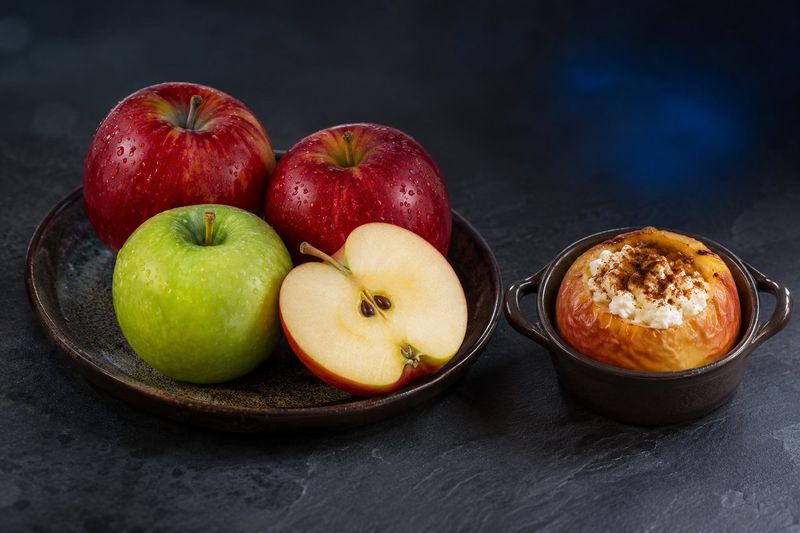
Yes, you can eat apples while losing weight: 100 g of apple has 53 kcal, and a whole apple is more filling than applesauce or juice. But weight goes down with a calorie deficit over the day; apples on their own don't lower your weight. If you simply add fruit to your usual food, your weight usually doesn't go down. An apple helps when it replaces higher-calorie food. You can eat one at night, too.
I'm Demid Lobanov, a fitness coach. In the recipe database for the meal plans I put together, apples appear in 11 of 260 dishes: in breakfast porridges and in snacks.
How many calories are in an apple
For my meal plans, I take the nutrient data for a raw apple with skin from USDA FoodData Central. I calculate the calories using the Russian formula. Per 100 g:
- 53 kcal;
- 11.4 g of digestible carbs;
- 2.4 g of fiber;
- 0.3 g of protein and 0.2 g of fat.
An average apple weighs about 180 g. Without the core, about 160 g is left, which is roughly 85 kcal. The glycemic index of an apple is 36. That's a low index: 55 or less is considered low.
Baking doesn't add calories unless you add honey or sugar. The apple loses water, so count calories by its weight before baking.
Do apples help you lose weight?
There aren't many studies on apples and weight, and weight changed little in them.
- Conceição de Oliveira and colleagues, 2003 and 2008: one study of 49 overweight women aged 30–50 with high cholesterol from an outpatient clinic in Rio de Janeiro. Three apples, three pears, or three oat cookies a day were added to their food. They contained equal amounts of calories and fiber, but the cookies had 6 times more calories per gram. The 2003 paper describes 12 weeks on a diet from a dietitian. The fruit group lost 1.22 kg, and the cookie group lost 0.88 kg, a loss that was not significant. The difference between the groups was significant. The 2008 analysis of the same data describes 10 weeks. With apples, the women ate 25 kcal a day less and lost 0.93 kg; with cookies, their weight didn't change;
- Liddle and colleagues, 2021: 44 overweight people ate three whole apples a day, about 200 g of flesh, for 6 weeks. Inflammation markers went down, but weight didn't change;
- Chai and colleagues, 2012: 160 postmenopausal women ate 75 g of dried apples a day for a year, which is roughly two apples. They lost 1.5 kg, but this didn't differ significantly from the prune group.
In large observational studies by Bertoia and colleagues in 2015, 133,468 people in three US cohorts were followed for up to 24 years. Each additional daily serving of apples or pears was associated with a weight loss of 1.24 pounds, about 0.56 kg, over 4 years. This is an association: observations like these don't prove cause.
Guyenet's 2019 systematic review focuses on studies of whole, fresh fruit. When people eat more of it, their weight over 3–24 weeks stays the same or drops slightly. Eaten before a meal or instead of higher-calorie food, fruit usually lowers the calories of that meal.
But the simple advice to "eat more fruits and vegetables" without cutting back on other food doesn't lead to weight loss. A 2014 meta-analysis by Kaiser and colleagues showed this.
The takeaway: compared with cookies of the same calorie content, an apple comes out ahead. Per gram, it has 6 times fewer calories, and a person eats fewer calories over the day. If you just add apples to your usual food without removing anything, your weight usually doesn't change. So an apple helps when it replaces a higher-calorie snack.
Apple, applesauce, or juice
A whole apple is more filling than applesauce or juice with the same calories.
In a 2009 study by Flood-Obbagy and colleagues, 58 adults ate a 266 g, 125 kcal portion of apple, applesauce, or apple juice 15 minutes before lunch. With the whole apple, they took in 15% fewer calories at lunch, including the snack, than without a snack: 187 kcal fewer. Applesauce and juice were less filling. Fiber added to the juice didn't increase fullness.
In a 2020 study by Krishnasamy and colleagues, 18 healthy adults ate a 178 kcal portion of apples, applesauce, or juice. The stomach emptied halfway in 65 minutes after whole apples and in 41 and 38 minutes after applesauce and juice. Fullness after whole apples was higher than after juice.
In a 2012 study by Houchins and colleagues, 34 people spent 8 weeks at a time getting fruits and vegetables either as beverages or whole, on top of their usual food. Weight went up in both cases: by 1.95 kg with beverages and by 1.36 kg with whole fruits and vegetables. The difference between them was not significant. Adding food on top of your usual diet increases weight in any form.
Can you eat an apple at night while losing weight?
Yes, as long as it fits within your daily calorie target. In studies, finishing eating earlier gave people a small advantage, about a kilogram. But that doesn't rule out dinner. More on this in the article Can You Eat at Night?
Apples have almost no protein, so in my recipes they often come with cottage cheese or yogurt; that way the snack contains protein too. For example, a baked apple with cottage cheese and cinnamon has 261 kcal and 17.6 g of protein.
How many apples can you eat while losing weight?
There's no separate limit for apples: eat as many as fit within your daily calorie target. In studies, people ate three apples a day: in some cases they lost weight, in others they didn't. My recipes use 120–200 g of apple per dish.
If you eat an apple instead of a cookie or a piece of candy, you'll take in fewer calories over the day. If you eat it on top of them, more. If you have diabetes, discuss how much fruit to eat with your doctor.
Apple dishes from my meal plans
| Dish | Ingredients, raw weight | Calories | Protein |
|---|---|---|---|
| Apple with almonds | apple 180 g, almonds 20 g | 215 kcal | 4.8 g |
| Baked apple with cottage cheese and cinnamon | apple 200 g, 5% cottage cheese 100 g, honey 10 g | 261 kcal | 17.6 g |
| Oatmeal cooked in water with apple and cinnamon | rolled oats 60 g, apple 150 g, 5% cottage cheese 120 g, honey 10 g | 477 kcal | 28.3 g |
How to eat apples and lose weight: step by step
- Calculate your calorie target: see the article How Many Calories You Need a Day.
- Eat whole apples: applesauce and juice are less filling.
- Replace a higher-calorie snack with an apple.
- Add protein to your apple: cottage cheese or yogurt.
- Count apples in your calories for the day, including in the evening.
- After two weeks, compare your average weight for the week with the previous week: if it isn't going down, cut your portions of high-calorie food.
I also talk about nutrition and training on my YouTube channel @lobanov_fitness.
Sources
- U.S. Department of Agriculture. FoodData Central. Apples, raw, with skin (FDC 171688).
- Atkinson FS et al. International tables of glycemic index and glycemic load values: 2008. Diabetes Care, 2008. Article · Full text
- Conceição de Oliveira M et al. Weight loss associated with a daily intake of three apples or three pears among overweight women. Nutrition, 2003. Article
- de Oliveira MC et al. A low-energy-dense diet adding fruit reduces weight and energy intake in women. Appetite, 2008. Article
- Liddle DM et al. Daily apple consumption reduces plasma and peripheral blood mononuclear cell-secreted inflammatory biomarkers in adults with overweight and obesity: a 6-week randomized, controlled, parallel-arm trial. Am J Clin Nutr, 2021. Article
- Bertoia ML et al. Changes in Intake of Fruits and Vegetables and Weight Change in United States Men and Women Followed for Up to 24 Years: Analysis from Three Prospective Cohort Studies. PLoS Med, 2015. Article · Full text
- Kaiser KA et al. Increased fruit and vegetable intake has no discernible effect on weight loss: a systematic review and meta-analysis. Am J Clin Nutr, 2014. Article · Full text
- Flood-Obbagy JE et al. The effect of fruit in different forms on energy intake and satiety at a meal. Appetite, 2009. Article · Full text
- Krishnasamy S et al. Processing Apples to Puree or Juice Speeds Gastric Emptying and Reduces Postprandial Intestinal Volumes and Satiety in Healthy Adults. J Nutr, 2020. Article
- Chai SC et al. Daily apple versus dried plum: impact on cardiovascular disease risk factors in postmenopausal women. J Acad Nutr Diet, 2012. Article
- Guyenet SJ. Impact of Whole, Fresh Fruit Consumption on Energy Intake and Adiposity: A Systematic Review. Front Nutr, 2019. Article · Full text
- Houchins JA et al. Beverage vs. solid fruits and vegetables: effects on energy intake and body weight. Obesity (Silver Spring), 2012. Article