
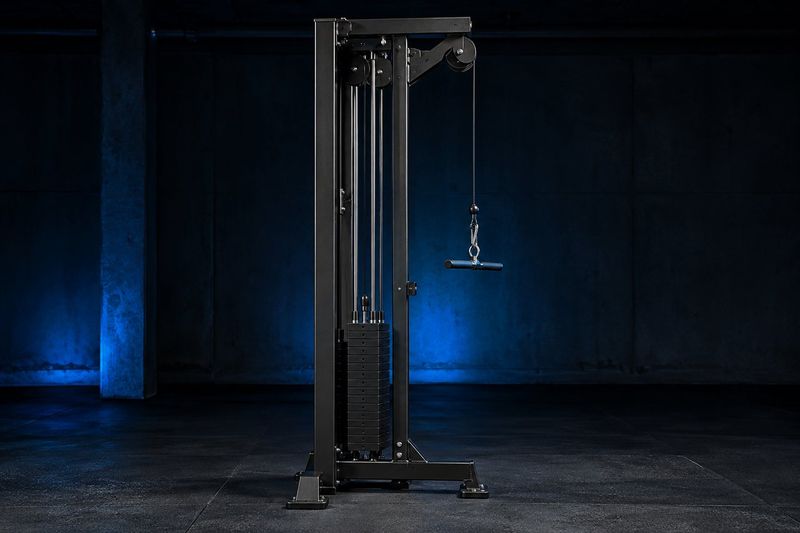
The cable triceps extension, also known as the triceps pushdown, is an exercise in which you extend your elbows against the resistance of a cable while your upper arms stay still. All three heads of the triceps work. The long head is loaded more when your upper arm is raised overhead. In the 2023 study by Maeo and colleagues, overhead cable extensions produced 1.5 times more growth of the long head than extensions with the upper arm down.
I'm Demid Lobanov, a fitness coach. In the programs I've written, the high-pulley pushdown with a straight bar appears 4 times and the overhead rope extension 2 times.
What muscles do cable triceps extensions work?
The triceps brachii, the three-headed muscle of the upper arm, does the work. All three of its heads attach to the olecranon and extend the elbow (Hall, Chapter 7). The lateral and medial heads originate on the humerus, so the position of the upper arm doesn't change their length.
The long head originates on the scapula and crosses the shoulder joint. It's longer when the upper arm is raised and shorter when it's lowered. That's how it's described in my exercise library.
| Muscle | What it does | When it works more |
|---|---|---|
| Lateral head of the triceps | Extends the elbow | With the upper arm down, it's the main one, according to my exercise library |
| Medial head of the triceps | Extends the elbow | Through the whole range of motion, especially at the end of the extension |
| Long head of the triceps | Extends the elbow, helps extend the shoulder | When the upper arm is raised overhead |
| Lats, teres major, rear delt | Hold the upper arm against the torso | During high-pulley pushdowns |
High-pulley pushdown or overhead extension
The triceps grows more with the overhead version. In the study by Maeo and colleagues, 21 adults did elbow extensions on a cable machine for 12 weeks: one arm overhead, the other with the upper arm down along the torso.
The range of motion was the same, from 90° at the elbow to full extension. Participants did 5 sets of 10 reps at 70% of their max 2 times a week.
| What was measured | Overhead | Upper arm along the torso |
|---|---|---|
| Long head | +28.5% | +19.6% |
| Lateral and medial heads combined | +14.6% | +10.5% |
| Whole triceps | +19.9% | +13.9% |
The loads used overhead were 34–39% lighter, yet growth was greater. Overhead, the long head is stretched, so the extension happens at a longer muscle length. But the long head also grew noticeably with the upper arm down, by 19.6%. This is a single study with 21 participants.
That's why, in my exercise library, the extension with the upper arm down isn't the only triceps exercise: the overhead variation is added to it.
| Variation | Upper arm position | Emphasis according to my exercise library |
|---|---|---|
| High-pulley pushdown with a straight or EZ bar | Along the torso | Lateral and medial |
| Overhead with a rope | Vertical, overhead | Long |
| Single-arm overhead, elbow out to the side | Raised and moved out to the side | Lateral, with the long head assisting |
Which attachment to choose: straight bar, EZ bar, or rope
Choose the attachment based on what's comfortable for your elbows and wrists. Which heads work more is determined by the position of the upper arm. The idea that a straight bar with an overhand grip engages the lateral head more is not confirmed either way in my exercise library.
| Attachment | Grip | Why it's convenient |
|---|---|---|
| Straight bar | Palms down | The most stable position at the end of the extension, usually more weight |
| Curved EZ bar | Palms angled | Easier on the wrists and elbows than a straight bar |
| Rope | Palms facing each other | Your hands spread apart at the end of the extension, more comfortable for the elbows |
Where the extension is hardest
On the high pulley, the movement is hardest around 90° at the elbow, when the forearm is perpendicular to the cable. Near full extension, the forearm lines up with the cable and the load almost disappears, even though that's where you feel the burn most.
Going deeper than 90°, the load also drops, and the upper arm starts drifting forward with the cable. That's how it's analyzed in my exercise library.
So the working range is from 90–100° at the elbow to straight arms. There's no need to chase the burn at the end of the extension.
How to do the high-pulley pushdown: step by step
- Stand facing the high pulley, grab the attachment, and pin your upper arms to your sides.
- Start with your elbows bent to about 90°.
- Extend your elbows until your arms are straight, without hyperextending them.
- Only your forearms move: your elbows don't drift forward or back.
- Don't lean forward or push the weight down with your body.
- Return the attachment to 90° at the elbow under control.
In the overhead rope extension, your upper arms stay vertical next to your head, and only your forearms move. If your elbows flare out and your upper arms drop, the exercise turns into a French press with the upper arm half lowered. The advantage for the long head is lost.
Common mistakes with cable triceps extensions
| Mistake | What happens | How to fix it |
|---|---|---|
| The elbow drifts back and up | The extension turns into a press driven by the torso | Pin your upper arms to your sides, use a lighter weight |
| Leaning forward and pushing with body weight | The movement is done by the torso, and the triceps works less | Keep your torso still |
| Elbows flare out in the overhead version | The upper arm drops, and the long head shortens | Keep your upper arms vertical next to your head |
| Arching the lower back in the overhead version | This compensates for limited shoulder mobility | If you can't raise your arm any higher, do the extension with the upper arm down |
| Chasing the burn at the end of the extension | There's almost no load there | Work from 90° at the elbow to straight arms |
Cable triceps extensions with elbow or shoulder pain
In my exercise library, cable extensions aren't ruled out by the diagnosis itself: what decides is the stage, tolerance, and dosage. During a flare-up of lateral epicondylitis or triceps tendinopathy, use a lighter weight and a neutral grip with the rope: a straight bar with an overhand grip loads the wrist extensors more.
If your shoulder hurts when you raise your arm overhead or your arm won't go all the way up, temporarily replace the overhead version with extensions with the upper arm down. Don't push through sharp pain without an established diagnosis: see a doctor for an examination first.
Pain at rest or at night, numbness, shooting pains, and weakness in the arm are reasons to stop training and see a doctor.
How to add cable triceps extensions to your workout: step by step
- Add cable extensions to your presses: presses also load the triceps, and extensions top up the volume. In the 2024 study by Lanza and colleagues, the triceps grew from the bench press alone.
- Combine high-pulley pushdowns with the overhead variation. According to my exercise library, in the bench press the long head gets only a third to a half of the stimulus an isolation exercise provides.
- Use a weight that lets you keep your upper arms pinned to your sides for the whole set.
- Choose the number of sets using How Many Sets per Week.
- Add weight when, for two workouts in a row, you complete all sets within your target rep range, with the last set at the top of the range and with clean technique.
If you need a plan for your goal and your gym, there's the personalized program.
I post exercise breakdowns on my YouTube channel @lobanov_fitness.
For pairing triceps isolation with compound presses, see How to Build Arms and Barbell Bench Press. You can check your volume balance and technique on video in a training audit.
Sources
- Hall SJ. Basic Biomechanics. 9th edition. McGraw Hill, 2022. Chapter 7: the upper extremity.
- Maeo S et al. Triceps brachii hypertrophy is substantially greater after elbow extension training performed in the overhead versus neutral arm position. Eur J Sport Sci, 2023. Article
- Lanza MB et al. Muscle hypertrophy response across four muscles involved in the bench press exercise: Randomized 10 weeks training intervention. J Bodyw Mov Ther, 2024. Article




