


A training plateau occurs when working weights, clean repetitions at standardized technique, and muscular progress remain stuck for 4–8 weeks straight despite consistent training. In most cases, the bottleneck lies in controllable variables: too many or too few sets, stopping too far from failure, constantly swapping exercises, accumulated fatigue, or inadequate recovery.
Restarting progress begins with auditing your training log. Overhauling your entire routine or doubling weekly sets without inspecting your numbers usually adds fatigue rather than results. Below we break down plateaus in natural resistance training (without pharmacological support or endocrine disorders): what research shows and how to diagnose the cause step by step.
What a training plateau is and why progress slows down
Sports science distinguishes short-term stalling from a true long-term plateau in muscle growth (Kataoka et al., 2024). Early in your training career, working numbers climb quickly—largely through technique and motor coordination gains (ACSM Position Stand, Ratamess et al., 2009). Over years of consistent lifting, anabolic signaling pathways can become less responsive to familiar loading, protein balance remains sensitive to energy availability, and aging gradually blunts the anabolic response.
Separate two very different scenarios:
- Normal deceleration. After a year of consistent lifting, adding +2.5 kg to a compound lift every 4–8 weeks or +1 clean repetition every couple of weeks is healthy progress, not a plateau.
- A genuine plateau. Your schedule, sleep, and nutrition are steady, yet for 4–8 consecutive weeks you cannot add weight or a single clean repetition at identical range of motion and tempo—or your numbers start slipping backward.
If only scale weight during fat loss has stopped moving while gym strength holds steady or climbs, the mechanism is different—we covered that in why weight stalls during fat loss.
Why adding more sets often stalls strength
The most common reaction to a stall is piling on extra exercises and sets for a lagging muscle group. Trials in resistance-trained lifters show that this reflex frequently backfires.
In a multilevel meta-regression of 67 studies involving 2,058 participants (Pelland et al., 2026), weekly set volume showed diminishing returns for both hypertrophy and strength—with diminishing returns considerably more pronounced for strength. Higher weekly frequency at equated volume modestly helped strength (also with diminishing returns) while having a negligible effect on hypertrophy.
Three randomized trials in trained lifters highlight the same pattern:
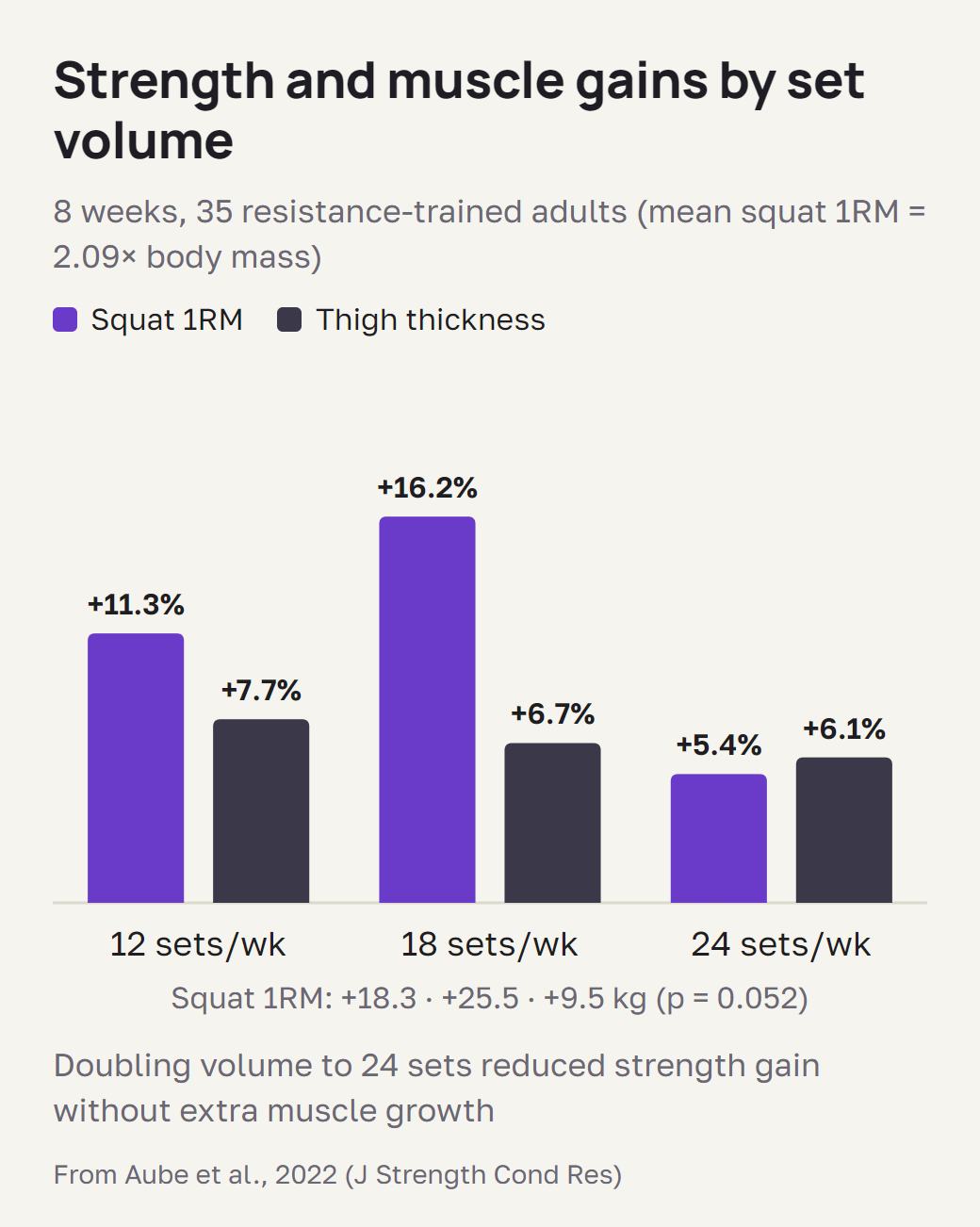
- In an 8-week RCT of 35 strong resistance-trained lifters (average back squat 2.09× body mass; Aube et al., 2022), 18 weekly sets gained +25.5 kg (+16.2%) in squat 1RM, 12 sets gained +18.3 kg (+11.3%), and 24 sets gained only +9.5 kg (+5.4%; the 18 vs. 24 difference did not reach statistical significance, p = 0.052). Summed thigh muscle thickness did not differ significantly across groups (+7.7%, +6.7%, and +6.1%).
- In an 8-week RCT of trained men (Barsuhn et al., 2025; 29 of 55 completed), all three groups (maintaining prior volume, +30%, and +60%) significantly increased squat 1RM (p < 0.0001) and thigh thickness (+1.07 cm, +0.76 cm, and +0.70 cm) with no hypertrophy advantage for higher volume. Overall 1RM showed a main group effect favoring habitual volume (174.7 vs. 159.0 and 149.0 kg, p < 0.0268, without a separate gain advantage). Jumping volume by +30% or +60% yielded no extra strength or growth.
- In a 6-week trial of 49 trained men (Heaselgrave et al., 2019), 9, 18, and 27 weekly biceps sets all increased thickness (+4.3%, +9.5%, and +5.4%) with no statistically significant difference between groups—27 sets did not outperform 18.
Excessive fatigue that fails to dissipate between sessions is the main culprit behind high-volume stalls. At the same time, one fixed set template does not fit everyone. In an 8-week within-subject RCT (Scarpelli et al., 2022; 16 trained adults, one leg trained on one protocol and the other leg on the second), individualizing volume to +20% above each lifter's logged baseline beat a flat 22-set template for vastus lateralis cross-sectional area (+1.08 cm², p = 0.042; ES 0.75).
Why trying to "shock the muscles" by swapping every exercise hurts
Another gym habit is replacing all exercises every 2–3 weeks so muscles "don't adapt." Frequent random rotation obscures progression: you lose your benchmark and spend weeks re-learning coordination on unfamiliar machines.
A systematic review of 8 studies in 241 young men (Kassiano et al., 2022) drew a clear distinction. Systematic, biomechanically planned variation (pairing movements with complementary resistance profiles) helps develop dynamic strength and regional muscle growth, whereas excessive, random rotation can compromise muscular adaptations.
In practice, I keep anchor exercises fixed for at least 6–8 weeks (8–12 weeks for primary compounds) while keeping execution technique consistent from session to session.
6 causes of a plateau and how to tell them apart
I am Demid Lobanov, a strength coach and methodology instructor. When clients come in for a training process audit saying their weights have been frozen for three months, the cause almost always sits in one of six areas:
| Plateau cause | Key sign in your log | What research shows | First practical move |
|---|---|---|---|
| Excessive volume & fatigue | Weights stall or drop, heavy soreness, poor sleep | 24 sets gained less squat strength than 18 (non-significant trend, p = 0.052, Aube, 2022); a deload preserves hypertrophy (Coleman, 2024) | Run a deload week and trim weekly sets by 20–30% |
| Insufficient effort (high RIR) | Low fatigue, identical weights for months, stopping cleanly at "10" | Hypertrophy improves closer to failure (Robinson, 2024) | Bring working sets to 1–2 reps in reserve with clean form |
| Too little volume with great recovery | Great recovery, hard sets, only 3–4 sets/week per muscle | Individualized +20% above logged baseline beat a flat template (Scarpelli, 2022) | Add 2–3 weekly working sets and evaluate over 4 weeks |
| Chaotic exercise swapping | New machines and exercise orders every week | Excessive random rotation can blunt gains (Kassiano, 2022) | Lock in 1–2 anchor lifts per muscle for 6–8+ weeks |
| Monotonous single rep range | Months of identical 3×10 at the same load in an experienced lifter | Undulating periodization edged linear for 1RM in trained lifters (Moesgaard, 2022) | Alternate heavier (5–7 reps) and moderate (8–12 reps) days |
| Sleep, calorie, or protein shortfall | Weights stall on a diet, elevated fatigue, slow recovery | Protein synthesis/breakdown depends on energy balance (Kataoka, 2024) | Aim to retain strength during a cut or restore sleep and protein |
When proximity to failure, periodization, and deloads help
Once volume is sensible and anchor exercises stay put, three levers break most stalls:
Proximity to failure (RIR). An exploratory multilevel meta-regression on estimated RIR (Robinson et al., 2024) showed a clear split: strength gains were similar across a wide range of RIR, while hypertrophy improved as sets got closer to failure. If muscle growth has stalled, film your last working set—in my practice, a set that feels "near maximal" often still shows several reps left in reserve on video.
Periodization. In a volume-equated meta-analysis of 35 studies (Moesgaard et al., 2022), periodized training produced larger 1RM strength gains than non-periodized work (ES 0.31, p = 0.02). Among trained lifters, undulating periodization (alternating heavier and lighter sessions within the week) borderline outperformed linear periodization for strength (ES 0.61, p = 0.05, 95% CI from 0.00), while hypertrophy did not differ at equal volume (p = 0.27 and p = 0.72). See periodization in strength training for practical templates.
Deload week. Many lifters fear losing muscle if they back off for a week. In a 9-week RCT of 39 trained adults (Coleman et al., 2024), even a complete one-week break at week 5 preserved thigh and calf hypertrophy compared with continuous training, though lower-body strength gains were slightly smaller. In practice, an active deload cutting working sets roughly in half at moderate effort clears accumulated fatigue while preserving motor skill (step-by-step protocol in deload week in strength training).
The role of a training log and outside feedback
Even a great plan breaks down if you track weights in your head. In an 8-week RCT of 36 young trained men and women (Coleman et al., 2023), two groups performed the exact same program—one under direct coach supervision and one unsupervised. The supervised group achieved greater gains in back squat 1RM, lean mass, and triceps and quadriceps thickness (bench press was similar).
In my own work, I log every client's working sets inside my own digital training log—coaches can also use this web app for fitness coaches to view past weights, reps, and technique videos side by side on one card. Without accurate numbers, it is impossible to separate a true plateau from drifting range of motion or lost focus.
Step-by-step plan to break a plateau over 4–6 weeks
If weights and reps have not moved for 3–8 weeks (3–4 weeks for a beginner, 6–8 weeks with 1+ year of training), adjust one variable at a time:
- Review the last 6 weeks of logs. Confirm range of motion, tempo, and rest intervals stayed consistent—see how to audit your workout program.
- Check sleep, calories, and recovery. In my practice, with chronic short sleep (under 7 hours), steep deficits, or persistent fatigue, restoring sleep and nutrition—and taking a deload if needed—comes first.
- Lock in double progression. Work in a narrow rep range (such as 8–10 or 10–12) and raise weight by the smallest increment only after hitting the top of the range cleanly across two consecutive sessions (see progressive overload in strength training).
- Adjust weekly volume and proximity to failure. Already doing 18–24+ hard sets/week with zero progress? Cut volume by 20–30% for 4 weeks. Doing only 6–8 sets with easy recovery? Add 20% to your logged baseline and push the final working set to 1–2 RIR.
- Add weekly undulation to a stalled compound lift. Run one heavier day (5–7 reps) and one moderate day (10–12 reps) instead of repeating identical sets twice a week.
- Re-evaluate after 4–6 weeks. If the stall persists, consider reviewing your full program and lift videos through a custom training program or training process audit. I also share technique and progression breakdowns on YouTube at @lobanov_fitness.
Frequently asked questions
How many weeks without adding weight counts as a true plateau?
For a beginner, 3–4 weeks without progress warrants checking the plan; for a lifter with a year or more of experience, 6–8 weeks with no gain in weight, reps, or technique quality despite steady sleep and nutrition.
Should you change your entire program when you hit a plateau?
No. The systematic review by Kassiano et al. (2022) indicates that excessive exercise rotation can hinder adaptations. Usually adjusting volume, proximity to failure, rep ranges, or inserting a deload while keeping anchor lifts is far more effective.
Can you break a strength plateau in a calorie deficit?
Because protein balance depends on energy availability (Kataoka et al., 2024), it depends on training age: in my practice, beginners and returning lifters often still gain strength in a mild deficit, whereas experienced lifters focus on retaining weights and muscle mass while dieting and plan bigger strength jumps after returning to maintenance.
Does simply adding more sets help if a muscle stops growing?
Only if your current volume is genuinely low and recovery is strong. When you already perform high weekly set counts, pushing volume higher often hurts strength without adding extra hypertrophy (Aube et al., 2022; Barsuhn et al., 2025).
Sources
- Kataoka R et al. The Plateau in Muscle Growth with Resistance Training: An Exploration of Possible Mechanisms. Sports Med, 2024. Article
- Pelland JC et al. The Resistance Training Dose Response: Meta-Regressions Exploring the Effects of Weekly Volume and Frequency on Muscle Hypertrophy and Strength Gains. Sports Med, 2026. Article
- Aube D et al. Progressive Resistance Training Volume: Effects on Muscle Thickness, Mass, and Strength Adaptations in Resistance-Trained Individuals. J Strength Cond Res, 2022. Article
- Barsuhn A et al. Training volume increases or maintenance based on previous volume: the effects on muscular adaptations in trained males. J Appl Physiol (1985), 2025. Article
- Heaselgrave SR et al. Dose-Response Relationship of Weekly Resistance-Training Volume and Frequency on Muscular Adaptations in Trained Men. Int J Sports Physiol Perform, 2019. Article
- Scarpelli MC et al. Muscle Hypertrophy Response Is Affected by Previous Resistance Training Volume in Trained Individuals. J Strength Cond Res, 2022. Article
- Kassiano W et al. Does Varying Resistance Exercises Promote Superior Muscle Hypertrophy and Strength Gains? A Systematic Review. J Strength Cond Res, 2022. Article
- Moesgaard L et al. Effects of Periodization on Strength and Muscle Hypertrophy in Volume-Equated Resistance Training Programs: A Systematic Review and Meta-analysis. Sports Med, 2022. Article
- Robinson ZP et al. Exploring the Dose-Response Relationship Between Estimated Resistance Training Proximity to Failure, Strength Gain, and Muscle Hypertrophy: A Series of Meta-Regressions. Sports Med, 2024. Article
- Coleman M et al. Supervision during resistance training positively influences muscular adaptations in resistance-trained individuals. J Sports Sci, 2023. Article
- Coleman M et al. Gaining more from doing less? The effects of a one-week deload period during supervised resistance training on muscular adaptations. PeerJ, 2024. Article · Full text
- American College of Sports Medicine (Ratamess NA et al.). Position Stand: Progression Models in Resistance Training for Healthy Adults. Med Sci Sports Exerc, 2009. Article