
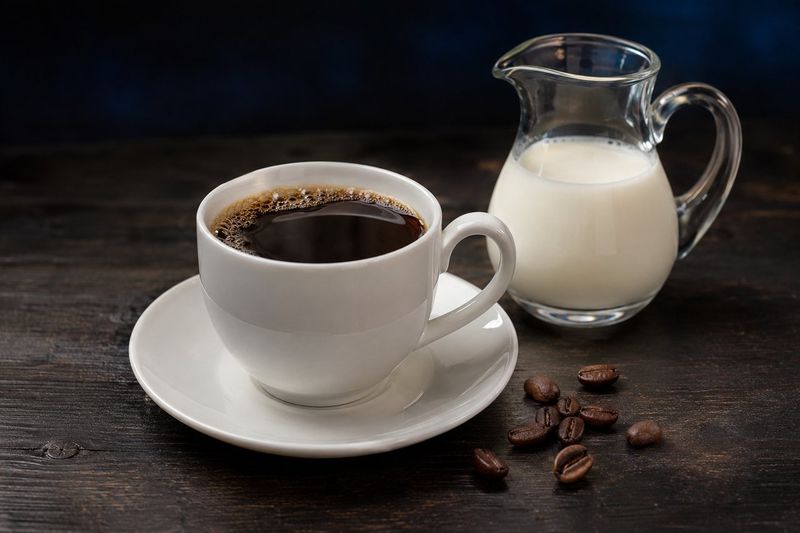
You can drink coffee while losing weight. Black coffee without sugar has almost no calories: a 200 ml cup has about 2 kcal. The calories come from what you add: milk, cream, sugar, and syrup. Coffee itself doesn't noticeably reduce weight. In observational studies it's linked to less weight gain, but only by fractions of a kilogram over several years. Weight loss comes from a calorie deficit. Coffee either plays almost no part in it or adds calories through what you put in it.
I'm Demid Lobanov, a fitness coach. In the meal plans I build, unsweetened tea and coffee aren't counted, while milk and sugar in coffee count as food. In the questionnaire for the meal plan, I ask separately how a person takes their coffee or tea: with milk, cream, sugar, syrup, or nothing added.
How many calories are in coffee
Coffee itself has almost no calories; the difference comes from what you add. The table is calculated from USDA data for coffee and from the food database I use to build meal plans.
| What's in the cup | Amount | Calories |
|---|---|---|
| Brewed coffee | 200 ml | about 2 |
| Espresso | 30 ml serving | about 3 |
| Instant coffee made with water | 200 ml | about 3 |
| 2.5% milk | 100 g | 53 |
| 10% cream | 20 g | 24 |
| Sugar | 5 g | 20 |
| Oat milk | 100 g | 46 |
A cup of brewed coffee with 100 g of milk and 10 g of sugar is about 95 kcal. Two of those a day add up to about 190 kcal. That's as many calories as a small snack.
Does coffee help you lose weight
Coffee has no strong effect. In three large US cohorts followed by Henn and colleagues in 2023, each extra daily cup of unsweetened coffee was associated with 0.12 kg less weight gain over 4 years. This held for both regular and decaf coffee. These are observational data, and they only show an association. Data like these can't prove that coffee reduces weight.
Direct trials don't show an effect either. In a 1992 randomized trial by Astrup and colleagues, participants were randomly assigned to groups. For 24 weeks, 180 people with obesity followed a diet and took either 200 mg of caffeine three times a day or a placebo, a substance with no active ingredient. Weight went down the same in both. A 2024 network meta-analysis by Jayedi and colleagues pooled the results of 22 randomized trials with 1,710 participants. Neither coffee nor decaf reduced weight. A small effect, with low certainty, was found only for green tea: about a kilogram.
A 2019 meta-analysis by Tabrizi and colleagues pooled 13 randomized trials with 606 participants. By the authors' calculation, doubling the caffeine dose meant 22% more weight loss. But the results of the studies varied widely: heterogeneity, a measure of how much the results differ from each other, was 91%. The abstract doesn't make clear which studies gave caffeine alone and which gave it mixed with other substances.
Caffeine doesn't change hunger, and its effect on how much you eat is weak and short-lived. In a 2018 study by Panek-Shirley and colleagues, 50 adults had a drink with or without caffeine and, half an hour later, ate as much breakfast as they wanted. After a low dose (1 mg per kilogram of body weight, which is 70 mg for someone who weighs 70 kg), they ate about 10% less at breakfast. After 3 mg per kilogram, they ate the same amount as without caffeine. Hunger ratings didn't differ, and there was no difference in food intake for the rest of the day. The authors write that caffeine is not a tool for suppressing appetite.
Coffee with milk while losing weight
You can drink it as long as the milk is counted in your daily calories. There are 53 kcal in 100 g of 2.5% milk and about 107 kcal in 200 g. Milk like this counts as food.
My recipe database has a breakfast called “ground chicken and cheese sandwiches, coffee with milk.” It includes 150 g of milk for the coffee, about 80 kcal. Those 80 kcal are part of the dish's calorie count.
Plant-based milk counts too: unsweetened oat milk has about 46 kcal per 100 g; check the label for the exact number. Cream with 10% fat has more than twice the calories of milk: 119 kcal per 100 g.
You don't have to give up milk to lose weight. If coffee with milk is your habit, weigh the milk once and add it to your daily calories.
Coffee with sugar while losing weight
Sugar adds calories to coffee. In the same Henn study, each added teaspoon of sugar was associated with 0.09 kg of weight gain over 4 years. It outweighed the link between coffee and less weight gain. Cream and powdered creamer weren't associated with weight gain.
There are 20 kcal in 5 g of sugar. If you drink three cups a day with 10 g of sugar each, that's 120 kcal a day. Those need to be counted too. Count syrups by the label, just like sugar.
How much coffee you can drink per day
What limits how much coffee you can drink is caffeine, since coffee itself has almost no calories. The European Food Safety Authority sees no health concerns for non-pregnant adults with habitual intake of up to 400 mg of caffeine a day and up to 200 mg at one time.
| Drink | Caffeine per serving |
|---|---|
| Brewed coffee, 200 ml | about 80 mg |
| Espresso, 30 ml | about 64 mg |
| Instant coffee, 200 ml | about 52 mg |
| Decaf instant coffee, 200 ml | about 2 mg |
The figures in the table are USDA averages. A real cup can have more or less caffeine, depending on the beans and how the coffee is brewed. The 2023 Gardiner meta-analysis used 107 mg per 250 ml as the standard. So 400 mg is four to five cups of brewed coffee at 200 ml each. During pregnancy and breastfeeding, the agency sees no concerns up to 200 mg a day, which is about two cups. For children and teenagers, the agency didn't have enough data; the guideline is 3 mg per kilogram of body weight. If you're pregnant or have heart disease, high blood pressure, or stomach problems, your doctor decides how much coffee you can drink.
Coffee in the evening and sleep
Coffee can make your sleep worse, and the effect depends on the dose and timing. In a 2025 randomized trial by Gardiner and colleagues, 23 young men took 100 or 400 mg of caffeine 12, 8, and 4 hours before bed. After 100 mg, sleep didn't change, even when it was taken 4 hours before bed. A single 400 mg dose delayed falling asleep and changed sleep structure even when taken 12 hours before bed, that is, in the morning. Participants felt their sleep got worse only when they took it 4 hours before bed. In the other cases, they didn't notice any effect.
In meta-analyses, caffeine shortens sleep by 35–45 minutes on average: Gardiner 2023 (24 studies) and Chang 2025 (22 studies, 956 people). In Chang, this was true for both low and high doses. By Gardiner 2023's calculation, a cup of coffee should be finished no later than 8.8 hours before bed. People differ in how sensitive they are to caffeine. If you have a harder time falling asleep after an evening cup, move it a few hours earlier.
Does coffee make you lose water
Coffee doesn't make your body lose a noticeable amount of water. In a 2015 meta-analysis by Zhang and colleagues, a typical 300 mg dose of caffeine increased urine output by 109 ml on average. The effect was stronger in women, and there was no effect during exercise. The authors consider concerns about losing fluid because of caffeine unfounded, especially when the coffee is consumed before exercise. For more on drinking water, see the article How Much Water to Drink per Day.
Coffee for weight loss: step by step
- Drink coffee if you enjoy it and it doesn't interfere with your sleep.
- Don't count black coffee without sugar: it has almost no calories.
- Weigh the milk, cream, sugar, and syrup you add to your coffee and include them in your daily calories.
- Stay within 400 mg of caffeine a day, which is four to five cups of brewed coffee. During pregnancy and breastfeeding, stay within 200 mg.
- Don't take a lot of caffeine at once: a single 400 mg dose disrupted sleep even when taken in the morning. Have your last cup about 9 hours before bed.
- After two weeks, compare your average weight for the week with the previous week. If you stuck to your meal plan and your weight barely went down, cut 5–10 g of fat per day. Cream or milk in your coffee are the first candidates.
If you need meals built around your calorie target and your tastes, there's the meal plan.
I post nutrition and training breakdowns on my YouTube channel @lobanov_fitness.
Sources
- Henn M et al. Changes in Coffee Intake, Added Sugar and Long-Term Weight Gain – Results from Three Large Prospective US Cohort Studies. Am J Clin Nutr, 2023. Article · Full text
- Tabrizi R et al. The effects of caffeine intake on weight loss: a systematic review and dos-response meta-analysis of randomized controlled trials. Crit Rev Food Sci Nutr, 2019. Article
- Astrup A et al. The effect and safety of an ephedrine/caffeine compound compared to ephedrine, caffeine and placebo in obese subjects on an energy restricted diet. A double blind trial. Int J Obes Relat Metab Disord, 1992. PubMed
- Jayedi A et al. Comparative effects of tea and coffee drinking on body weight in adults: a systematic review and network meta-analysis of randomised trials. Br J Nutr, 2024. Article
- Panek-Shirley LM et al. Caffeine Transiently Affects Food Intake at Breakfast. J Acad Nutr Diet, 2018. Article
- EFSA Panel on Dietetic Products, Nutrition and Allergies. Scientific Opinion on the safety of caffeine. EFSA Journal, 2015. Article
- Gardiner CL et al. Dose and timing effects of caffeine on subsequent sleep: a randomized clinical crossover trial. Sleep, 2025. Article · Full text
- Gardiner C et al. The effect of caffeine on subsequent sleep: A systematic review and meta-analysis. Sleep Med Rev, 2023. Article
- Chang YH et al. Age- and dose-specific effects of caffeine on sleep: A meta-analysis of controlled crossover trials. Sleep Med, 2025. Article
- Zhang Y et al. Caffeine and diuresis during rest and exercise: A meta-analysis. J Sci Med Sport, 2015. Article · Full text
- USDA FoodData Central: brewed coffee (171890), espresso (171891), instant coffee (174130), decaf instant coffee (171894). Website