


Emotional eating is the tendency to eat in response to stress, fatigue, anxiety, or boredom rather than physical hunger. While it can derail weight management, it rarely comes down to "weak willpower"—research links it to emotion dysregulation, poor sleep, and rigid dieting rules.
Generic tips to "just drink water and eat mindfully" often fall flat. Below we synthesize 2018–2026 meta-analyses on causes, effective behavioral interventions, and the boundary between everyday stress eating and clinical eating disorders.
How emotional eating links to weight, stress, and sleep
Recent meta-analyses show emotional eating is a measurable adult weight factor driven primarily by negative emotions:
- Age and body weight. Across 41 studies (Lederman et al., 2026; 20 youth samples aged 12–21, 21 adult samples ≥22), individuals with BMI ≥25 reported higher emotional eating than normal-BMI peers (SMD = 0.27; p < 0.001; high heterogeneity I² = 91.8%), and obesity scored higher than overweight (SMD = 0.25; p < 0.001). The link was non-significant in youth ≤21 (SMD = −0.04; p = 0.774), significantly stronger in adults (β = 0.20; p = 0.020), and stronger in samples with more women (β = 0.53; p = 0.037).
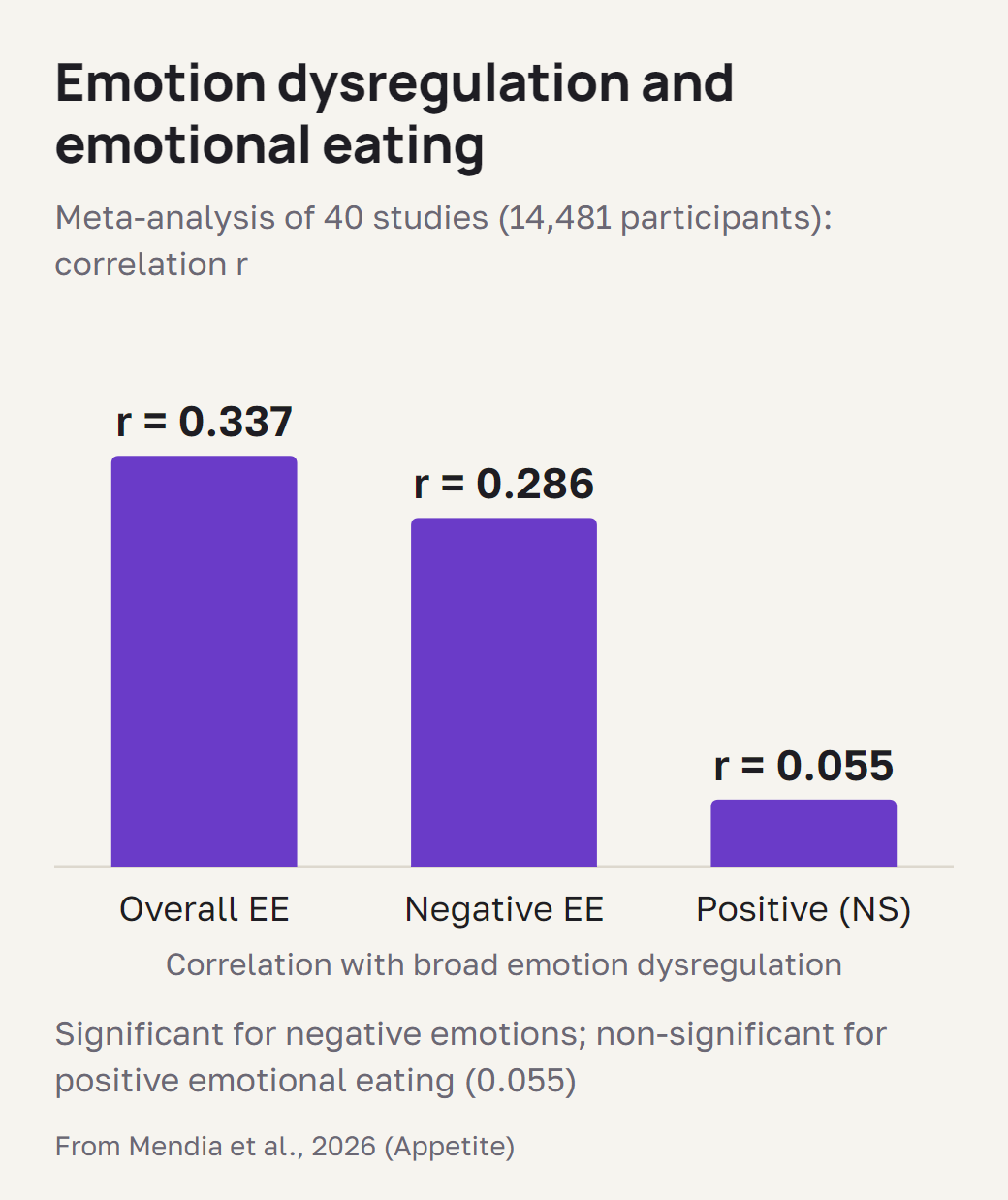
- Negative emotion dysregulation. A meta-analysis of 40 studies and 42 samples totaling 14,481 participants (Mendia et al., 2026) found a moderate correlation between broad emotion dysregulation and emotional eating (r = 0.337)—driven specifically by negative emotional eating (r = 0.286), whereas positive emotional eating was non-significant (r = 0.055).
- Poor sleep, stress, and rigid rules. A systematic review (Zerón-Rugerio et al., 2023) identified emotional eating and disinhibition as key links between inadequate sleep and obesity, especially in women (see sleep and weight loss). In the 3-year PREVIEW study of 1,311 adults (Jalo et al., 2022), frequent high stress eroded flexible restraint (p = 0.026) and heightened hunger and disinhibition (p < 0.001). In 1,341 participants (Linardon et al., 2020), low intuitive eating paired with all-or-nothing thinking yielded 84% recurrent overeating cases, and rigid restraint paired with low flexibility yielded 81%, versus 33% without extreme rigidity.
What actually works—and where mindfulness alone falls short
Meta-analyses draw a sharp line between structured behavioral strategies and standalone mindful eating:
- Targeted behavioral programs and 5 key BCTs. In 47 studies totaling 6,729 adults with BMI >25 (Power et al., 2025), emotional-eating interventions reduced emotional eating scores across 42 studies (SMD = −0.99; p < 0.001) and body weight across 32 studies (−4.09 kg; p < 0.001). Five behavior change techniques stood out: addressing incompatible beliefs, outcome goal setting, reviewing outcome goals, feedback on behavior, and pros/cons analysis.
- Conservative estimates and CBT. Adjusting 34 studies for publication bias (Smith et al., 2023) yielded smaller pooled changes (−1.08% weight, −2.37% emotional eating), highlighting cognitive behavioral therapy (CBT) as most promising. Across 12 CBT RCTs in 6,805 adults (Jacob et al., 2018), CBT added −1.70 kg weight loss, raised cognitive restraint (SMD = 0.72), and reduced emotional eating (SMD = −0.32; I² = 0%).
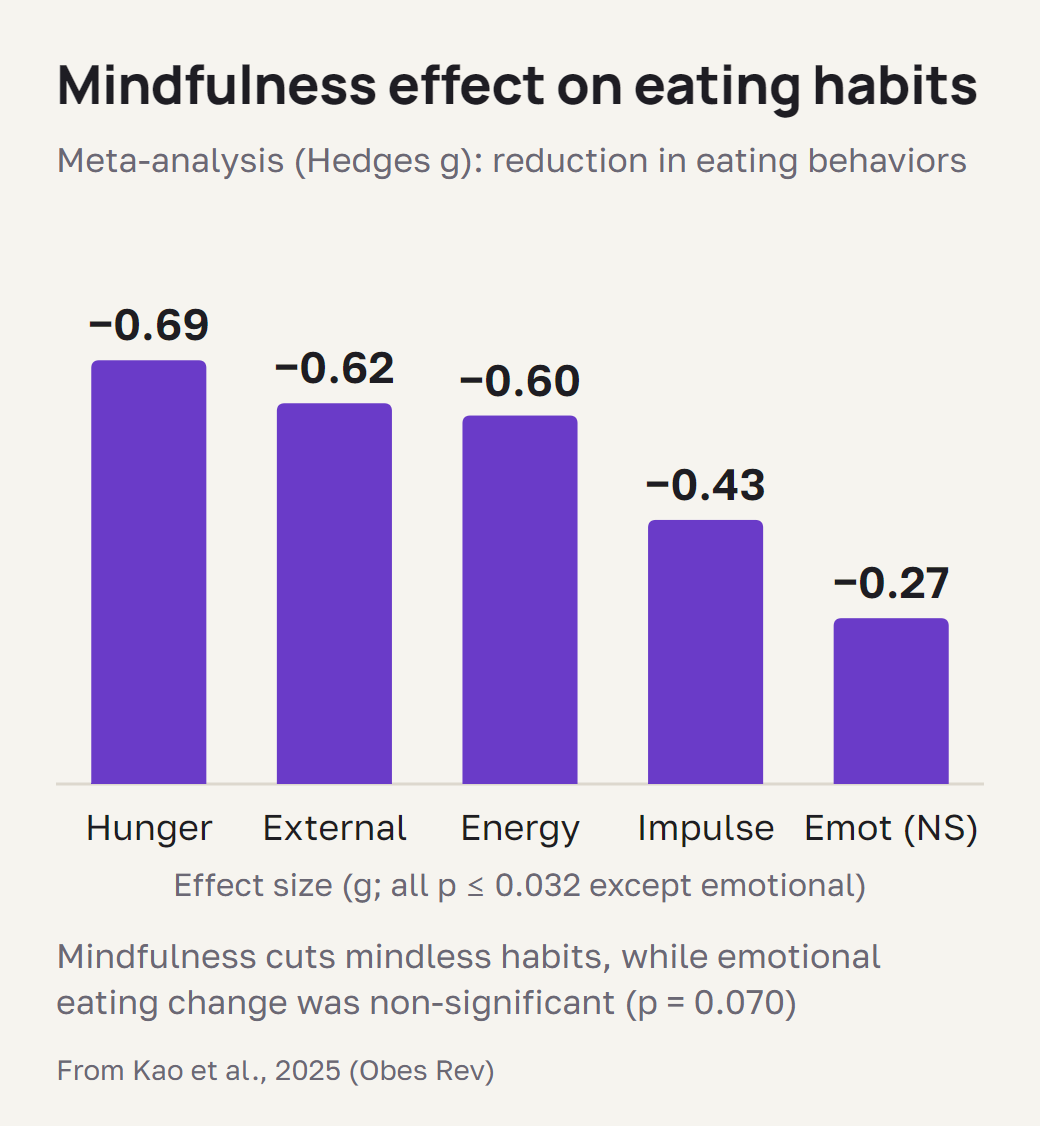
- Limits of mindfulness alone. A meta-analysis of mindfulness-based interventions (Kao et al., 2025) found clear benefits for mindless habits—cutting external eating (g = −0.62; p = 0.001), hunger eating (g = −0.69; p = 0.032), energy intake (g = −0.60; p = 0.003), impulsive choices (g = −0.43; p = 0.002), and sweet intake (g = −0.39; p < 0.001) while boosting fullness awareness (g = 0.64; p < 0.001). Yet effects on emotional eating (g = −0.27; p = 0.070; long-term g = −0.22; p = 0.809) and binge eating (g = −0.35; p = 0.136) were small and non-significant. Slow chewing alone rarely solves stress eating without structured routine and coping tools.
Physical hunger vs. emotional urge
| Sign | Physical hunger | Emotional urge |
|---|---|---|
| Onset | Builds gradually 3–5 hours after a meal | Hits abruptly after stress, conflict, or fatigue |
| Food preference | Regular satisfying meal sounds fine | Craving specific sweet, salty, or fatty foods |
| Feeling afterward | Calm fullness, easy to stop | Heaviness, guilt, or urge to keep grazing |
| Helpful response | Balanced meal with protein and fiber | Short pause, decompression, trigger check, routine |
Five practical daily steps
I am Demid Lobanov, a fitness coach and training methodologist. In custom nutrition plans, online coaching, and free consultations, we start with physiological basics—often half of evening "emotional lapses" vanish once daytime undereating stops.
- Cover daytime hunger. Regular protein- and fiber-rich meals dramatically curb evening cravings.
- Drop "forbidden food" lists. Rigid clean-vs.-bad rules fuel all-or-nothing lapses (Linardon, 2020; see diet lapses and weekend overeating). Keep trigger snacks out of immediate sight while budgeting moderate portions calmly.
- Protect sleep. Chronic sleep deficit erodes evening self-regulation (Zerón-Rugerio, 2023).
- Use a 10–15 minute pause. Rather than forbidding food, wait 10–15 minutes—drink water or tea, take a brief walk, and ask whether you are physically hungry or simply drained.
- Log triggers without self-blame. Jotting down situation, emotion, and outcome provides behavioral feedback (Power, 2025). If overeating happens, skip punishment cardio and fasting—simply return to your regular meal next.
I also share sustainable nutrition and weight-maintenance breakdowns on YouTube at @lobanov_fitness.
When you need a psychotherapist or psychiatrist, not a fitness coach
Nutrition structure helps everyday stress eating, but does not treat clinical eating disorders. Seek a CBT psychotherapist or psychiatrist if you experience:
- recurrent binge episodes with a feeling of complete loss of control;
- eating secretly out of intense shame or disgust;
- compensatory behaviors (vomiting, laxatives, diuretics, extreme fasting, or punishment exercise);
- persistent depression, severe anxiety, or sleep disruption interfering with daily life.
Frequently asked questions
Is emotional eating always an eating disorder?
No. Occasionally eating comfort food after a tough day is normal human behavior. Clinical disorders involve recurrent episodes with loss of control, significant distress, or compensatory behaviors.
Does cutting out all sugar stop stress eating?
Usually the opposite—strict bans strengthen all-or-nothing thinking and relapse risk (Linardon, 2020). Keep bulk triggers out of sight while allowing planned moderate portions without guilt.
Can exercise alone eliminate stress eating?
Exercise alone does not replace emotional regulation skills. Combining steady meals, sleep, movement, and behavioral tools works best.
What should I do the morning after evening overeating?
Skip punitive weigh-ins, do not skip breakfast, and avoid extra punishment cardio. Hydrate, eat your regular balanced breakfast, and note what triggered last night's episode.
Sources
- Lederman C et al. Emotional eating and weight status: A systematic review and meta-analysis across adolescents and adults. Br J Health Psychol, 2026. Article
- Mendia J et al. Uncovering the association between broad emotional dysregulation and emotional eating: A meta-analysis. Appetite, 2026. Article
- Power D et al. Emotional Eating Interventions for Adults Living With Overweight and Obesity: A Systematic Review and Meta-Analysis of Behaviour Change Techniques. J Hum Nutr Diet, 2025. Article · Full text
- Smith J et al. Emotional Eating Interventions for Adults Living with Overweight or Obesity: A Systematic Review and Meta-Analysis. Int J Environ Res Public Health, 2023. Article · Full text
- Jacob A et al. Impact of cognitive-behavioral interventions on weight loss and psychological outcomes: A meta-analysis. Health Psychol, 2018. Article
- Kao TA et al. Effects of mindfulness-based interventions on obesogenic eating behaviors: A systematic review and meta-analysis. Obes Rev, 2025. Article · Full text
- Zerón-Rugerio MF et al. Are Emotional Eating and Other Eating Behaviors the Missing Link in the Relationship between Inadequate Sleep and Obesity? A Systematic Review. Nutrients, 2023. Article · Full text
- Jalo E et al. Perceived stress as a predictor of eating behavior during the 3-year PREVIEW lifestyle intervention. Nutr Diabetes, 2022. Article · Full text
- Linardon J et al. Interactions between different eating patterns on recurrent binge-eating behavior: A machine learning approach. Int J Eat Disord, 2020. Article
- Aragon AA et al. International society of sports nutrition position stand: diets and body composition. J Int Soc Sports Nutr, 2017. Article · Full text