

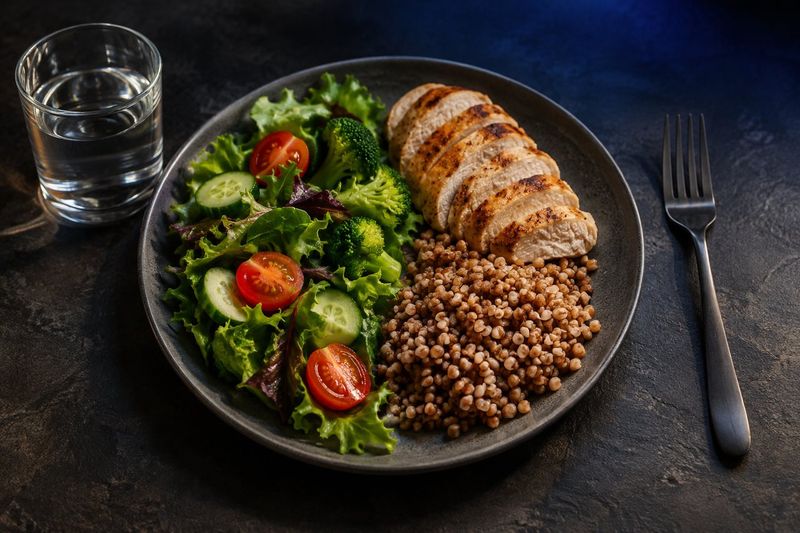
The Harvard plate is often presented as the ideal replacement for a kitchen scale: divide your meal into three sections, and the weight drops on its own without spreadsheets or apps. In practice, the method really works well for getting started, especially if you are tired of strict diets.
Still, a visual layout has clear limits. According to 2021–2026 meta-analyses, portion-control plates help lower body weight by an average of 1.7–3.7 kg over the first 3–6 months. In nutrition research, lowering a diet's energy density with vegetables and fiber helps manage calorie intake while keeping portions filling (Rolls, 2014). Once untracked oils, sauces, and sugary drinks stay in the diet, or when you need to hit an accurate protein target for strength training, plate dividers alone are no longer enough.
How the Harvard plate works and why it lowers calorie intake
The classic layout from the Harvard T.H. Chan School of Public Health divides a main meal into three parts:
- Half the plate (50%): non-starchy vegetables and greens, such as broccoli, cabbage, cucumbers, tomatoes, bell peppers, zucchini, and leafy salads. A small portion of fruit or berries fits here too. Potatoes do not count toward this half—they belong with the side carbs.
- One quarter of the plate (25%): a protein source, such as lean meat, poultry, fish, seafood, eggs, cottage cheese, legumes, or tofu.
- One quarter of the plate (25%): complex carbs, such as buckwheat, brown rice, oats, barley, quinoa, durum wheat pasta, whole-grain bread, or baked potatoes.
A review of portion-control research explains the physiology behind this layout (Rolls, 2014). Telling people to "just eat less of everything" works poorly because they stay hungry. When you dedicate half the volume to foods with low energy density, meal volume stays satisfying while total calories at lunch and dinner go down. Low energy density means a food contains plenty of water and fiber for relatively few calories.
What meta-analyses and RCTs show about the plate method
Enough direct randomized controlled trials (RCTs) and meta-analyses have accumulated in recent years to evaluate the method in kilograms:
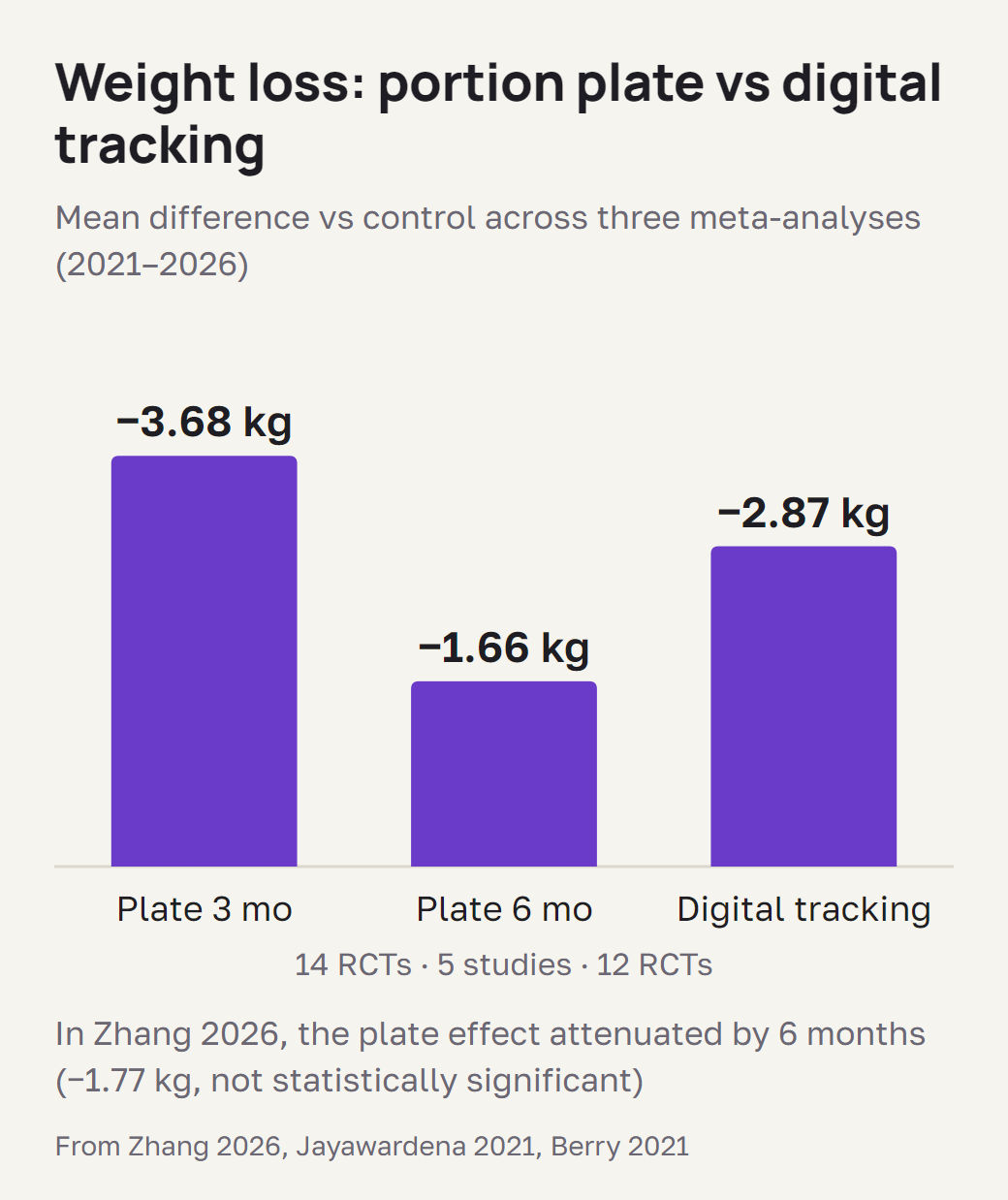
- In a systematic review and meta-analysis of 5 intervention studies (Jayawardena et al., 2021), portion-control plates lowered body weight by 2.02 kg over 3 months (95% CI −3.03 to −1.01; p < 0.0001). Body mass index (BMI) dropped by 0.87 kg/m², and waist circumference fell by 2.28 cm (p = 0.05). Over 6 months, weight reduction was 1.66 kg (−1.64% of body weight; p = 0.002).
- An updated 2026 meta-analysis pooled 14 RCTs with 1,762 adults with chronic conditions (Zhang et al., 2026). Portion-control plates produced a clear early drop at month 3 (−3.68 kg, 95% CI −7.78 to −0.42). By month 6, the difference versus control narrowed (−1.77 kg, 95% CI −4.46 to 0.92, not statistically significant). Glycated hemoglobin HbA1c improved consistently (−0.82%).
- An RCT of 65 adults with obesity showed a similar pattern (Kesman et al., 2011; 42 participants reached month 6). At 3 months, weight decreased by 2.4% in the plate-plus-dietitian group versus 0.5% in usual care (p = 0.041). By 6 months, the difference was no longer significant (a 2.1% reduction versus 0.7%; p = 0.232).
- Further evidence came from a meta-analysis of 28 studies on portion-control tools (Vargas-Alvarez et al., 2021). The overall effect on food intake was small (d = −0.22). Smaller bowls and spoons had a stronger effect on portion size (d = −0.48), and calibrated tableware drove a modest weight reduction (d = −0.20). Simply switching to a smaller plain plate without dividers or food structure did not work on its own (d = −0.03; 95% CI −0.12 to 0.06 across 7 comparisons).
The plate method vs. calorie tracking
Digital food tracking in apps offers more controllable outcomes, but it requires consistency. In a meta-analysis of 12 RCTs (Berry et al., 2021), digital self-monitoring of diet and activity increased weight loss by 2.87 kg (95% CI −3.78 to −1.96; p < 0.001). Daily energy intake dropped by an average of 182 kcal (p < 0.01). Tailored feedback worked significantly better than standard advice (p < 0.001).
A systematic review of 39 RCTs (Patel et al., 2021) highlighted the flip side. More consistent logging was linked to greater weight loss in 74% of cases. Yet very few programs maintained logging on 75% of days or more. That is why the plate method and calorie tracking pair well together: the plate sets an easy daily structure, while short check-in periods of tracking expose blind spots.
Four traps that keep the Harvard plate from producing fat loss
My name is Demid Lobanov, and I am a fitness coach. When a client says she "eats strictly by the plate method, yet the scale is not moving," one of four issues frequently shows up:
- Hidden fats on top of a balanced plate. Two tablespoons of olive oil on salad, a chunk of cheese over the side dish, nuts "for health," and cooking oil for frying chicken easily add 300–450 kcal to an otherwise modest lunch. Visually, the plate still looks ideal, while the deficit disappears.
- Everything outside the plate. Coffee with milk and syrup, a handful of dried fruit, a couple of cookies with tea, bites from the fridge, and an evening glass of wine never touch the plate. Yet they can create a daily calorie surplus.
- High-fat picks in the protein quarter. A quarter plate of chicken breast or cod and a quarter plate of fatty pork, sausages, or salmon in cream sauce differ markedly in calories.
- Too little protein during strength training. If the protein quarter holds cottage cheese pancakes, hummus, or a single egg, daily protein falls short. According to the ISSN position stand (Aragon et al., 2017), sufficient protein during a calorie deficit matters for preserving lean mass. You can estimate your actual calorie and protein targets once in the calories and macros calculator.
A practical weekly meal framework using the plate method
Instead of inventing complicated meals every day, build a simple mix-and-match framework of 3–4 staples per meal and rotate them across the week:
| Day / option | Protein (25% of plate) | Carbs (25% of plate) | Vegetables and greens (50% of plate) | Fat control |
|---|---|---|---|---|
| Mon / Thu (lunch) | Baked turkey breast | Boiled buckwheat | Cucumber, tomato, and herb salad | 1 tsp olive oil |
| Tue / Fri (lunch) | Oven-baked cod or pollock fillet | Brown rice or pearl barley | Steamed broccoli and cauliflower | Lemon juice + 1 tsp oil |
| Wed / Sat (lunch) | Braised lean beef | Baked potato or bulgur | Sauerkraut and bell pepper | No heavy gravies or mayo |
| Sun (lunch) | Baked trout or salmon | Durum wheat pasta | Large mixed green salad with cherry tomatoes | No added oil (fish is already fatty) |
| Dinner (any day) | Chicken fillet, seafood, omelet, or cottage cheese | Smaller grain portion or a slice of bread (by hunger) | Stewed zucchini, green beans, or fresh salad | Measure sour cream and cheese with a spoon |
For breakfast, the same idea works without a literal flat plate: an omelet with vegetables and whole-grain toast, or low-fat cottage cheese with berries and oats.
How to test in two weeks whether the plate method is enough
I, Demid Lobanov, recommend a simple two-week check:
- Build 3 main meals using the plate layout and cut liquid calories and untracked snacks between meals. Measure oil for salads and cooking with a teaspoon rather than pouring by eye from the bottle.
- Weigh yourself in the morning on an empty stomach 3–4 times a week and track the weekly average instead of single-day swings.
- Evaluate after 14 days. If your average weight drops steadily (roughly 0.3–0.7% of body weight per week) without severe hunger, the plate method is doing its job. You do not need a kitchen scale right now.
- If your weight stays flat for two weeks straight, run 3–5 days of check-in food weighing to see actual calories and protein intake. You can also use a ready-made individual monthly nutrition plan with exact portions and no daily math.
If you want to combine nutrition with strength training and adjust the plan regularly to fit your real schedule, you can work with me in online coaching. For more on calorie deficits and portion accuracy, read how to weigh food properly, weight loss meal plan, how much protein you need per day, and weight loss plateau. I also share short nutrition and training breakdowns on my YouTube channel @lobanov_fitness.
Sources
- Jayawardena R et al. Impact of portion-control plates (PCP) on weight reduction: A systematic review and meta-analysis of intervention studies. Obes Res Clin Pract, 2021. Article
- Zhang S et al. Time-dependent metabolic effects of portion-control plate interventions in adults with chronic diseases: a systematic review and meta-analysis. BMC Prim Care, 2026. Article · Full text
- Vargas-Alvarez MA et al. Impact of Portion Control Tools on Portion Size Awareness, Choice and Intake: Systematic Review and Meta-Analysis. Nutrients, 2021. Article · Full text
- Kesman RL et al. Portion control for the treatment of obesity in the primary care setting. BMC Res Notes, 2011. Article · Full text
- Rolls BJ. What is the role of portion control in weight management? Int J Obes (Lond), 2014. Article · Full text
- Berry R et al. Does self-monitoring diet and physical activity behaviors using digital technology support adults with obesity or overweight to lose weight? A systematic literature review with meta-analysis. Obes Rev, 2021. Article
- Patel ML et al. Self-Monitoring via Digital Health in Weight Loss Interventions: A Systematic Review Among Adults with Overweight or Obesity. Obesity (Silver Spring), 2021. Article · Full text
- Aragon AA et al. International society of sports nutrition position stand: diets and body composition. J Int Soc Sports Nutr, 2017. Article · Full text
- Harvard T.H. Chan School of Public Health. Healthy Eating Plate. Page