
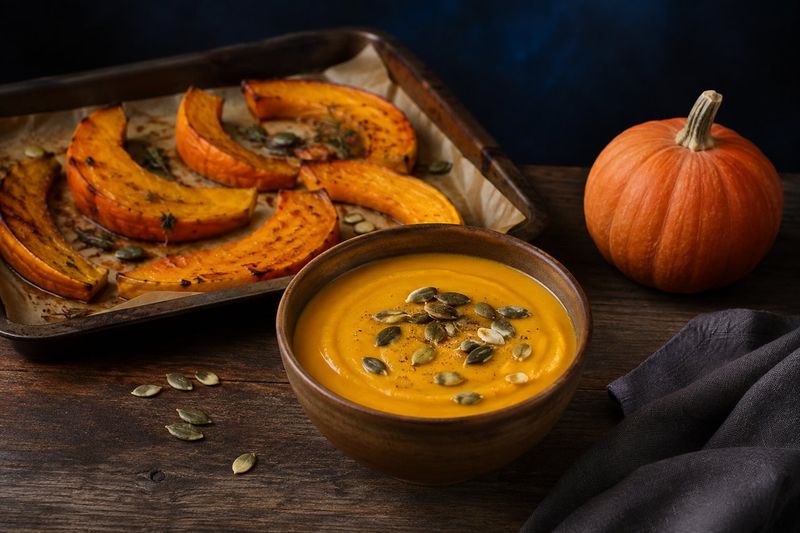
You can eat pumpkin while losing weight: 100 g of raw pumpkin has about 30 kcal. A 200 g serving provides about 60 kcal. Pumpkin is low in calories, so the calorie content of a pumpkin dish depends mainly on the oil, cream, honey, and sugar.
I'm Demid Lobanov, a fitness coach. In the database I use to build meal plans for clients, pumpkin is part of 4 of 260 dishes: millet porridge, two pureed soups, and a cottage cheese casserole. Each serving contains 60–350 g of it.
Calories in pumpkin
According to USDA, 100 g of raw pumpkin contains 1 g of protein, 0.1 g of fat, and 6.5 g of carbs, of which 0.5 g is fiber. The calculation with my database's formula gives about 30 kcal; the USDA calculation gives 26.
In my database, foods are counted by their raw weight. When roasted, vegetables lose water: according to my database's reference guide, approximately a quarter of their weight. So 100 g of roasted pumpkin is made from a larger amount of raw pumpkin and has more calories. With boiling, it's the other way around: according to USDA, 100 g of boiled pumpkin has about 18 kcal. Weigh pumpkin before cooking; that makes the calculation more accurate.
Does pumpkin help you lose weight
Pumpkin helps if it replaces higher-calorie food. I didn't find any studies on how pumpkin affects weight: researchers studied vegetables in general.
In a year-long study by Ello-Martin and colleagues from 2007, 97 women with obesity were split into two groups. One was advised to eat less fat, the other to eat less fat and more water-rich foods, primarily vegetables and fruit. Over the year, the second group lost 7.9 kg versus 6.4 kg.
If you simply add vegetables to your usual food, your weight won't necessarily go down. A 2014 meta-analysis by Kaiser and colleagues pooled the results of 7 randomized trials. People were advised to eat more vegetables and fruit or were given them, with no restrictions on the rest of their food. There was no difference in weight compared with the comparison group.
A meta-analysis by Mytton and colleagues from the same year pooled 8 studies with 1,026 participants that lasted 15 weeks on average. The difference was small, about 0.5 kg in favor of those who ate more vegetables and fruit. So pumpkin works when it takes the place of part of your side dish or sweets.
Roasted pumpkin for weight loss
You can eat roasted pumpkin. 200 g of raw pumpkin has about 60 kcal, and 10 g of oil adds another 90 kcal. So weigh the oil for roasting too.
If you roast pumpkin with honey or sugar, it will have more calories. According to my database, 10 g of honey has about 33 kcal.
Pumpkin soup for weight loss
Soup before a meal can help you eat less. In a 2007 study by Flood and colleagues, 60 normal-weight adults ate vegetable soup before lunch, including pureed soup. Lunch together with the soup came out 20% lower in calories than lunch without soup. This is a single-lunch study, and the soup in it was low in calories.
There's also a year-long study by Rolls and colleagues from 2005. In it, 200 adults with overweight and obesity lost weight on a calorie-restricted diet. Those who ate two servings of low-calorie soup every day lost 7.2 kg over the year. Those who were given high-calorie snacks instead of soup lost 4.8 kg. The group that wasn't given any foods lost 8.1 kg. So soup works as a replacement for higher-calorie food.
The calories in pumpkin soup depend on what you add to it. My database has a pureed pumpkin soup with cream and chicken: 580 kcal per serving. Of that, 350 g of pumpkin provides about 105 kcal, 40 g of 10% cream about 48 kcal, 10 g of olive oil 90 kcal, and 15 g of pumpkin seeds about 89 kcal. The rest comes from 140 g of chicken breast, about 159 kcal, 100 g of potatoes, about 75 kcal, and onion. So weigh the cream, oil, and seeds for the soup too.
What to eat pumpkin with
Pumpkin pairs well with a protein food. In my database, the dinner "cottage cheese casserole with pumpkin, raspberries, and flaxseed" contains 499 kcal and 48.8 g of protein. The breakfast "millet porridge with pumpkin and honey" contains 396 kcal. Pumpkin also works as a side dish in place of part of your grains. WHO advises adults to eat at least 400 g of vegetables and fruit a day, and pumpkin can be part of that.
If you have diabetes or another condition for which your diet is prescribed by a doctor, choose what goes into your meals together with them.
Pumpkin for weight loss: step by step
- Count pumpkin in your daily calories: about 30 kcal per 100 g of raw pumpkin.
- Weigh pumpkin before cooking.
- Weigh oil, cream, honey, and seeds: they're higher in calories than the pumpkin itself.
- Eat pumpkin in place of part of your side dish or sweets.
- For soup before a meal, choose a version with a small amount of cream and oil.
- After two weeks, compare your average weight for the week with your average for the previous week. If your weight isn't going down, cut back your portions of higher-calorie food.
I post nutrition and training breakdowns on my YouTube channel @lobanov_fitness.
Sources
- Kaiser KA et al. Increased fruit and vegetable intake has no discernible effect on weight loss: a systematic review and meta-analysis. Am J Clin Nutr, 2014. Article · Full text
- Flood JE et al. Soup preloads in a variety of forms reduce meal energy intake. Appetite, 2007. Article · Full text
- USDA FoodData Central, SR Legacy: Pumpkin, raw (FDC 168448). Database
- Mytton OT et al. Systematic review and meta-analysis of the effect of increased vegetable and fruit consumption on body weight and energy intake. BMC Public Health, 2014. Article · Full text
- Ello-Martin JA et al. Dietary energy density in the treatment of obesity: a year-long trial comparing 2 weight-loss diets. Am J Clin Nutr, 2007. Article · Full text
- Rolls BJ et al. Provision of foods differing in energy density affects long-term weight loss. Obes Res, 2005. Article
- World Health Organization. WHO updates guidelines on fats and carbohydrates, 2023. WHO news release




