
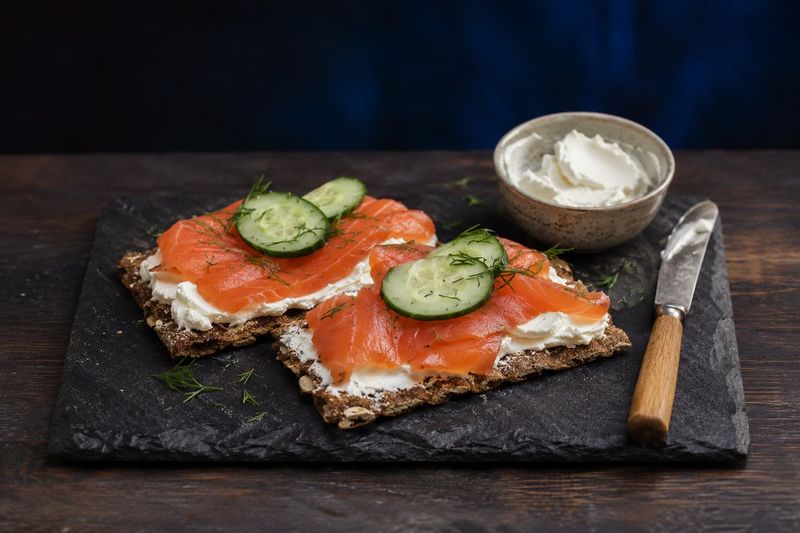
You can eat cream cheese while losing weight if you count it in your daily calories. Classic full-fat cream cheese has about 356 kcal per 100 g, and 25 g has about 89 kcal. It is not cottage cheese: protein is low and fat is high. That makes cream cheese practical as a spread in small portions.
I'm Demid Lobanov, a fitness coach. In the database I use to build meal plans for clients, cream cheese appears in 4 out of 260 dishes: sandwiches and crispbreads with salmon, crispbreads with radish, and an egg roll. A serving uses 25–40 g.
Cream cheese calories
According to USDA data, 100 g of classic American cream cheese has 6.2 g of protein, 34.4 g of fat, and 5.5 g of carbs. By my database's formula, that's about 356 kcal; by USDA data, 350.
Soft curd-style cream cheeses sold in Russia and Europe are sometimes lower in fat than American cream cheese in the USDA database. Check fat per 100 g on the label: if it's below 30 g per 100 g, calories will be lower.
Cream cheese vs cottage cheese
These are two very different foods. By my database:
| Food | Kcal per 100 g | Protein, g | Fat, g |
|---|---|---|---|
| Cream cheese | 356 | 6.2 | 34.4 |
| Cottage cheese 5% | 121 | 17.0 | 5.0 |
Cottage cheese has nearly three times as much protein and a third of the calories. If protein is what you need, pick cottage cheese. More in the article Cottage Cheese for Weight Loss.
Does high-fat cheese get in the way of weight loss
Not on its own, if it fits into your calories for the day. I found no studies looking specifically at cream cheese and body weight: researchers examined dairy products overall.
In the 2016 meta-analysis of observational studies by Schwingshackl et al., neither full-fat nor low-fat dairy was significantly associated with weight change. Still, that pooled only five cohorts, and their results varied widely.
For cheese specifically, the same meta-analysis found a link: each extra daily serving of cheese corresponded to roughly 11 g of weight gain per year. That number is tiny, and observational data cannot prove cause.
In randomized trials, the outcome depended on calories. In the 2018 meta-analysis by Geng et al. (37 trials), participants consuming more dairy without calorie restriction gained about 0.4 kg. Under calorie restriction, weight in the dairy groups dropped by 0.6 kg more than in the control groups.
Across all trials combined, there was no difference in body weight. According to the International Society of Sports Nutrition position stand (Aragon et al., 2017), fat loss depends on a sustained calorie deficit. Cream cheese simply takes up room in your daily calories, just like sour cream.
Which cream cheese to choose
Check two lines on the nutrition label:
- fat per 100 g: less fat means fewer calories;
- calories per 100 g so you can calculate your serving.
Pick a flavor you enjoy and track the grams.
How much cream cheese to use
There is no separate daily allowance. My dishes use 25–40 g per serving, which comes to about 89–143 kcal. For example, the snack “crispbreads with cream cheese and salmon” has 272 kcal and 12.1 g of protein, including 25 g of cream cheese. Spreading a thin layer and weighing it works best.
Cream cheese for weight loss: step by step
- Count cream cheese in your daily calories: classic cream cheese has about 356 kcal per 100 g.
- Weigh your serving: in my dishes that's 25–40 g.
- Check fat on the label: below 30 g per 100 g means fewer calories.
- Don't swap cottage cheese for cream cheese: cream cheese has nearly three times less protein.
- Pair it with fish, eggs, or vegetables.
- After two weeks, compare your average weekly weight with the previous week's average. If your weight isn't going down, trim portions of calorie-dense foods.
I publish breakdowns of nutrition and training on my YouTube channel @lobanov_fitness.
Sources
- Schwingshackl L et al. Consumption of Dairy Products in Relation to Changes in Anthropometric Variables in Adult Populations: A Systematic Review and Meta-Analysis of Cohort Studies. PLoS One, 2016. Article · Full text
- Geng T et al. Effects of Dairy Products Consumption on Body Weight and Body Composition Among Adults: An Updated Meta-Analysis of 37 Randomized Control Trials. Mol Nutr Food Res, 2018. Article
- USDA FoodData Central, SR Legacy: Cheese, cream (FDC 173418). Database
- Aragon AA et al. International society of sports nutrition position stand: diets and body composition. J Int Soc Sports Nutr, 2017. Article · Full text




