
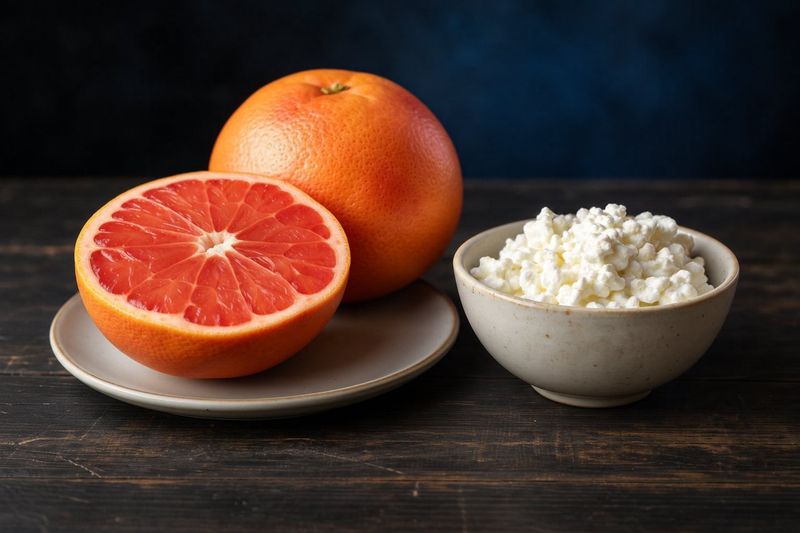
You can eat grapefruit while losing weight: 100 g has about 34 kcal, and the flesh of one fruit, about 250 g, has about 84 kcal. Research doesn't confirm that it burns fat. In a meta-analysis, grapefruit did not significantly reduce weight compared with a control group. If you take medications, check whether they can be combined with grapefruit.
I'm Demid Lobanov, a fitness coach. The database I use to build meal plans for clients includes a “grapefruit with cottage cheese” breakfast: 318 kcal and 31.8 g of protein per serving.
Grapefruit calories
According to USDA data, 100 g of grapefruit contains 0.6 g of protein, 0.1 g of fat, and 8.1 g of carbs. Of these, 1.1 g is fiber and 7 g is sugars. By my database's formula, that's about 34 kcal; by USDA data, 32. Half of the flesh, about 125 g, has about 42 kcal.
Does grapefruit burn fat
Research doesn't confirm it. The 2017 meta-analysis by Onakpoya et al. looked at 3 randomized trials involving 250 people with overweight. Grapefruit did not significantly reduce weight compared with the control group: in the grapefruit groups, weight dropped on average 0.45 kg more, but the difference was not significant. There are few studies, and they were short.
In the 2006 study by Fujioka et al., 91 people with obesity were split into four groups for 12 weeks. Participants in one group ate half a grapefruit before meals three times a day and lost 1.6 kg. The placebo group lost 0.3 kg. The difference was significant. The grapefruit juice and capsule groups lost 1.5 and 1.1 kg.
The 2012 study by Dow et al. included 74 people with overweight. There was no difference in weight compared with the control group.
In the 2011 study by Silver et al., 85 people with obesity received grapefruit, grapefruit juice, or water before meals for 12 weeks, along with calorie restriction. On average they lost 7.1% of their weight, and there was no difference in weight between the groups: water worked just as well.
So grapefruit fits as a light food before a main meal. It doesn't burn fat.
Grapefruit at night when losing weight
You can eat grapefruit at night. For weight, calories over the day matter more than meal timing. More in the article Can You Eat at Night.
Grapefruit and medications
Grapefruit can change how some medications work, most often by strengthening their effect. According to the 2013 review by Bailey et al., more than 85 drugs are known or suspected to interact with grapefruit. For 43 of them, the consequences can be serious.
One whole grapefruit or 200 mL of juice is enough for a noticeable effect. Spacing them apart in time doesn't help: after 10 hours, the effect is about half of the maximum, and after a day, about a quarter. With daily consumption, the effect gets stronger.
If you take medications, ask your doctor or check the package insert to see whether they can be combined with grapefruit. This applies to juice too.
What to eat grapefruit with
In my database, grapefruit is paired with a protein food. WHO recommends that adults eat at least 400 g of vegetables and fruit a day, and grapefruit can be part of that. My database has a “grapefruit with cottage cheese” breakfast: 318 kcal and 31.8 g of protein. It contains 200 g of grapefruit, 180 g of cottage cheese, and 10 g of honey.
Grapefruit for weight loss: step by step
- Count grapefruit in your daily calories: about 84 kcal in the flesh of one fruit.
- Don't count on grapefruit to burn fat: in the studies, weight went down with a calorie deficit.
- Eat grapefruit instead of higher-calorie sweets or before a meal.
- If you take medications, check whether they can be combined with grapefruit.
- You can eat grapefruit in the evening too, if it fits into your calories for the day.
- After two weeks, compare your average weight for the week with the average for the previous week. If your weight isn't going down, cut back on portions of calorie-dense foods.
I publish breakdowns of nutrition and training on my YouTube channel @lobanov_fitness.
Sources
- Onakpoya I et al. The effect of grapefruits (Citrus paradisi) on body weight and cardiovascular risk factors: A systematic review and meta-analysis of randomized clinical trials. Crit Rev Food Sci Nutr, 2017. Article
- Fujioka K et al. The effects of grapefruit on weight and insulin resistance: relationship to the metabolic syndrome. J Med Food, 2006. Article
- Silver HJ et al. Effects of grapefruit, grapefruit juice and water preloads on energy balance, weight loss, body composition, and cardiometabolic risk in free-living obese adults. Nutr Metab (Lond), 2011. Article · Full text
- Dow CA et al. The effects of daily consumption of grapefruit on body weight, lipids, and blood pressure in healthy, overweight adults. Metabolism, 2012. Article
- Bailey DG et al. Grapefruit-medication interactions: forbidden fruit or avoidable consequences? CMAJ, 2013. Article · Full text
- USDA FoodData Central, SR Legacy: Grapefruit, raw, pink and red and white, all areas (FDC 173033). Database
- World Health Organization. WHO updates guidelines on fats and carbohydrates, 2023. WHO news release




