
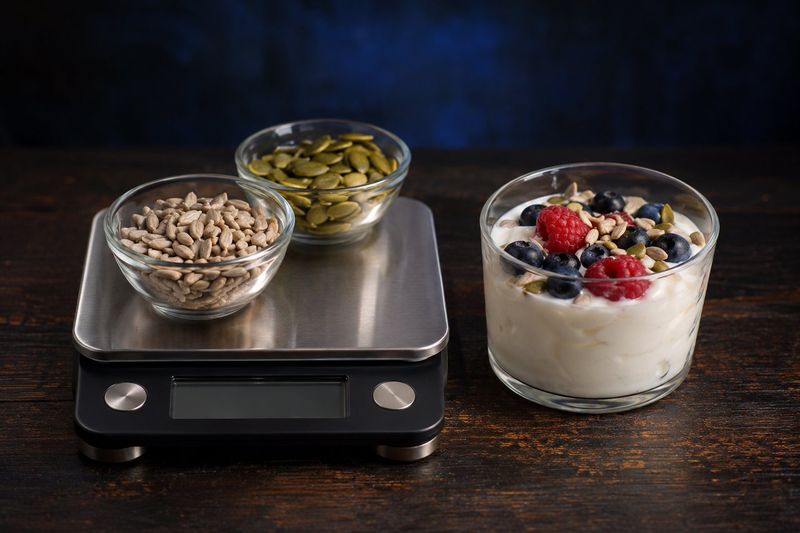
You can eat seeds while losing weight, but you need to weigh them. Shelled sunflower seeds have about 610 kcal per 100 g, and pumpkin seeds about 593. A 15 g serving provides about 90 kcal, and 30 g about 180. Seeds are easy to eat without noticing, so it's better to measure out a portion in advance.
I'm Demid Lobanov, a fitness coach. In the database I use to build meal plans for clients, seeds appear in 6 of 260 dishes: pumpkin seeds in breakfast yogurts and pumpkin soups, sunflower seeds in a yogurt snack. A serving contains 8–20 g.
Calories in seeds
Seeds are high in fat, so they're high in calories. The composition of shelled dried seeds per 100 g is taken from USDA data, and the calories are calculated using my database's formula. Roasted and salted seeds differ slightly in composition:
| Seeds | kcal per 100 g | Protein, g | Fat, g | kcal in 15 g | kcal in 30 g |
|---|---|---|---|---|---|
| Sunflower | 610 | 20.8 | 51.5 | 91 | 183 |
| Pumpkin | 593 | 30.2 | 49.0 | 89 | 178 |
USDA's own data put sunflower seeds at 584 kcal and pumpkin seeds at 559: my database calculates the calories of all foods using a single formula. In calories, seeds are close to nuts: walnuts, according to the same database, have 689 kcal per 100 g. The calorie values are calculated, so check the label for the exact figure.
Do seeds get in the way of weight loss
Not by themselves, as long as they fit into your daily calories. I didn't find any studies in which sunflower or pumpkin seeds were tested specifically for their effect on weight.
The study I did find with sunflower kernels involved 22 women with type 2 diabetes who got 30 g a day for three weeks (Richmond and colleagues, 2013). Weight didn't differ from the almond condition, but the food in that study was adjusted so that weight wouldn't change.
The closest foods to seeds in composition are nuts and flax. In the 2021 meta-analysis by Nishi and colleagues, which pooled 86 randomized trials with 5,873 participants, nuts didn't add weight. The change in weight was +0.09 kg, and certainty in the finding was high.
For flax (seeds, oil, and extracts), there are two meta-analyses of randomized trials. In the 2017 analysis by Mohammadi-Sartang and colleagues (45 trials), weight decreased by 0.99 kg. The effect was seen with whole seeds at 30 g a day or more, with courses of 12 weeks or longer, and in people with a body mass index of 27 or higher.
In the 2024 analysis by Musazadeh and colleagues (64 trials), weight decreased by 0.63 kg. Certainty was moderate, and the results of the trials varied widely.
Flax is a special case. In the 2008 study by Kristensen and colleagues, whole flaxseeds reduced fat absorption more noticeably than sunflower seeds did. So the results for flax don't carry over to sunflower and pumpkin seeds.
What matters most for weight is calories: 30 g of seeds provides about 180 kcal, almost as much as a small snack.
Pumpkin or sunflower
They barely differ in calories. Pumpkin seeds have more protein: 30.2 g per 100 g versus 20.8 g in sunflower seeds. But seeds aren't a main source of protein: 15 g of pumpkin seeds has only about 4.5 g of protein. Choose the ones you like and count the grams.
How many seeds you can eat per day
There's no set amount: it depends on your daily calories. The WHO recommends a varied diet, including nuts and seeds. In my dishes, a serving contains 8–20 g of seeds, which is about 47–119 kcal. For example, the breakfast "Greek yogurt with berries and seeds" has 271 kcal and 25.3 g of protein and contains 15 g of pumpkin seeds.
Seeds are easy to add to yogurt, porridge, salad, or soup. If you crack seeds straight from the bag, the portion is hard to keep track of, so it's better to pour out the amount you need right away.
Seeds at night when losing weight
You can eat seeds at night if they fit into your daily calories. For weight, calories over the day matter more than meal timing. For more, see the article Can you eat at night.
In the evening, too, it's better to pour out a portion in advance, say 15 g. For more on nuts, see the article Nuts for weight loss.
Seeds for weight loss: step by step
- Count seeds in your daily calories: about 600 kcal per 100 g, and about 90 kcal per 15 g.
- Measure out a portion on a kitchen scale in advance, and don't eat from the bag.
- Add seeds to yogurt, porridge, salad, or soup.
- Choose pumpkin or sunflower seeds by taste: they're nearly identical in calories.
- Don't count on seeds as your main source of protein.
- After two weeks, compare your average weight for the week with your average weight for the previous week. If your weight isn't going down, cut the portions of high-calorie foods.
If you're allergic to seeds, they're cut out of the diet, and your nutrition is discussed with a doctor.
I post breakdowns of nutrition and training on my YouTube channel @lobanov_fitness.
Sources
- Nishi SK et al. Are fatty nuts a weighty concern? A systematic review and meta-analysis and dose-response meta-regression of prospective cohorts and randomized controlled trials. Obes Rev, 2021. Article · Full text
- Mohammadi-Sartang M et al. The effect of flaxseed supplementation on body weight and body composition: a systematic review and meta-analysis of 45 randomized placebo-controlled trials. Obes Rev, 2017. Article
- Musazadeh V et al. The effects of flaxseed (Linum usitatissimum) supplementation on anthropometric indices: An updated systematic review and meta-analysis of randomized clinical trials. Complement Ther Med, 2024. Article
- Richmond K et al. Markers of cardiovascular risk in postmenopausal women with type 2 diabetes are improved by the daily consumption of almonds or sunflower kernels: a feeding study. ISRN Nutr, 2013. Article · Full text
- Kristensen M et al. Whole flaxseeds but not sunflower seeds in rye bread reduce apparent digestibility of fat in healthy volunteers. Eur J Clin Nutr, 2008. Article
- USDA FoodData Central, SR Legacy: Seeds, sunflower seed kernels, dried (FDC 170562); Seeds, pumpkin and squash seed kernels, dried (FDC 170556). Database
- WHO. Healthy diet. Fact sheet, January 26, 2026. Page