
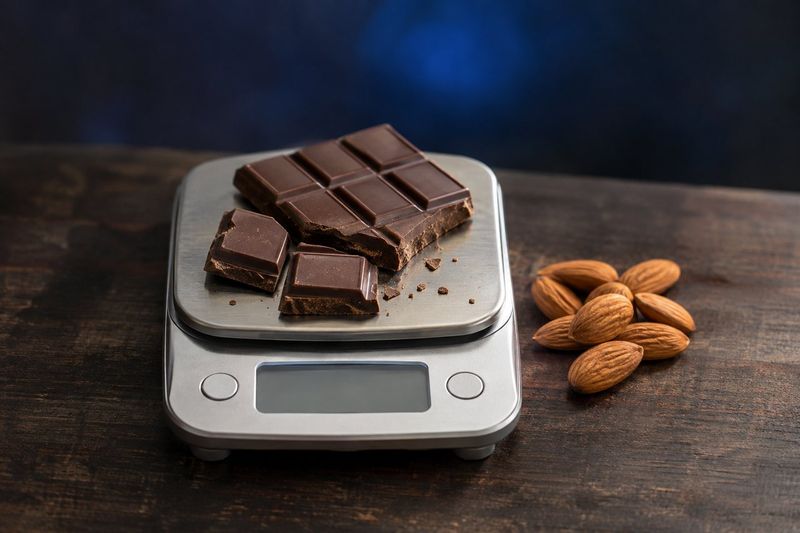
You can eat chocolate while losing weight as long as it fits into your daily calories. Dark chocolate is actually slightly higher in calories than milk chocolate: according to USDA data, 598 and 535 kcal per 100 g. In a 20 g serving, the difference is 13 kcal. On the other hand, 70–85% dark chocolate has half the sugars. Dark chocolate does not help you lose weight on its own: in meta-analyses of randomized trials, where participants are randomly assigned to groups, cocoa and dark chocolate did not reduce weight.
I'm Demid Lobanov, a fitness coach. In my nutrition materials, the rule is simple: everything is allowed within your calorie budget. I don't ban sweets; I manage the portion. In the meal database I use to build meal plans for clients, dark chocolate appears in two snacks. For example, “dark chocolate with almonds” is 20 g of chocolate and 15 g of almonds, 205 kcal in total.
Calories in chocolate
USDA data per 100 g and per 20 g serving:
| Chocolate | Kcal per 100 g | Sugars per 100 g | Fiber per 100 g | 20 g: kcal and sugars |
|---|---|---|---|---|
| Dark 70–85% | 598 | 24 g | 10.9 g | 120 kcal, 4.8 g |
| Dark 60–69% | 579 | 36.7 g | 8 g | 116 kcal, 7.3 g |
| Milk | 535 | 51.5 g | 3.4 g | 107 kcal, 10.3 g |
These are average USDA values. In the samples of 70–85% dark chocolate, sugars ranged from 14.5 to 30.3 g per 100 g, so check the label on your own bar. The difference in calories is small: dark chocolate has less sugar but more fat. That's why what matters most for weight loss is the weight of the serving, not the cocoa percentage.
Does dark chocolate help you lose weight
No, according to research, it doesn't. In the 2019 meta-analysis by Kord-Varkaneh et al., which pooled 35 randomized trials, cocoa and dark chocolate did not significantly change body weight, body mass index, or waist circumference. Overall, weight changed by 0.1 kg, which is within the margin of error. Weight loss was found only in a subgroup of studies with a serving of 30 g or more per day and a duration of 4–8 weeks. The authors' overall conclusion: cocoa and dark chocolate do not significantly reduce weight, body mass index, or waist circumference.
The 2024 meta-analysis by Arisi et al. included 31 randomized trials of cocoa extract or chocolate with at least 70% cocoa, each lasting at least 4 weeks. Weight was assessed in 11 of them (612 people): weight, body mass index, and waist circumference did not change. Cholesterol, fasting blood sugar, and blood pressure decreased slightly, but that has nothing to do with weight loss.
Does chocolate get in the way of weight loss
It does if you don't count its calories. That's a basic meal-planning rule, and observational data agree with it. In the 2015 observational study by Greenberg et al. (107,243 postmenopausal women, 3 years), each additional 28 g of chocolate candy per day was associated with a weight gain of 0.92 kg over 3 years. This is an observational study: it shows an association but does not prove cause.
The conclusion matches the meal-planning rule: count chocolate toward your daily calories and weigh your serving.
How much chocolate per day is OK when losing weight
There is no separate norm for chocolate: the amount depends on your daily calories. My snack has 20 g of dark chocolate. The added sugar in chocolate is a free sugar, and the WHO advises getting less than 10% of calories from free sugars. With a daily target of 1,500 kcal, that's about 37 g per day.
20 g of 70–85% dark chocolate contains about 5 g of sugars; 20 g of milk chocolate, about 10 g. Some of the sugars in milk chocolate are milk sugar, which the WHO doesn't count as free sugar, but milk chocolate still contains more added sugar. Also count the sugar in tea, coffee, drinks, and other sweets.
Dark or milk chocolate for weight loss
Go by taste and sugar content. Dark chocolate with 70–85% cocoa is even slightly higher in calories than milk chocolate, but it has half the sugars and more fiber. Dark chocolate also contains caffeine: per USDA, 80 mg per 100 g, about 16 mg in 20 g; milk chocolate has 20 mg per 100 g.
In short-term studies, dark chocolate was more filling. In the 2011 study by Sørensen et al., 16 young men ate 17% less at their next meal after 100 g of dark chocolate than after milk chocolate. In Marsh et al. (2017), 14 postmenopausal women also ate less after dark chocolate than after milk chocolate with the same calories. These were single meals; weight loss was not studied in these experiments.
If you specifically want milk chocolate, you can eat it too, in the same serving and within your daily calories.
If you crave sweets all the time
You don't need to ban chocolate, but you shouldn't eat it without counting either. The causes of sugar cravings and ways to reduce them are covered in the article Sugar cravings. If you have diabetes, the amount of chocolate and other sweets is worked out together with your doctor.
Chocolate and weight loss: step by step
- Count chocolate toward your daily calories: dark is about 600 kcal per 100 g, milk about 535.
- Weigh your serving: 20 g is a handy reference point, about 110–120 kcal.
- Choose 70–85% dark chocolate if you want less sugar.
- Keep free sugars under 10% of daily calories: at 1,500 kcal, that's about 37 g.
- Don't expect dark chocolate to speed up weight loss: in studies, it did not reduce weight.
- If you have diabetes, work out the amount of sweets together with your doctor.
- After two weeks, compare your average weight for the week with your average weight for the previous week. If your weight isn't going down, reduce your portions of high-calorie foods.
I publish nutrition and training breakdowns on my YouTube channel @lobanov_fitness.
Sources
- Kord-Varkaneh H et al. Does cocoa/dark chocolate supplementation have favorable effect on body weight, body mass index and waist circumference? A systematic review, meta-analysis and dose-response of randomized clinical trials. Crit Rev Food Sci Nutr, 2019. Article
- Arisi TOP et al. Effects of Cocoa Consumption on Cardiometabolic Risk Markers: Meta-Analysis of Randomized Controlled Trials. Nutrients, 2024. Article · Full text
- Greenberg JA et al. Chocolate-candy consumption and 3-year weight gain among postmenopausal U.S. women. Obesity (Silver Spring), 2015. Article · Full text
- WHO. Healthy diet. Fact sheet, January 26, 2026. Page
- USDA FoodData Central: Chocolate, dark, 70-85% cacao solids (170273); Chocolate, dark, 60-69% cacao solids (170272); Candies, milk chocolate (167587). Website
- Sørensen LB et al. Eating dark and milk chocolate: a randomized crossover study of effects on appetite and energy intake. Nutr Diabetes, 2011. Article · Full text
- Marsh CE et al. Consumption of dark chocolate attenuates subsequent food intake compared with milk and white chocolate in postmenopausal women. Appetite, 2017. Article




