

Drop sets, supersets, and rest-pause training are often sold in the gym as secret intensity techniques that break plateaus and build muscle faster than straight sets. Recent meta-analyses published between 2023 and 2026 tell a far more grounded story.
On average, these techniques do not outperform traditional straight sets for muscle hypertrophy. Their genuine, evidence-backed advantage is cutting workout duration by a third to half while achieving comparable results–at the cost of higher perceived exertion.
What drop sets actually deliver in meta-analyses
A drop set takes a working set to muscular or technical failure, immediately reduces the load, and continues for another set with minimal rest.
In a systematic review of 6 studies covering 142 participants (5 studies in the meta-analysis; Sødal et al., 2023), both drop sets and traditional straight sets produced significant muscle growth with no statistically significant difference between them (SMD = 0.155; p = 0.392). However, several drop-set protocols took half to one-third of the time required by traditional sets.
An updated 2026 meta-analysis of 12 studies (274 participants: 9 chronic and 4 acute studies) by Havers et al. (2026) reinforced that verdict:
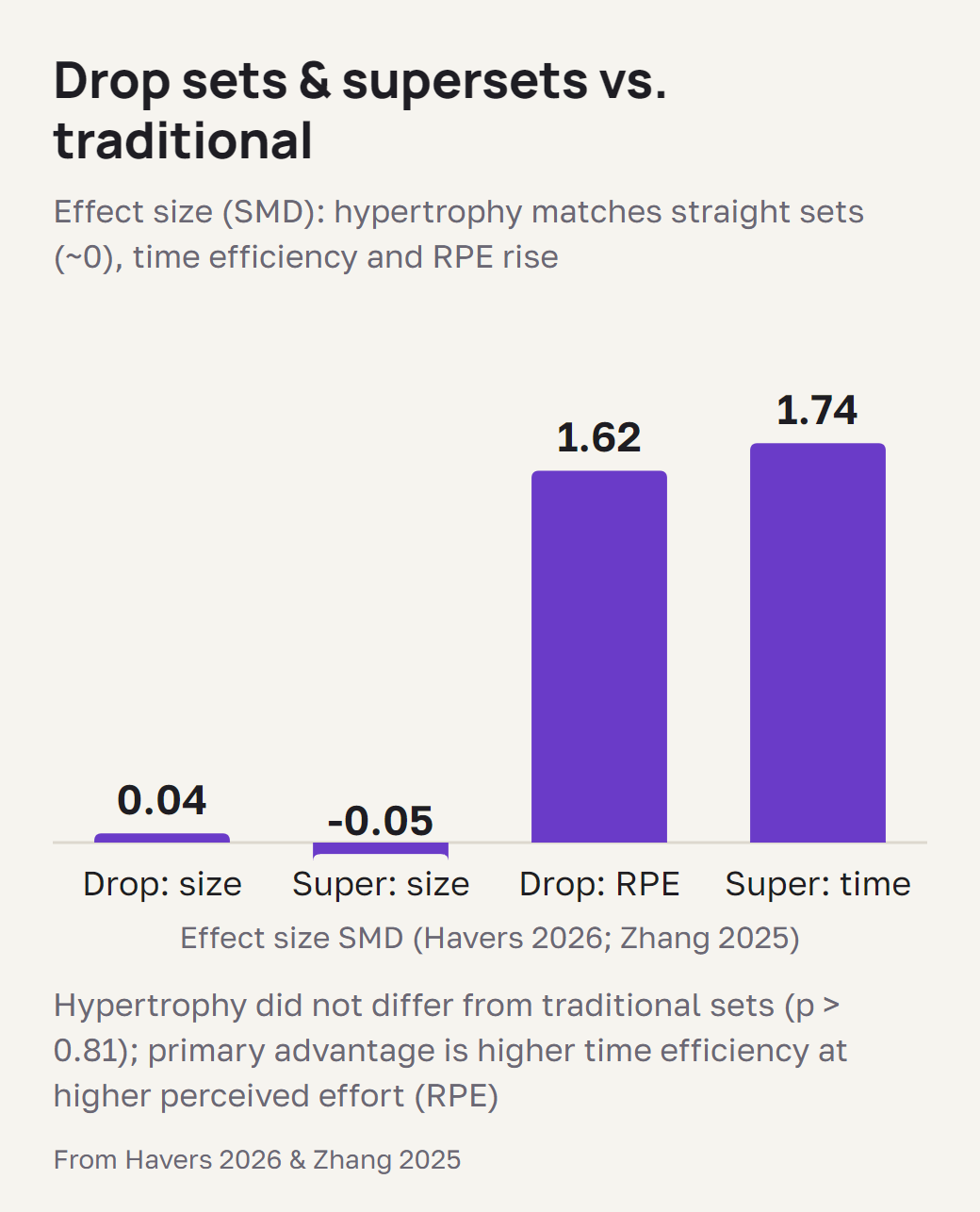
- Muscle hypertrophy: no significant difference versus traditional sets (SMD = 0.04; 95% CI −0.29 to 0.36; p = 0.813).
- Strength and muscular endurance: no significant difference (strength SMD = −0.04; endurance SMD = 0.53).
- The trade-off: drop sets significantly elevated rating of perceived exertion (SMD = 1.62) and blood lactate (SMD = 0.67).
The authors emphasize accounting for higher perceived effort and potential recovery demands when programming drop sets.
Supersets: which pairings preserve volume and which reduce it
A superset pairs two exercises back to back with little or no rest. In a meta-analysis of 19 studies (313 participants; 16 acute studies and only 3 chronic studies, including 2 measuring hypertrophy), Zhang et al. (2025) found supersets matched traditional training in total reps (p = 0.92), volume load (p = 0.86), maximal strength (SMD = 0.10; p = 0.36), strength endurance (p = 0.81), and hypertrophy (SMD = −0.05; p = 0.87).
Training time efficiency jumped markedly (SMD = 1.74; p = 0.01), alongside higher energy cost (SMD = 1.93), blood lactate during (SMD = 0.94) and after the session (SMD = 1.13), and perceived exertion (SMD = 0.77). Exercise pairing mattered decisively:
- Agonist-antagonist supersets (opposing muscles such as chest + back or biceps + triceps) actually increased total completed reps compared with traditional sets (SMD = 0.68; p = 0.01).
- Same-muscle supersets (biomechanically similar lifts back to back) significantly lowered volume load (SMD = −1.08; p < 0.01).
In practice, alternating opposing machines–such as a seated lever chest press paired with a neutral-grip lever horizontal row–is the cleanest way to save gym time without sacrificing working weights.
Rest-pause and myo-reps: any extra hypertrophy edge?
Rest-pause training involves taking a working set to failure (or technical failure), resting 10–20 seconds, and completing 1–2 mini-sets with the same weight. Myo-reps follow a similar cluster logic after an activation set.
In a meta-analysis of 23 studies on advanced resistance training systems in recreationally trained adults aged 18–45 (Tsartsapakis et al., 2026), overall hypertrophy did not significantly exceed straight sets (g = 0.046), while strength showed a moderate gain (g = 0.351, driven mainly by velocity-based training and eccentric overload). Rest-pause showed a modest hypertrophy signal, though individual RCTs vary:
- In a 6-week RCT of 18 trained lifters (Prestes et al., 2019), rest-pause matched straight sets for strength while yielding greater thigh thickness (+11% vs. +1%) and leg-press endurance (+27% vs. +8%), with no significant difference in other measured regions. A key caveat (highlighted by Iversen et al., 2021): the control group performed 3×6 at 80% 1RM farther from failure while rest-pause went to failure, and the rest-pause sessions were shorter (~35 vs. ~57 min, roughly −39%).
- In an 8-week volume-matched RCT of 28 trained men (Enes et al., 2021), rest-pause, drop sets, and straight sets produced comparable thigh muscle thickness gains, while squat 1RM rose more with rest-pause than traditional sets (p = 0.001; no significant difference vs. drop sets).
- In an 8-week 2026 RCT of 23 trained adults (Vargas-Molina et al., 2026), progressive-overload rest-pause and drop sets delivered comparable DXA lean mass (+1.2 vs. +1.4 kg; p = 0.688) and bench press 1RM gains (+9.5 vs. +12.3 kg; p = 0.086), with no traditional-set control group and indirect DXA assessment.
- In an 8-week comparative myo-reps trial in 22 trained men (Bradshaw et al., 2026), hypertrophy and strength did not differ from straight sets with ~30% less volume load (p = 0.001), while the acute crossover arm (n = 9) finished in significantly less time (p < 0.001).
Comparing the methods
A time-efficiency review by Iversen et al. (2021) notes that supersets, drop sets, and rest-pause roughly halve workout duration with comparable hypertrophy outcomes. Meanwhile, the 2026 ACSM Position Stand (Currier et al., 2026, 137 systematic reviews) notes that hypertrophy is enhanced by sufficient weekly volume (≥10 sets per muscle group) and progressive overload. When pressed for time, Iversen recommends at least 4 weekly sets per muscle group of multi-joint exercises.
| Method | Main advantage | Limitations & trade-offs | Best placement |
|---|---|---|---|
| Agonist-antagonist superset | Preserves volume load and cuts session time (Zhang, 2025) | Needs access to two stations; raises energy cost, lactate, and RPE | Press + row, biceps + triceps, leg curl + leg extension |
| Drop set | Comparable growth in less time on one machine (Sødal, 2023) | High RPE and lactate (Havers, 2026) | Final set on pin-loaded machines with instant weight drops |
| Rest-pause / myo-reps | Saves time without changing weights (Bradshaw, 2026) | Repeated sets near failure accumulate fatigue quickly | Final set of isolation or lever-machine lifts |
| Traditional straight sets | Maximum technical control and clean tracking | Takes more time due to full rest intervals | Heavy free-weight compound lifts |
Four rules for programming intensification techniques safely
My name is Demid Lobanov, and I am a fitness coach and strength-training educator. In my coaching practice, I treat intensification methods as targeted time-savers rather than mandatory daily burnout, following core progression principles (ACSM, 2009):
- Keep drop sets and rest-pause out of heavy free-weight compounds. On barbell squats and deadlifts, accumulated fatigue rapidly degrades form. Pin-loaded machines, lever machines, and isolation work are far better suited.
- Cap them at 1–2 exercises per session. Use a drop set (1–2 load drops of ~20–30% after technical failure) or rest-pause (10–20 seconds rest followed by 1–2 mini-sets) on the final set only.
- Use opposing supersets to trim the whole workout. Pairing pressing with pulling or biceps with triceps trims workout time markedly without sacrificing working loads.
- Judge them by progression and recovery. These techniques work when weights and reps on your main lifts keep advancing over several weeks and between-session recovery stays solid.
Coaches looking to build time-efficient client programs systematically can explore mentorship for trainers; lifters wanting a structured personal plan can check individual training programs. Related guides: How Long to Rest Between Sets and Training to Failure. I also post training breakdowns on YouTube at @lobanov_fitness.
Sources
- Havers T et al. Acute and Chronic Effects of Drop-Set Training: A Meta-Analysis and Systematic Review. Sports Med Open, 2026. PMID 41920484
- Zhang X et al. Superset Versus Traditional Resistance Training Prescriptions: A Systematic Review and Meta-analysis Exploring Acute and Chronic Effects on Mechanical, Metabolic, and Perceptual Variables. Sports Med, 2025. PMID 39903375
- Tsartsapakis I et al. Effects of Advanced Resistance Training Systems on Muscle Hypertrophy and Strength in Recreationally Trained Adults: A Systematic Review and Meta-Analysis. J Funct Morphol Kinesiol, 2026. PMID 41718208
- Sødal LK et al. Effects of Drop Sets on Skeletal Muscle Hypertrophy: A Systematic Review and Meta-analysis. Sports Med Open, 2023. PMID 37523092
- Vargas-Molina S et al. Comparison of Repetition-Based Progressive-Overload Strategies in Resistance Training: Rest-Pause Versus Drop Sets. Scand J Med Sci Sports, 2026. PMID 42340141
- Bradshaw JT et al. Similar Strength and Hypertrophic Adaptations in Less Time? Myo-Reps vs. Traditional Straight-Sets in Resistance-Trained Men. J Strength Cond Res, 2026. PMID 42112925
- Enes A et al. Rest-pause and drop-set training elicit similar strength and hypertrophy adaptations compared with traditional sets in resistance-trained males. Appl Physiol Nutr Metab, 2021. PMID 34260860
- Prestes J et al. Strength and Muscular Adaptations After 6 Weeks of Rest-Pause vs. Traditional Multiple-Sets Resistance Training in Trained Subjects. J Strength Cond Res, 2019. PMID 28617715
- Iversen VM et al. No Time to Lift? Designing Time-Efficient Training Programs for Strength and Hypertrophy: A Narrative Review. Sports Med, 2021. PMID 34125411
- Currier BS et al. American College of Sports Medicine Position Stand. Resistance Training Prescription for Muscle Function, Hypertrophy, and Physical Performance in Healthy Adults: An Overview of Reviews. Med Sci Sports Exerc, 2026. PMID 41843416
- American College of Sports Medicine. Progression models in resistance training for healthy adults. Med Sci Sports Exerc, 2009. PMID 19204579