
Postpartum diastasis recti abdominis (DRA) is surrounded by strict warnings–women are often told to avoid curl-ups, strength training, and direct ab work forever. Randomized trials and meta-analyses published between 2023 and 2025 tell a much calmer, evidence-based story.
Well-structured exercise builds abdominal strength and consistently ranks higher in meta-analyses for narrowing inter-recti separation than passive abdominal binders or complete rest (though effects vary by measurement site and limited direct comparisons). The keys are following a sensible postpartum timeline, managing intra-abdominal pressure on the exhale, and staying symptom-free.
What diastasis recti is and what actually reduces separation
Diastasis recti abdominis is a widening of the linea alba connecting the left and right sides of the rectus abdominis. In a systematic review of 8 studies of varying designs (336 women; Benjamin et al., 2014), antenatal exercise was associated with a 35% lower presence of DRA (RR 0.65), though those early studies were low quality.
A large systematic review and meta-analysis of 65 studies across 24 countries (21,334 participants; Beamish et al., 2025) reported two core findings during the first year postpartum. Pelvic floor muscle training lowered the odds of urinary incontinence by 37% (7 RCTs, 1,930 participants; OR 0.63; moderate certainty) and pelvic organ prolapse by 56% (1 RCT, 123 participants; OR 0.44). Targeted abdominal training reduced inter-recti distance (IRD) at rest and during a head lift more than no exercise (low certainty).
Two 2025 network meta-analyses compared specific approaches:
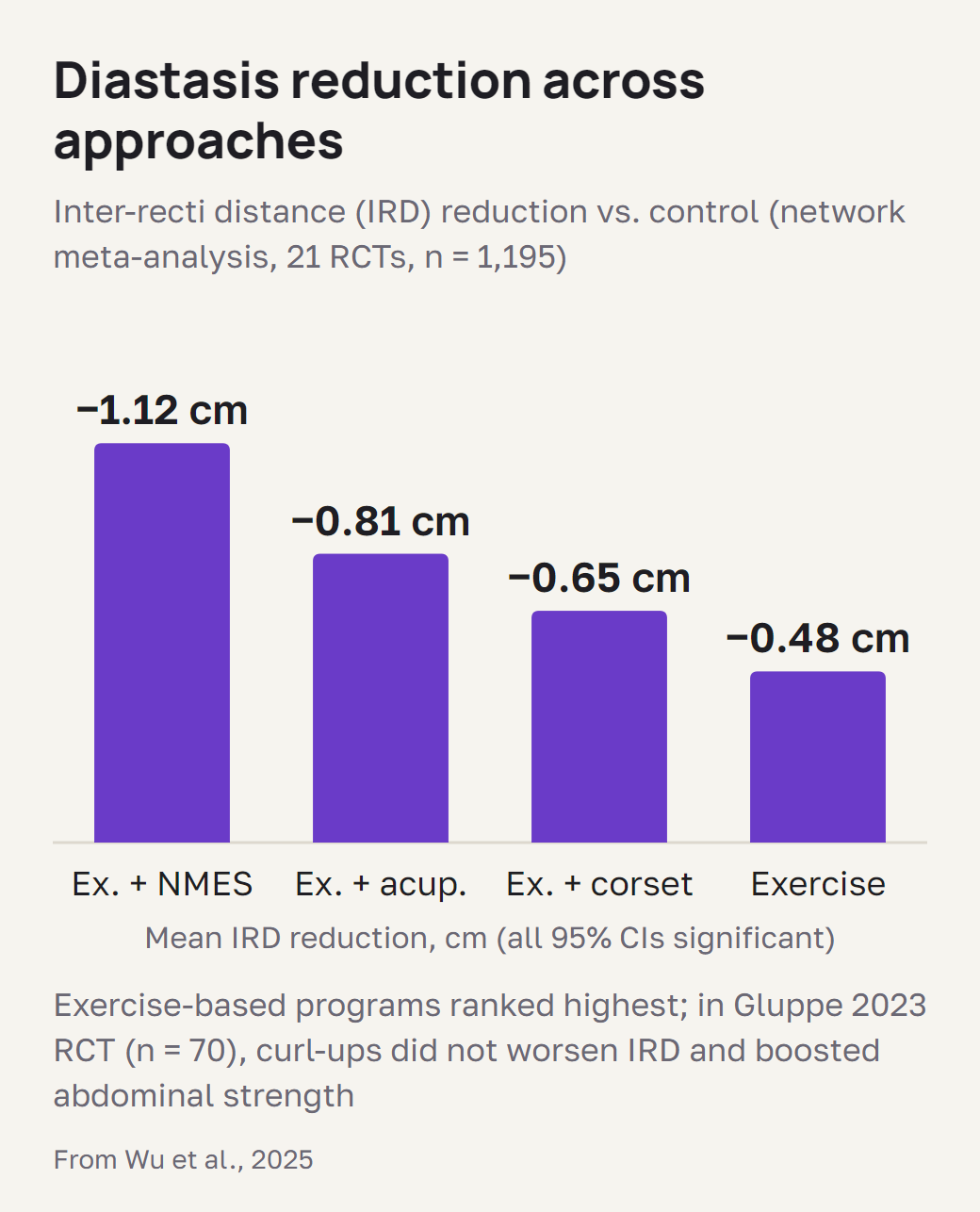
- Across 21 RCTs (1,195 women with IRD >2 cm; Wu et al., 2025), significant IRD reductions versus control came from exercise paired with neuromuscular electrical stimulation (−1.12 cm, 91.0% probability of ranking first), exercise with acupuncture (−0.81 cm), exercise with a corset (−0.65 cm), and exercise alone (−0.48 cm). Exercise-based programs consistently outranked passive approaches without exercise, though the authors noted sparse direct data.
- Across 27 RCTs (1,340 women; Bigdeli et al., 2025), combined deep and superficial abdominal training (often with breathing work and NMES) reduced IRD by 22.6–26.3 mm versus control (SUCRA 0.88–0.96), whereas standalone binders achieved −10.32 mm (SUCRA 0.52) and kinesio taping −3.93 mm (SUCRA 0.18). Notably, 40 of 42 pairwise network comparisons relied on a single trial, with GRADE certainty ranging from low to high.
Meanwhile, a meta-analysis of 13 RCTs (Abdullah et al., 2025) showed abdominal exercises significantly narrowed IRD below the umbilicus compared with binding or no treatment (−0.31 cm; p = 0.004), while effects measured 2 cm or more above the umbilicus were not statistically significant.
Are abdominal curl-ups really off-limits?
For years, curl-ups were blamed for widening the linea alba while maximal abdominal hollowing was promoted as the only safe choice. Ultrasound trials and a direct RCT updated that view.
In a cross-sectional ultrasound study of 38 parous women with DRA (Gluppe et al., 2020), head lifts (by 10 mm above the umbilicus) and twisted curl-ups (by 9.4 mm) acutely narrowed IRD. By contrast, maximal in-drawing (+4.7 mm) and pelvic floor contraction combined with maximal in-drawing (+5.0 mm) significantly widened IRD below the umbilicus (isolated pelvic floor contraction alone was +2.8 mm, non-significant). In Lee and Hodges (2016) (26 women with DRA and 17 controls), preactivating the transversus abdominis before a curl-up reduced linea alba distortion–potentially aiding force transfer across the abdominal wall, though the distortion index still needs further validation.
A decisive 12-week RCT tested 70 women 6–12 months postpartum with DRA (>28 mm at rest or >25 mm during a curl-up; Gluppe et al., 2023). Performing head lifts, straight curl-ups, and twisted curl-ups 5 days per week neither worsened nor reduced IRD (mean difference 1 mm at rest 2 cm above the umbilicus; 95% CI −1 to 4 mm) and did not worsen pelvic floor symptoms or low back pain, while significantly increasing rectus abdominis thickness (+0.7 mm) and abdominal strength (+9 Nm).
In an earlier review of 7 RCTs (Gluppe et al., 2021), the −0.63 cm IRD estimate for transversus abdominis training rested on just 2 pilot RCTs (30 participants, very low certainty). Taken together, curl-ups are not the first starting exercise early postpartum, yet they are not a lifelong ban either.
Phased exercise selection for diastasis recti
My name is Demid Lobanov, and I am a fitness coach. In my postpartum return-to-training framework, progression centers on phasing exercises cleanly and controlling intra-abdominal pressure on the exhale–without midline doming ("coning") or breath-holding.
| Phase & exercises | Practical purpose | Technical cues |
|---|---|---|
| Gentle phase (weeks 1–4): breathing + gentle pelvic floor work | Restores breath coordination and lowers odds of pelvic floor symptoms (Beamish, 2025) | Avoid harsh sucking-in or breath-holding |
| Toning phase (weeks 5–12): glute bridge & incline plank | Rebuilds glute and trunk tone; incline plank with hands elevated replaces flat floor planks | Exhale on effort, keep the midline flat without doming |
| Training phase (weeks 13–24, after medical clearance): dead bug, rows, squats | Builds neutral-spine trunk control under load | Neutral lower back, steady breathing, moderate weight |
| After weeks 13–24 with a flat midline: straight & twisted curl-ups | Increase abdominal strength and thickness without worsening IRD (Gluppe, 2023) | Smooth tempo with exhale control, zero jerking |
Two staple exercises introduced progressively across the toning and training phases:
- Glute bridge from the floor or bench. Strengthens the glutes and posterior chain on a calm exhale without excessive straining–a core toning-phase staple.
- Dead bug (training phase, weeks 13–24 after medical clearance). Lying supine with a neutral lower back and bent knees, exhale smoothly while lowering the opposite arm and leg as long as the abdomen stays flat. Shorten range if doming appears or the lower back arches off the floor.
For individualized video form checks and exercise substitutions, explore a technique consultation or structured online coaching.
When to see a doctor before exercising
Consult a physician, surgeon, or pelvic-floor physical therapist before independent strength training if any of the following apply:
- fewer than 6 weeks postpartum, or fewer than 6 months without an in-person medical check;
- a firm or painful bulge near the navel or along the midline (to rule out a hernia);
- urinary leakage when coughing, laughing, or lifting, or a feeling of pelvic heaviness;
- pain or pulling discomfort around a C-section scar;
- marked lower-back or pelvic pain that worsens with exercise;
- no progress despite regular training.
Four-step return-to-training plan
After medical clearance, I (Demid Lobanov) structure the return in four steps (using general healthy-adult frequency principles of 2–3 sessions per week and 2–3 sets from ACSM, 2009 as a baseline guide):
- Gentle start (weeks 1–4). Smooth exhale breathing and gentle pelvic floor work without straining or lifting.
- Toning phase (weeks 5–12, post-clearance). Floor or bench glute bridges, incline planks with hands elevated instead of flat floor planks, and light exhale-paced movements.
- Training phase (weeks 13–24, after medical exam). Dead bugs with a neutral lower back plus moderate-weight rows and squats with zero midline doming.
- Gradual progression and curl-ups. Once basic lifts stay flat, comfortable, and symptom-free, head lifts and short curl-ups can be introduced gently. Readiness to advance means steady breathing, a flat midline, and zero next-day symptoms.
Related guides: Dead Bug Exercise, Plank Technique, How to Train Abs, and Returning to Lifting After a Break. I also share form tutorials on YouTube at @lobanov_fitness.
Sources
- Beamish NF et al. Impact of postpartum exercise on pelvic floor disorders and diastasis recti abdominis: a systematic review and meta-analysis. Br J Sports Med, 2025. PMID 39694630 · Full text
- Gluppe SB, Ellström Engh M, Bø K. Curl-up exercises improve abdominal muscle strength without worsening inter-recti distance in women with diastasis recti abdominis postpartum: a randomised controlled trial. J Physiother, 2023. PMID 37286390
- Wu WC et al. Comparative Efficacy and Acceptability of Non-surgical Treatments with or without Exercise for Diastasis Recti Abdominis in Postpartum Women: A Network Meta-Analysis of Randomized Controlled Trials. Sports Med, 2025. PMID 39878918
- Bigdeli N et al. An evidence-based comparison of rehabilitation strategies for diastasis recti abdominis in postpartum women: a systematic review and network meta-analysis. Sci Rep, 2025. PMID 41224804 · Full text
- Abdullah et al. Comparative Efficacy of Abdominal Exercises and Abdominal Binding on Diastasis Recti Abdominis Reduction in Postpartum Women: A Systematic Review and Meta-Analysis of Randomized Controlled Trials. Physiother Res Int, 2025. PMID 40018828
- Gluppe S, Engh ME, Bø K. What is the evidence for abdominal and pelvic floor muscle training to treat diastasis recti abdominis postpartum? A systematic review with meta-analysis. Braz J Phys Ther, 2021. PMID 34391661 · Full text
- Gluppe SB, Engh ME, Bø K. Immediate Effect of Abdominal and Pelvic Floor Muscle Exercises on Interrecti Distance in Women With Diastasis Recti Abdominis Who Were Parous. Phys Ther, 2020. PMID 32302393
- Lee D, Hodges PW. Behavior of the Linea Alba During a Curl-up Task in Diastasis Rectus Abdominis: An Observational Study. J Orthop Sports Phys Ther, 2016. PMID 27363572
- Benjamin DR, van de Water ATM, Peiris CL. Effects of exercise on diastasis of the rectus abdominis muscle in the antenatal and postnatal periods: a systematic review. Physiotherapy, 2014. PMID 24268942
- American College of Sports Medicine. Progression models in resistance training for healthy adults. Med Sci Sports Exerc, 2009. PMID 19204579