
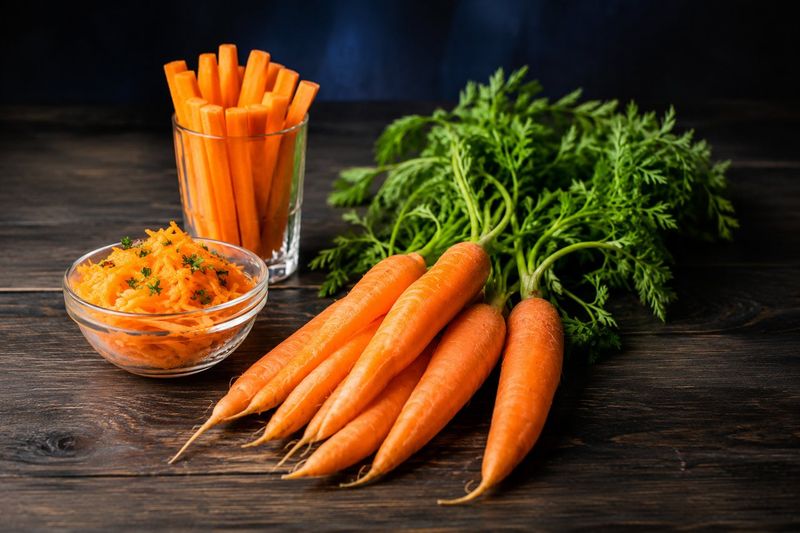
You can eat carrots while losing weight: 100 g of raw carrots has about 38 kcal, and a 150 g serving has about 57 kcal. Sugar content is modest, around 5 g per 100 g. Carrots help when they replace higher-calorie foods. Korean-style carrot salad has more calories because of the oil.
I'm Demid Lobanov, a fitness coach. In the database I use to build meal plans for clients, carrots go into 38 out of 260 dishes: soups, stews, pilaf, braised fish, and a snack with nut butter. A serving uses 50–150 g.
Carrot calories
According to USDA data, 100 g of raw carrots has 0.9 g of protein, 0.2 g of fat, and 9.6 g of carbs, including 2.8 g of fiber and 4.7 g of sugars. By my database's formula, that's about 38 kcal; by USDA data, 41.
The sugar in carrots is no reason to avoid them. One hundred fifty grams of carrots contains about 7 g of sugars. For body weight, daily calories matter far more.
Do carrots help you lose weight
Carrots help when they take the place of more calorie-dense food. I found no studies testing carrots alone for weight loss: researchers examined vegetables and fruit together. There is a satiety trial, though. In the 2006 study by Moorhead et al., young women ate lunch with carrots served whole, blended as puree, or as isolated nutrients without carrot structure. After whole carrots, they ate the least both at that meal and over the rest of the day.
Simply adding vegetables on top of your usual meals won't necessarily bring weight down. The 2014 meta-analysis by Kaiser et al. looked at 7 randomized trials, only 2 of which met every eligibility criterion. Participants were advised to eat more fruit and vegetables or were given them without limits on the rest of their food. Weight did not differ from the control group. In another 2014 meta-analysis by Mytton et al. (8 trials, 1,026 participants), the difference was small — about 0.5 kg.
Results improved when extra vegetables came alongside cutting dietary fat. In a year-long trial by Ello-Martin et al. in 2007, 97 women with obesity were split into two groups: one was advised to eat less fat, and the other to eat less fat plus more water-rich foods, primarily vegetables and fruit. Among the 71 women who completed the year, the second group lost 7.9 kg versus 6.4 kg.
Korean-style carrot salad while losing weight
You can eat Korean-style spiced carrot salad if you account for the oil. One hundred fifty grams of raw carrots has about 57 kcal, while every 10 g of oil adds 90 kcal. For store-bought salad, check oil and sugar on the nutrition label. When making it at home, weigh the oil.
Carrots at night when losing weight
You can eat carrots at night. For weight, calories over the day matter more than meal timing. More in the article Can You Eat at Night.
What to eat carrots with
WHO recommends at least 400 g of vegetables and fruit per day for adults, and carrots can be part of that. Carrots pair well with a food rich in protein or fat, as long as that accompaniment is weighed. In my database, the snack “carrot sticks with nut butter” has 183 kcal: 150 g of carrots gives about 57 kcal, while 20 g of peanut butter adds about 126 kcal. The dinner “braised hake with carrots and onions” has 364 kcal and 42.5 g of protein.
With medical conditions where a doctor prescribes your diet, decide on portions of carrots and spicy carrot salads together with your doctor.
Carrots for weight loss: step by step
- Count carrots in your daily calories: about 38 kcal per 100 g.
- Eat carrots in place of part of a side dish or dessert rather than enlarging the meal.
- In Korean-style carrot salad, count the oil: 10 g is 90 kcal.
- Weigh nut butter served with carrots: it is far higher in calories than the carrots.
- You can eat carrots in the evening too, if they fit into your calories for the day.
- After two weeks, compare your average weekly weight with the previous week's average. If your weight isn't going down, trim portions of calorie-dense foods.
I publish breakdowns of nutrition and training on my YouTube channel @lobanov_fitness.
Sources
- Kaiser KA et al. Increased fruit and vegetable intake has no discernible effect on weight loss: a systematic review and meta-analysis. Am J Clin Nutr, 2014. Article · Full text
- Mytton OT et al. Systematic review and meta-analysis of the effect of increased vegetable and fruit consumption on body weight and energy intake. BMC Public Health, 2014. Article · Full text
- Moorhead SA et al. The effects of the fibre content and physical structure of carrots on satiety and subsequent intakes when eaten as part of a mixed meal. Br J Nutr, 2006. Article
- Ello-Martin JA et al. Dietary energy density in the treatment of obesity: a year-long trial comparing 2 weight-loss diets. Am J Clin Nutr, 2007. Article · Full text
- USDA FoodData Central, SR Legacy: Carrots, raw (FDC 170393). Database
- World Health Organization. WHO updates guidelines on fats and carbohydrates, 2023. WHO news release