
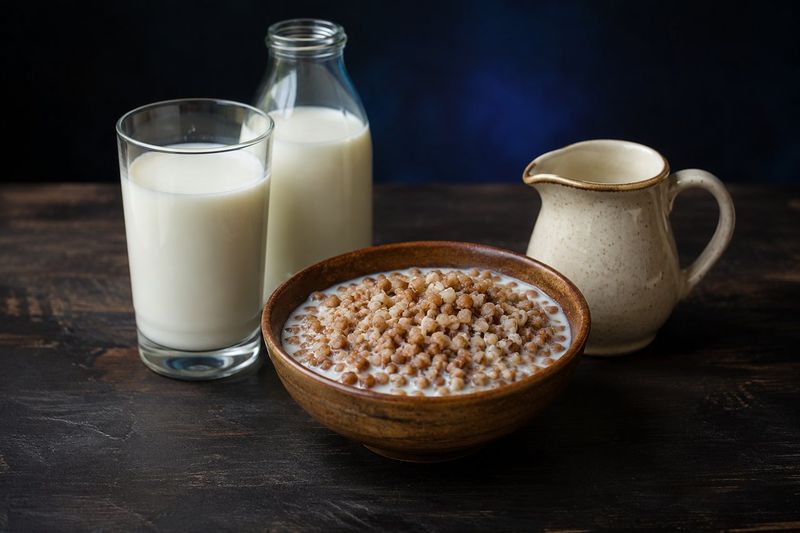
You can drink milk while losing weight: 100 g of 2.5% milk has 53 kcal and 2.9 g of protein. Weight goes down with a daily calorie deficit; milk itself doesn't reduce weight. In a meta-analysis, dairy products reduced weight in short studies and with calorie restriction, but not without restriction or over a year or longer. You can drink milk at night too, as long as it fits into your daily calories.
I'm Demid Lobanov, a fitness coach. In the dish database for the meal plans I create, milk appears in 24 of 260 dishes: in porridges, omelets, smoothies, and mashes.
How many calories are in milk
For my meal plans, I take protein, fat, and carb data from the table of the Federal Research Center of Nutrition and Biotechnology (Russia). I calculate calories using the Russian formula: that gives 53 kcal, while the Center's table itself lists 54. 100 g of 2.5% milk contains:
- 53 kcal;
- 2.9 g of protein;
- 2.5 g of fat;
- 4.8 g of carbs.
A 200 g glass has about 107 kcal and 5.8 g of protein. Milks of different fat levels differ mainly in fat content, and a gram of fat provides 9 kcal. So 200 g of 3.2% milk has about 13 kcal more than 2.5% milk, and 1.5% milk has about 18 kcal less. Milk has a low glycemic index: 39 for whole milk and 37 for skim.
| Per 100 g | Kcal | Protein, g | Fat, g | Carbs, g |
|---|---|---|---|---|
| Milk 2.5% | 53 | 2.9 | 2.5 | 4.8 |
| Lactose-free 2.5% | 53 | 2.9 | 2.5 | 4.8 |
| Soy milk, original | 53 | 3.3 | 1.8 | 5.7 |
| Oat milk | 46 | 1.0 | 1.5 | 7.0 |
| Kefir 2.5% | 50 | 2.9 | 2.5 | 4.0 |
Soy milk is close to cow's milk in protein, while oat milk has a third as much. The data for original soy milk come from USDA. It contains sugar, and the unsweetened kind has fewer calories, so check the label. The data for oat milk are an average from the labels of Russian brands. A specific drink may differ.
Does milk help you lose weight? What the research shows
On its own, no; in a calorie deficit, a little. A 2012 meta-analysis by Chen and colleagues looked at 29 randomized trials with 2,101 participants. Overall, dairy products did not reduce weight: the difference was 0.14 kg and was not significant.
Weight went down in short studies, under a year, and where calories were restricted. Without calorie restriction and in studies lasting a year or longer, the result was the opposite. A meta-analysis is a statistical pooling of the results of several studies.
The 2016 meta-analysis by Stonehouse and colleagues included 27 studies. In them, people aged 18–50 with excess weight lost weight on a calorie-deficit diet. Some of the studies gave whey protein instead of dairy products.
In the studies without strength training, almost all participants were women. With dairy, weight dropped by 1.16 kg more and fat by 1.49 kg more. In the studies with strength training, no difference was found.
In a 2011 study by Josse and colleagues, 90 women with excess weight spent 16 weeks losing weight in a deficit and exercised every day. The group with more protein and dairy lost more fat in the second half of the study and gained lean body mass. In this group, both dairy and total protein changed, so the effect of dairy can't be separated from the effect of protein.
In a 2016 study by Fathi and colleagues, 75 women followed a diet without a calorie deficit for 8 weeks; 58 completed it. The groups that added two servings of low-fat milk or kefir reduced their weight and waist size more than the group with the usual two servings. Milk and kefir did not differ from each other.
Genetic studies that looked specifically at milk show something different. People with a gene variant that lets them digest milk well as adults, and who drink more milk, have a slightly higher body mass index. The difference was 0.17 kg/m² in a 2016 meta-analysis by Hartwig and colleagues.
Vimaleswaran and colleagues reached the same conclusion in 2021, using data from up to 417,000 people. These are not diet studies. They speak to habitual milk intake over years, without accounting for calories.
Does milk curb hunger?
Better than a fruit drink with the same calories. In a 2009 study by Dove and colleagues, 34 people with excess weight drank either 600 ml of skim milk or a fruit drink with the same calories at breakfast. After the milk, fullness was higher all morning. At lunch 4 hours later, people ate about 8.5% less. This is the result of a single breakfast; it says nothing about weight over months.
Which milk to choose for weight loss
Choose the fat level based on your daily calories. In 2016, Schwingshackl and colleagues pooled observational data from groups of adults. Neither full-fat nor low-fat dairy was associated with weight change. Observational studies show only an association: they don't prove cause.
If you have enough calories for the day, 2.5–3.2% milk works. If your calories are tighter, low-fat milk frees some of them up for other food.
Plant-based milk doesn't help you lose weight by itself. Original soy milk is almost the same as cow's milk in calories; oat milk is lighter, but it has little protein. If milk sometimes makes you bloated, try lactose-free milk: it's the same in calories and protein. The cause of bloating is for a doctor to determine. Lactose-free milk has the same protein, so it isn't suitable if you're allergic to cow's milk protein; that's a question for your doctor.
Can you drink milk at night?
Yes, if the milk fits into your daily calories: your weight depends on calories over the whole day. More in the article "Can You Eat at Night?". A glass of milk at night has no special effect. In studies of pre-sleep protein, participants were given 20–40 g of casein, a milk protein. 200 g of milk has about 6 g of protein.
Milk with honey at night adds the honey's calories: 10 g of honey is about 33 kcal more.
Coffee with milk when losing weight
You can drink it; just count the milk in your coffee toward your calories. 50 g of 2.5% milk is about 27 kcal. One cup barely changes the picture for the day. Several cups a day with milk and sugar already add up to a noticeable amount.
How much milk can you drink when losing weight?
There's no specific milk allowance for weight loss: the amount is set by your daily calories and protein. In the studies from the Stonehouse meta-analysis, people ate 2–4 servings of dairy a day. In my meal plans, one dish has anywhere from 40 g of milk in an omelet to 300 g in porridge.
If you have kidney disease or are on a diet prescribed by a doctor, agree on the amount of dairy and protein with your doctor.
Examples of dishes with milk from my meal plans
| Dish | Milk | Kcal per serving |
|---|---|---|
| Buckwheat with milk | 200 g | 305 |
| Milk smoothie with strawberries and oats | 250 g | 257 |
| Three-egg omelet with tomatoes | 40 g | 293 |
| Chum salmon with cauliflower mash | 50 g | 385 |
In the porridge and the smoothie, milk is the base of the dish; in the omelet and the mash, it's a small addition.
How to drink milk and lose weight: step by step
- Count milk in your daily calories: 200 g of 2.5% milk is about 107 kcal.
- Choose the fat level by calories: 2.5–3.2% if you have enough calories, low-fat if your calories are tighter.
- Use milk in porridge, omelets, and smoothies as part of a meal.
- Count the milk in your coffee too, especially if you have several cups.
- Drink milk at night if it fits into your daily calories.
- After two weeks, compare your average weight for the week with the previous week: if it isn't going down, cut back your portions of high-calorie foods.
I also talk about nutrition and training on my YouTube channel @lobanov_fitness.
Sources
- Federal Research Center of Nutrition and Biotechnology (Russia). Chemical Composition of Foods Used in the Russian Federation. Pasteurized milk 2.5%, kefir 2.5% (in Russian).
- U.S. Department of Agriculture. FoodData Central. Soymilk, original and vanilla, unfortified (FDC 172446).
- Atkinson FS et al. International tables of glycemic index and glycemic load values: 2008. Diabetes Care, 2008. Article · Full text
- Chen M et al. Effects of dairy intake on body weight and fat: a meta-analysis of randomized controlled trials. Am J Clin Nutr, 2012. Article · Full text
- Stonehouse W et al. Dairy Intake Enhances Body Weight and Composition Changes during Energy Restriction in 18-50-Year-Old Adults-A Meta-Analysis of Randomized Controlled Trials. Nutrients, 2016. Article · Full text
- Josse AR et al. Increased consumption of dairy foods and protein during diet- and exercise-induced weight loss promotes fat mass loss and lean mass gain in overweight and obese premenopausal women. J Nutr, 2011. Article · Full text
- Fathi Y et al. Kefir drink leads to a similar weight loss, compared with milk, in a dairy-rich non-energy-restricted diet in overweight or obese premenopausal women: a randomized controlled trial. Eur J Nutr, 2016. Article
- Dove ER et al. Skim milk compared with a fruit drink acutely reduces appetite and energy intake in overweight men and women. Am J Clin Nutr, 2009. Article
- Schwingshackl L et al. Consumption of Dairy Products in Relation to Changes in Anthropometric Variables in Adult Populations: A Systematic Review and Meta-Analysis of Cohort Studies. PLoS One, 2016. Article · Full text
- Hartwig FP et al. Association of lactase persistence genotype with milk consumption, obesity and blood pressure: a Mendelian randomization study in the 1982 Pelotas (Brazil) Birth Cohort, with a systematic review and meta-analysis. Int J Epidemiol, 2016. Article · Full text
- Vimaleswaran KS et al. Evidence for a causal association between milk intake and cardiometabolic disease outcomes using a two-sample Mendelian Randomization analysis in up to 1,904,220 individuals. Int J Obes (Lond), 2021. Article · Full text
- Reis CEG et al. Effects of pre-sleep protein consumption on muscle-related outcomes - A systematic review. J Sci Med Sport, 2021. Article




