
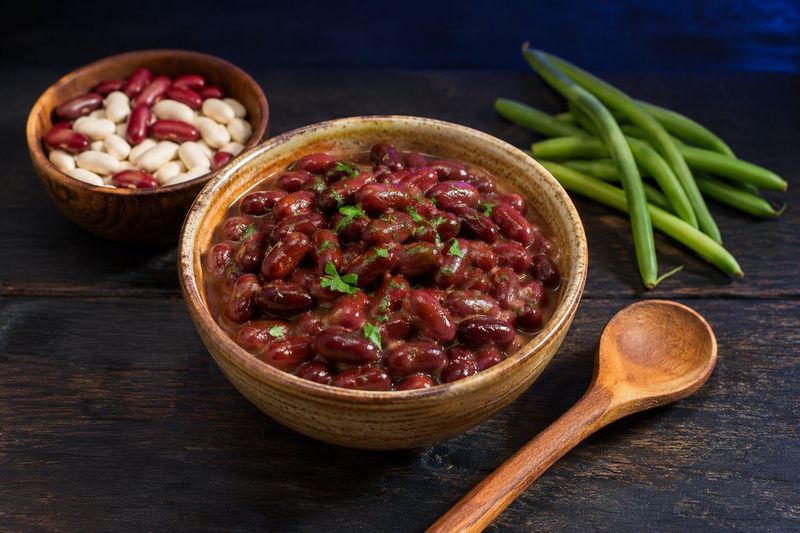
Yes, you can eat beans while losing weight. Drained canned red kidney beans have about 116 kcal and 8 g of protein per 100 g, and green beans about 32 kcal. In a meta-analysis of randomized trials, legumes helped people lose about 0.3 kg more over a month and a half. Beans don't work miracles, but they provide protein, fiber, and fullness.
I'm Demid Lobanov, a fitness coach. In the recipe database I use to build meal plans for clients, beans appear in 13 of 260 dishes: lobio, bean stew, salads with tuna and with egg, and bean and chicken soup.
Calories in beans
The data come from the food database I use to build meal plans. The composition is taken from USDA and the tables of the Federal Research Center of Nutrition and Biotechnology (Russia), and calories are calculated using the Russian formula.
| Beans, 100 g | Kcal | Protein, g | Carbs, g | Fiber, g |
|---|---|---|---|---|
| Red kidney, dry (Federal Research Center) | 315 | 21.0 | 47.0 | 12.4 |
| Canned red kidney, drained | 116 | 8.0 | 16.0 | 5.5 |
| Green (values for raw, eat after cooking) | 32 | 1.8 | 4.3 | 2.7 |
Dry beans are weighed before cooking. They absorb water as they cook, so 100 g of dry beans and 100 g of cooked beans are different portions. In terms of calories, green beans are closer to vegetables than to legumes.
Do beans help you lose weight?
A little. In the 2016 meta-analysis by Kim and colleagues (21 randomized trials, 940 people), diets with legumes, such as beans, lentils, chickpeas, and peas, led to 0.34 kg more weight loss than diets without them. Participants typically ate about 132 g of legumes a day, and the studies lasted about 6 weeks. The estimate ranged from 0.04 to 0.63 kg, so the effect could have been close to zero. The effect appeared both with and without a calorie deficit. The authors write that more research is needed on long-term weight loss.
In a newer 2026 meta-analysis by Rahmanian and colleagues (36 studies of legumes other than soy), weight went down by 0.98 kg. However, the study results varied widely, and some of them looked at legume extracts and proteins rather than whole beans. There's no separate meta-analysis specifically on whole beans and weight: the data apply to legumes as a whole.
Legumes increase fullness but have little effect on the next meal. In the 2014 meta-analysis by Li and colleagues (9 studies), fullness after a meal with legumes was 31% higher than after a meal with the same calories without them. Yet people ate the same amount at their next meal.
Bottom line: beans help as part of a diet that fits into your daily calories. On their own, they don't reduce weight.
Canned beans for weight loss
Canned beans are fine: they're already cooked and easy to add to salads and stews. The calorie figure in the database is for drained beans, so the liquid is poured off. My dishes use 150–300 g of canned beans per serving, which is 175–349 kcal.
For example, the dinner “tuna with beans, cucumber, and lettuce” is 432 kcal and 42.9 g of protein, and the dinner “bean salad with egg and herbs” is 460 kcal and 31 g of protein.
Red and white beans
Choose red or white beans to your taste. There's one rule for any dry beans: cook them all the way through. Raw and undercooked beans contain phytohemagglutinin, a plant protein that causes poisoning. As Watier-Grillot and colleagues describe, four or five raw beans are enough, and vomiting, diarrhea, and abdominal pain start 1–3 hours later.
According to the same paper, dry beans are prepared like this: soak them for at least 5 hours, preferably 10, then drain the water and cook them in boiling water for at least 30 minutes. Beans must not be slow-cooked at a low temperature.
One example is the 2018 outbreak in France described by Watier-Grillot and colleagues. After eating chili con carne in a military base cafeteria, 200 people fell ill. The beans had been soaked for only an hour and a half and cooked overnight in an oven at 80 °C.
In Japan in 2006, as described by Ogawa 2014, more than 1,000 people developed gastrointestinal symptoms and 100 were hospitalized after a TV show about a diet using powder made from roasted white beans. The heating wasn't enough to destroy lectins, the plant proteins that phytohemagglutinin belongs to. Canned beans are sold already cooked.
Green beans for weight loss
You can eat green beans even in large amounts: about 32 kcal per 100 g. Calorie-wise, they're a vegetable, but they also need to be cooked before eating. According to the same Watier-Grillot paper, poisoning has also been described after eating raw or undercooked green beans. In my database, they appear in three dishes. For example, the dinner “halibut with green beans” is 318 kcal and 38.9 g of protein.
Can you eat beans for dinner?
Yes, if they fit into your daily calories: with the same number of calories, meal timing has little effect on weight loss results. More on this in Dinner for Weight Loss. In my database, beans appear in several dinners.
Do beans cause bloating?
Sometimes, but less often than people tend to think. In three 2011 studies by Winham and colleagues, people ate half a cup of beans every day for 8–12 weeks. In the first week, about half of those eating pinto beans or baked beans reported increased gas, compared with 19% of those eating black-eyed peas. In the following weeks, complaints dropped noticeably. The authors write that concerns about gas from legumes may be exaggerated and that people's reactions vary.
If you haven't eaten legumes often before, increase the portion gradually. If you have a bowel condition and your doctor restricts fiber or legumes, agree on the amount of beans with them.
Beans for weight loss: step by step
- Eat beans as a source of protein and fiber, fitting them into your daily calories.
- Weigh dry beans before cooking, soak them for 5–10 hours, drain the water, and boil them for at least 30 minutes.
- Drain the liquid from canned beans: about 116 kcal per 100 g without it.
- Use green beans as a vegetable, but cook them: about 32 kcal per 100 g.
- If you rarely eat legumes, increase the portion gradually.
- After two weeks, compare your average weight for the week with your average weight for the previous week. If your weight isn't going down, cut back on portions of high-calorie foods.
I post nutrition and training breakdowns on my YouTube channel @lobanov_fitness.
Sources
- Kim SJ et al. Effects of dietary pulse consumption on body weight: a systematic review and meta-analysis of randomized controlled trials. Am J Clin Nutr, 2016. Article
- Li SS et al. Dietary pulses, satiety and food intake: a systematic review and meta-analysis of acute feeding trials. Obesity (Silver Spring), 2014. Article
- Watier-Grillot S et al. From Foodborne Disease Outbreak (FBDO) to Investigation: The Plant Toxin Trap, Brittany, France, 2018. Toxins (Basel), 2023. Article · Full text
- Ogawa H et al. The «white kidney bean incident» in Japan. Methods Mol Biol, 2014. Article
- Winham DM et al. Perceptions of flatulence from bean consumption among adults in 3 feeding studies. Nutr J, 2011. Article · Full text
- USDA FoodData Central: Beans, kidney, red, mature seeds, canned, drained solids (174285); Beans, snap, green, raw (169961). Website
- Rahmanian R et al. Effects of Non-Soy Legumes on Body Weight and Body Composition: A Systematic Review and Meta-Analysis of Randomized Controlled Trials. Food Sci Nutr, 2026. Article · Full text